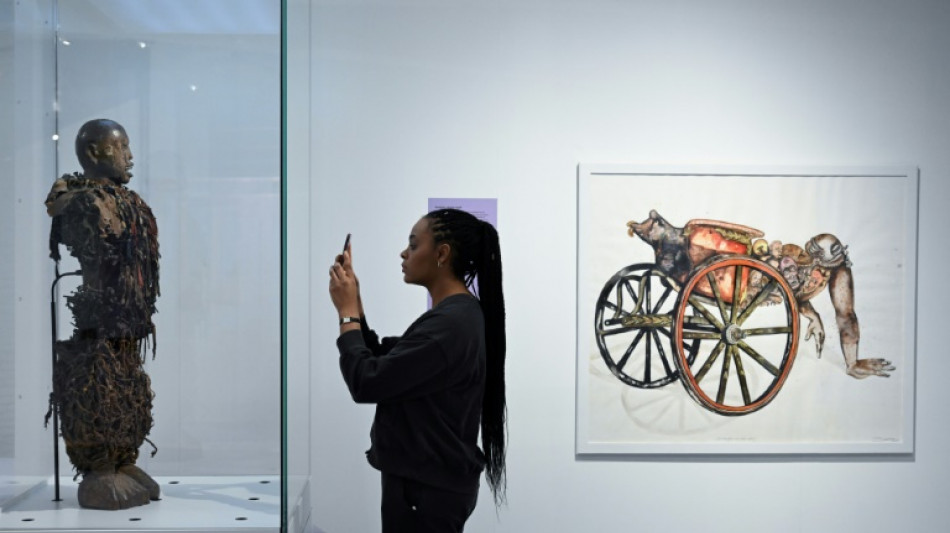
Belgium's Africa museum pores over colonial-era collection / Photo: JOHN THYS - AFP

 Latvian partial election results suggest pro-European choice
 In Egypt's Sinai, Gazan builds school for children displaced by war
 Trump tariffs a mixed bag for US auto industry
 Yemen government forces say struck Houthi targets

 Music links past, present for Pedro Pascal's cellist in 'Behemoth!'

 ALEX BODI ȘI AMBASADORUL REPUBLICII SUDANUL DE SUD, GUM DOMINIC MATIOK, DISCUTĂ LA BERLIN DESPRE POSIBILITATEA ÎNFIINȚĂRII UNUI CONSULAT ONORIFIC LA BUCUREȘTI
 Dodgers step up World Series three-peat bid with 5-3 win over Braves
 Spain break down Czechs as England outclass Croatia in Nations League
 Yamal on target as Spain hold off Czech Republic
 Latvian exit polls suggest pro-European choice
 Lula, Bolsonaro wrap up campaigns ahead of knife-edge election

 Tuchel hails 'complete' England after Croatia demolition

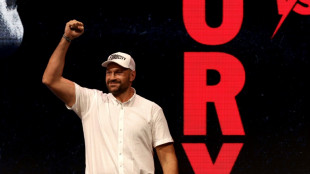 Fury to invite Trump to lead ring walk before Joshua showdown

 Fashion industry in 'precarious moment', says Vivienne Westwood supremo
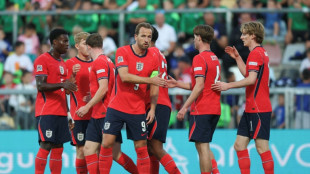 Seventh heaven for England in Nations League rout of Croatia
 Storms, flooding cause chaos on Greek holiday island of Crete
 #IAmJaneDoe: online support campaign in US university rape case
 Brazil shine on Selecao's first visit to India
 Zverev sets up Djokovic quarter-final at China Open, Rybakina out
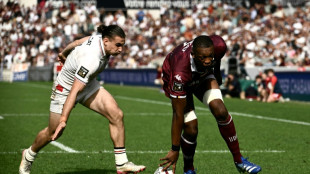 Happier at home, Bordeaux hammer Lyon in Top 14
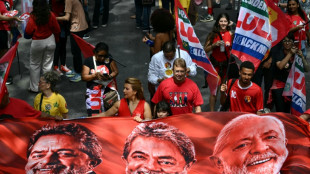 Lula, Bolsonaro in final push for votes ahead of knife-edge election

 Boisterous fashion week barnstorms 'sleepy' Nigerian capital
 UAE investigators say flydubai co-pilot was planning 'terrorist act'
 Rahul smacks century in India v Windies ODI
 Daryz seeks to join exclusive club of dual Arc winners
Belgium's main museum dedicated to Africa has started delving into the origins of its enormous collection, as a first step towards possible restitution of items that were obtained in violent ways during colonial times.
"We want to get a better idea of the origin of the pieces and see if we can establish which were obtained through theft, violence or manipulation," Bart Ouvry, director of the Royal Museum for Central Africa on Brussels' outskirts, told AFP.
An inventory of 80,000 objects -- sculptures, masks, utensils, musical instruments -- from the Democratic Republic of Congo (DRC) was already handed over to Kinshasa authorities two years ago.
Shortly after, in 2022, Belgium adopted a law setting out how it would hand back works that were despoiled between 1885 and 1960, when Belgium ruled over the DRC, known then as Congo, first as King Leopold II's private property then as a Belgian colony.
So far, Kinshasa has not made a formal return request, said Thomas Dermine, the Belgian minister in charge of the matter.
He said a joint committee of Belgian and DRC experts would be set up to determine which objects were legitimately obtained and which were not.
To mark the process, a new exhibition, "ReThinking Collections", opened at the museum on Thursday with a statue that once belonged to a Congolese chief, Ne Kuko of Boma, presented as "A Symbol of Stolen Art".
"The Congolese diasporas view this statue as an emblem of the need for restitution," noted Agnes Lacaille, one of the exhibition's curators.
The Nkisi Nkonde Statue was taken by a Belgian officer and explorer, Alexandre Delcommune, during an 1878 expedition in western Congo as punishment for the region hiking taxes on Belgian trade routes.
A historian, Didier Gondola, said that colonial soldiers, administrative officials and missionaries "collected" such artefacts, often using "violence" or "coercion".
Though Belgium is plunging into the issue now, restitution requests were sent starting in the late 1960s by Mobutu Sese Seko, dictator of the country that at that time was known as Zaire.
A decade later, the museum handed over 114 pieces, but not its most prized ones.
"In Mobutu's time, for example, the Europeans said 'We are doing you a favour, because we are conserving your objects. If we gave them to you, they would end up on the international art market, would be sold on, because the government is corrupt, or they'd be ruined because you don't have the means to conserve them'," Gondola said.
- 'National heritage' -
But times have changed, he stressed.
"In Kinshasa, there is a very beautiful museum, just as modern as this one, and there is enough space that these objects can be brought back into the national heritage," he said.
As a halfway measure, Belgium's King Philippe delivered a giant ritual "kakuungu" mask to the DRC's national museum as an "unlimited" loan. The monarch expressed "deep regret" for Belgium's colonial period.
Belgium's plunder did more than erode the DRC's physical heritage, explained another exhibition curator, Sarah Van Beurden, as she stood before a "manza" xylophone taken in 1911-1912.
"When you take an object like this xylophone, you take away the ability for a community to maintain its cultural customs," she said.
"You can return the object. But you can't return what the community has lost."
In a gesture to repair that loss, a project has been mounted with DRC youth from the community where the instrument was taken to recreate -- "in a different way" -- music that it produces, she said.
A.Aguiar--PC



