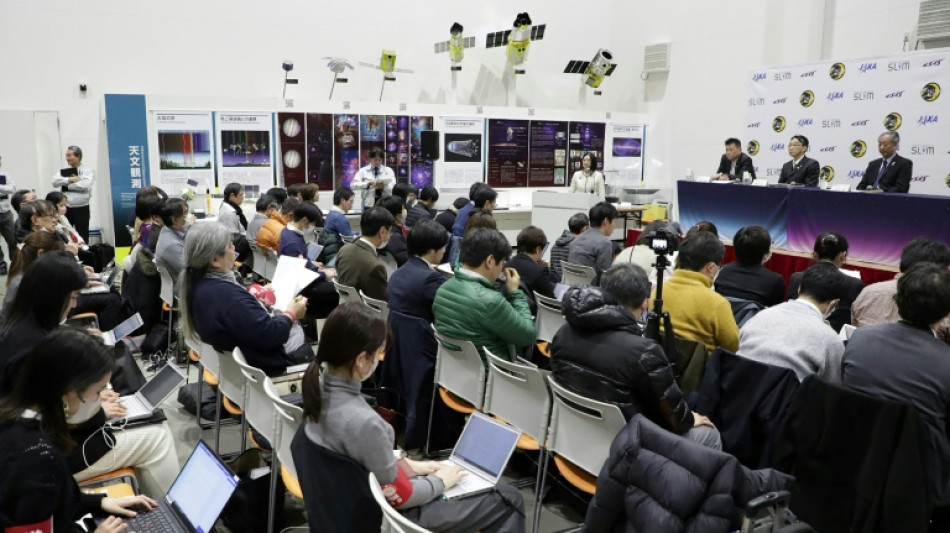
Japan says 'possibility' Moon lander power can be restored / Photo: STR - JIJI PRESS/AFP/File

 Latvian partial election results suggest pro-European choice

 In Egypt's Sinai, Gazan builds school for children displaced by war

 Trump tariffs a mixed bag for US auto industry

 Yemen government forces say struck Houthi targets

 Music links past, present for Pedro Pascal's cellist in 'Behemoth!'

 ALEX BODI ȘI AMBASADORUL REPUBLICII SUDANUL DE SUD, GUM DOMINIC MATIOK, DISCUTĂ LA BERLIN DESPRE POSIBILITATEA ÎNFIINȚĂRII UNUI CONSULAT ONORIFIC LA BUCUREȘTI

 Dodgers step up World Series three-peat bid with 5-3 win over Braves

 Spain break down Czechs as England outclass Croatia in Nations League

 Yamal on target as Spain hold off Czech Republic

 Latvian exit polls suggest pro-European choice

 Lula, Bolsonaro wrap up campaigns ahead of knife-edge election

 Tuchel hails 'complete' England after Croatia demolition

 Fury to invite Trump to lead ring walk before Joshua showdown

 Fashion industry in 'precarious moment', says Vivienne Westwood supremo

 Seventh heaven for England in Nations League rout of Croatia

 Storms, flooding cause chaos on Greek holiday island of Crete

 #IAmJaneDoe: online support campaign in US university rape case

 Brazil shine on Selecao's first visit to India

 Zverev sets up Djokovic quarter-final at China Open, Rybakina out

 Happier at home, Bordeaux hammer Lyon in Top 14

 Lula, Bolsonaro in final push for votes ahead of knife-edge election

 Boisterous fashion week barnstorms 'sleepy' Nigerian capital

 UAE investigators say flydubai co-pilot was planning 'terrorist act'

 Rahul smacks century in India v Windies ODI

 Daryz seeks to join exclusive club of dual Arc winners

Japan switched off its Moon lander almost three hours after a historic touchdown to allow for a possible recovery of the craft when the sun hits its solar panels, the space agency said Monday.
With its unmanned Smart Lander for Investigating Moon (SLIM) mission -- dubbed "Moon Sniper" for the craft's precision landing capabilities -- Japan became the fifth country to achieve a soft lunar landing.
But after the touchdown at 20 minutes past midnight on Saturday (1520 GMT Friday), the Japan Aerospace Exploration Agency (JAXA) could not confirm that the lightweight craft's solar batteries were generating power.
Before turning the lander off remotely, mission control was able to receive technical and image data from its descent, and from the lunar surface.
"We're relieved and beginning to get excited after confirming a lot of data has been obtained," JAXA said Monday in a statement, adding that "according to the telemetry data, SLIM's solar cells are facing west".
"If sunlight hits the Moon from the west in the future, we believe there's a possibility of power generation, and we're currently preparing for restoration," it said.
SLIM is one of several new lunar missions launched by governments and private firms, 50 years after the first human Moon landing.
Crash landings and communication failures are rife, and only four other countries have made it to the Moon: the United States, the Soviet Union, China and most recently India.
JAXA said it had disconnected SLIM's battery just before 3:00 am (1800 GMT Friday) when it had 12 percent power remaining, "in order to avoid a situation where the restart (of the lander) would be hampered".
- Probes detached -
The agency is now carrying out a detailed analysis of the data, to help determine whether the craft achieved the goal of arriving within 100 metres (330 feet) of its intended landing spot.
The mission was aiming for a crater where the Moon's mantle, the usually deep inner layer beneath its crust, is believed to be exposed on the surface.
By analysing the rocks there, JAXA had hoped to shed light on the mystery of the Moon's possible water resources -- key to building bases there one day as possible stopovers on the way to Mars.
Two probes detached successfully, one with a transmitter and another designed to trundle around the lunar surface beaming images to Earth.
This shape-shifting mini-rover, slightly bigger than a tennis ball, was co-developed by the firm behind the Transformer toys.
JAXA said on Monday it was preparing to make further announcements this week on the results of the mission, and the status of the SLIM craft.
Although not everything went to plan, "we may be able to produce plenty of results and we're happy that the landing succeeded", it said.
Previous Japanese lunar missions have failed twice -- one public and one private.
In 2022, the country unsuccessfully sent a lunar probe named Omotenashi as part of the United States's Artemis 1 mission.
In April, Japanese startup ispace tried in vain to become the first private company to land on the Moon, losing communication with its craft after what it described as a "hard landing".
H.Silva--PC