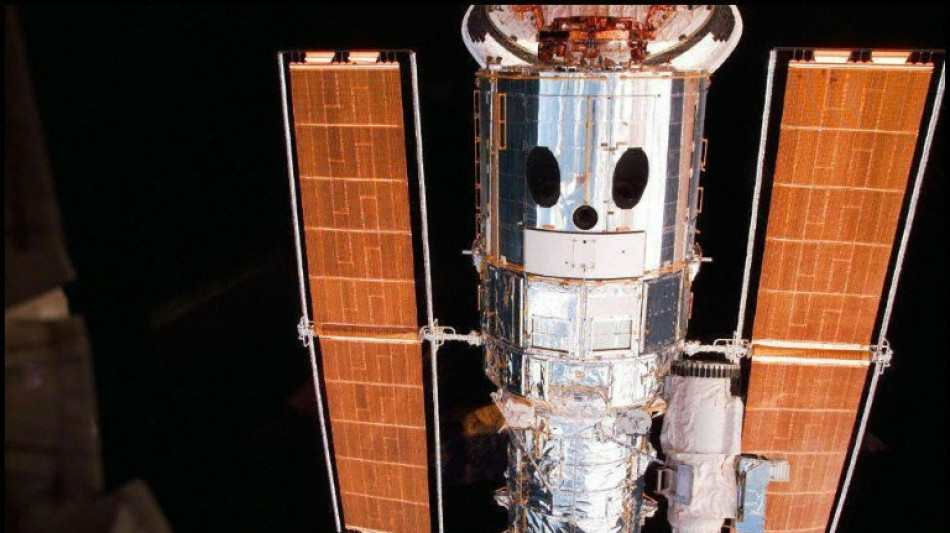
Hubble finds water vapor in small planet's atmosphere / Photo: NASA - AFP/File

 Latvian partial election results suggest pro-European choice

 In Egypt's Sinai, Gazan builds school for children displaced by war

 Trump tariffs a mixed bag for US auto industry

 Yemen government forces say struck Houthi targets

 Music links past, present for Pedro Pascal's cellist in 'Behemoth!'

 ALEX BODI ȘI AMBASADORUL REPUBLICII SUDANUL DE SUD, GUM DOMINIC MATIOK, DISCUTĂ LA BERLIN DESPRE POSIBILITATEA ÎNFIINȚĂRII UNUI CONSULAT ONORIFIC LA BUCUREȘTI

 Dodgers step up World Series three-peat bid with 5-3 win over Braves

 Spain break down Czechs as England outclass Croatia in Nations League

 Yamal on target as Spain hold off Czech Republic

 Latvian exit polls suggest pro-European choice

 Lula, Bolsonaro wrap up campaigns ahead of knife-edge election

 Tuchel hails 'complete' England after Croatia demolition

 Fury to invite Trump to lead ring walk before Joshua showdown

 Fashion industry in 'precarious moment', says Vivienne Westwood supremo

 Seventh heaven for England in Nations League rout of Croatia

 Storms, flooding cause chaos on Greek holiday island of Crete

 #IAmJaneDoe: online support campaign in US university rape case

 Brazil shine on Selecao's first visit to India

 Zverev sets up Djokovic quarter-final at China Open, Rybakina out

 Happier at home, Bordeaux hammer Lyon in Top 14

 Lula, Bolsonaro in final push for votes ahead of knife-edge election

 Boisterous fashion week barnstorms 'sleepy' Nigerian capital

 UAE investigators say flydubai co-pilot was planning 'terrorist act'

 Rahul smacks century in India v Windies ODI

 Daryz seeks to join exclusive club of dual Arc winners

The Hubble Space Telescope has observed the smallest planet outside our solar system to contain water vapor in its atmosphere, a "landmark discovery" that brings astronomy a step closer to characterizing Earth-like worlds.
At around twice Earth's diameter, planet GJ 9827d orbits a red dwarf star 97 light-years away in the constellation Pisces, NASA and the European Space Agency (ESA) said in statements on Thursday.
The team behind the finding are examining two scenarios: either the planet is a "mini-Neptune" with a hydrogen-rich atmosphere laced with water, or it's a warmer version of Jupiter's moon Europa, which contains twice as much water as Earth under its crust.
"The planet GJ 9827d could be half water, half rock," said Bjorn Benneke of the Universite de Montreal, who co-led the research. "And there would be a lot of water vapor on top of some smaller rocky body."
"Until now, we had not been able to directly detect the atmosphere of such a small planet. And we're slowly getting in this regime now," he added.
Over a period of three years, Hubble observed the planet during 11 transients, or events in which it crossed in front of its star.
During transients, starlight is filtered through the planet's atmosphere, allowing astronomers to use Hubble's instruments to analyze the patterns of colors (wavelengths), which revealed the telltale signature of water molecules.
Even if GJ 9827d has a water-rich atmosphere, its hot, Venus-like temperature of 800 degrees Fahrenheit (425 Celsius) would make it an uninhabitable steamy world.
Nevertheless, the Hubble discovery paves the way to future study of GJ 9827d and similar planets, especially by the James Webb Space Telescope, which can use its high resolution infrared images to look for more atmospheric molecules including carbon dioxide, and methane.
"Water on a planet this small is a landmark discovery," added co-leader Laura Kreidberg of Max Planck Institute for Astronomy in Germany.
"It pushes closer than ever to characterizing truly Earth-like worlds."
V.Fontes--PC



