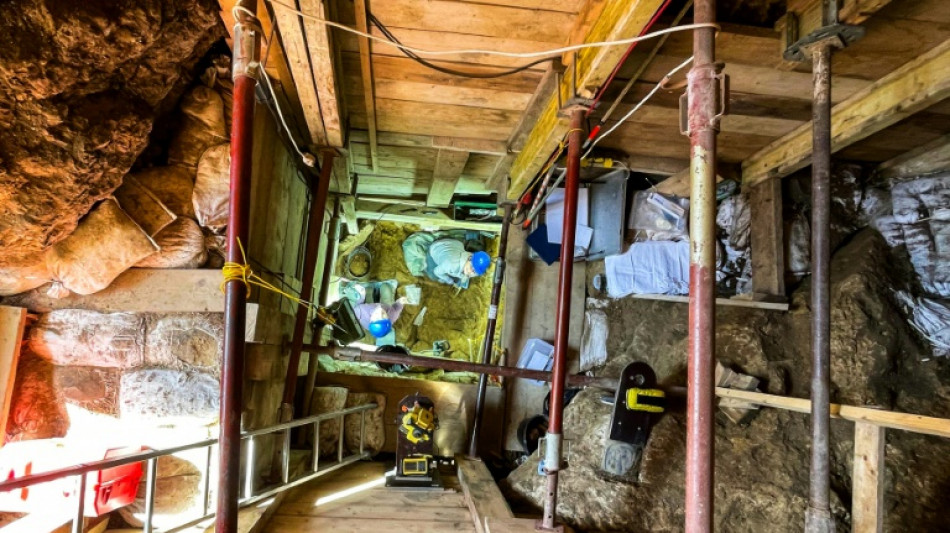
Humans reached icy northern Europe in time of Neanderthals / Photo: Handout - MAX-PLANCK INSTITUTE/AFP

 'Act before it's too late': Tokyo residents fight for more trees

 'Disappointing' as South Korea flag mishap sees Games end on sour note

 Pre-COP host Tuvalu at frontline of climate change

 Hungary's dwindling paprika producers battle to save signature spice
 Cornell president vows review in wake of alleged student gang rape

 Latvian partial election results suggest pro-European choice

 In Egypt's Sinai, Gazan builds school for children displaced by war

 Trump tariffs a mixed bag for US auto industry

 Yemen government forces say struck Houthi targets

 Music links past, present for Pedro Pascal's cellist in 'Behemoth!'

 ALEX BODI ȘI AMBASADORUL REPUBLICII SUDANUL DE SUD, GUM DOMINIC MATIOK, DISCUTĂ LA BERLIN DESPRE POSIBILITATEA ÎNFIINȚĂRII UNUI CONSULAT ONORIFIC LA BUCUREȘTI

 Dodgers step up World Series three-peat bid with 5-3 win over Braves

 Spain break down Czechs as England outclass Croatia in Nations League

 Yamal on target as Spain hold off Czech Republic

 Latvian exit polls suggest pro-European choice

 Lula, Bolsonaro wrap up campaigns ahead of knife-edge election

 Tuchel hails 'complete' England after Croatia demolition

 Fury to invite Trump to lead ring walk before Joshua showdown

 Fashion industry in 'precarious moment', says Vivienne Westwood supremo

 Seventh heaven for England in Nations League rout of Croatia

 Storms, flooding cause chaos on Greek holiday island of Crete

 #IAmJaneDoe: online support campaign in US university rape case

 Brazil shine on Selecao's first visit to India

 Zverev sets up Djokovic quarter-final at China Open, Rybakina out

 Happier at home, Bordeaux hammer Lyon in Top 14

Pioneering groups of humans braved icy conditions to settle in northern Europe more than 45,000 years ago, a "huge surprise" that means they could have lived there alongside Neanderthals, scientists said Wednesday.
The international team of researchers found human bones and tools hiding behind a massive rock in a German cave, the oldest traces of Homo sapiens ever discovered so far north.
The discovery could rewrite the story of how the species populated Europe -- and how it came to replace the Neanderthals, who mysteriously went extinct just a few thousand years after humans arrived.
When the two co-existed in Europe, there was a "replacement phenomenon" between the Middle Paleolithic and the Upper Paleolithic periods, French paleoanthropologist Jean-Jacques Hublin, who led the new research, told AFP.
Archaeological evidence such as stone tools from both species has been discovered dating from this period -- but determining exactly who created what has proved difficult because of a lack of bones.
Particularly puzzling have been tools from what has been called the "Lincombian-Ranisian-Jerzmanowician" (LRJ) culture found at several sites north of the Alps, including in England and Poland.
One such site near the town of Ranis in central Germany was the focus of three new studies published in the journal Nature.
- Hidden behind a rock -
The cave was partially excavated in the 1930s, but the team hoped to find more clues during digs between 2016 to 2022.
The 1930s excavations had not been able to get past a nearly two-metre (six foot) rock blocking the way. But this time, the scientists managed to remove it by hand.
"We had to descend eight metres (26 feet) underground and board up the walls to protect the excavators," said Hublin of Germany's Max Planck Institute for Evolutionary Anthropology.
They were rewarded with the leaf-shaped stone blades seen at other LRJ sites, as well as thousands of bone fragments.
The team used a new technique called paleoproteomics, which involves extracting proteins from fossils, to determine which bones were from animals and which from humans.
Using radiocarbon dating and DNA analysis, they confirmed that the cave contained the skeletal remains of 13 humans.
That means that the stone tools in the cave -- which were once thought to have been made by Neanderthals -- were in fact crafted by humans as early as 47,500 years ago.
"This came as a huge surprise, as no human fossils were known from the LRJ before, and was a reward for the hard work at the site," said study co-author Marcel Weiss.
The fossils date from around the time when the first Homo sapiens were leaving Africa for Europe and Asia.
"For a long time we have thought of a great wave of Homo sapiens that swept across Europe and rapidly absorbed the Neanderthals towards the end of these transitional cultures around 40,000 years ago," Hublin said.
But the latest discovery suggests that humans populated the continent over repeated smaller excursions -- and earlier than had previously been assumed.
- A cold change -
This means there was even more time for modern humans to have lived side-by-side with their Neanderthal cousins, the last of whom died out in Europe's southwest 40,000 years ago.
This particular group arrived in a northern Europe that was far colder than today, more resembling modern-day Siberia or northern Scandinavia, the researchers said.
They lived in small, mobile groups, only briefly staying in the cave where they ate meat from reindeer, woolly rhinoceros, horses and other animals they caught.
"How did these people from Africa come up with the idea of heading towards such extreme temperatures?" Hublin said.
In any case, the humans proved they had "the technical capacity and adaptability necessary to live in a hostile environment", he added.
It had previously been thought that humans were not able to handle such cold until thousands of years later.
But humans outlasted the Neanderthals, who had long been acclimatised to the cold.
Exactly what happened to the Neanderthals remains a mystery. But some have pointed the finger at humans for driving their extinction, either by violence, spreading disease, or simply by interbreeding with them.
L.Torres--PC



