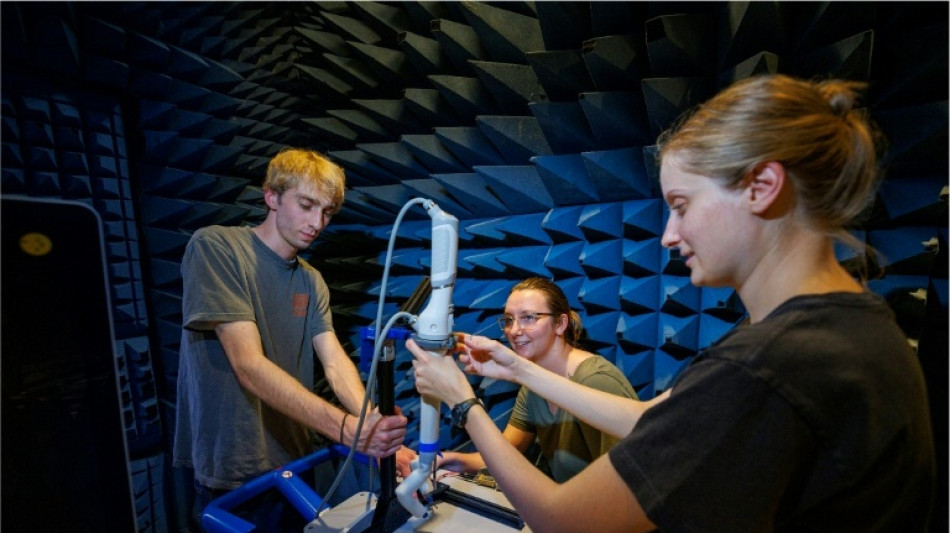
Space surgery: Doctors on ground operate robot on ISS for first time / Photo: Craig Chandler - Virtual Incision/AFP

 'Act before it's too late': Tokyo residents fight for more trees

 'Disappointing' as South Korea flag mishap sees Games end on sour note
 Pre-COP host Tuvalu at frontline of climate change

 Hungary's dwindling paprika producers battle to save signature spice

 Cornell president vows review in wake of alleged student gang rape

 Latvian partial election results suggest pro-European choice

 In Egypt's Sinai, Gazan builds school for children displaced by war

 Trump tariffs a mixed bag for US auto industry

 Yemen government forces say struck Houthi targets

 Music links past, present for Pedro Pascal's cellist in 'Behemoth!'

 ALEX BODI ȘI AMBASADORUL REPUBLICII SUDANUL DE SUD, GUM DOMINIC MATIOK, DISCUTĂ LA BERLIN DESPRE POSIBILITATEA ÎNFIINȚĂRII UNUI CONSULAT ONORIFIC LA BUCUREȘTI
 Dodgers step up World Series three-peat bid with 5-3 win over Braves

 Spain break down Czechs as England outclass Croatia in Nations League

 Yamal on target as Spain hold off Czech Republic

 Latvian exit polls suggest pro-European choice

 Lula, Bolsonaro wrap up campaigns ahead of knife-edge election

 Tuchel hails 'complete' England after Croatia demolition

 Fury to invite Trump to lead ring walk before Joshua showdown

 Fashion industry in 'precarious moment', says Vivienne Westwood supremo

 Seventh heaven for England in Nations League rout of Croatia

 Storms, flooding cause chaos on Greek holiday island of Crete

 #IAmJaneDoe: online support campaign in US university rape case

 Brazil shine on Selecao's first visit to India
 Zverev sets up Djokovic quarter-final at China Open, Rybakina out
 Happier at home, Bordeaux hammer Lyon in Top 14

Earth-bound surgeons remotely controlled a small robot aboard the International Space Station over the weekend, conducting the first-ever such surgery in orbit -- albeit on rubber bands.
The experiment, deemed a "huge success" by the participants, represents a new step in the development of space surgery, which could become necessary to treat medical emergencies during multi-year manned voyages, such as to Mars.
The technology could also be used to develop remote-control surgery techniques on Earth, to serve isolated areas.
The robot, developed by Virtual Incision (VIC) and the University of Nebraska, is called spaceMIRA.
It took off for the International Space Station at the end of January, aboard a payload carried by a SpaceX rocket.
Stored inside a compact box the size of a microwave oven, the robot was installed last Thursday by NASA astronaut Loral O'Hara, who has been in space since last September.
The experiment then took place on Saturday, conducted from Virtual Incision's headquarters in Lincoln, Nebraska.
It lasted around two hours, with six surgeons taking a go at operating the robot, which is equipped with a camera and two arms.
"The experiment tested standard surgical techniques like grasping, manipulating and cutting tissue. The simulated tissue is made up of rubber bands," Virtual Incision said in a statement.
In a video shared by the company, one arm equipped with pincers can be seen gripping the band and stretching it, while the other arm equipped with scissors makes a cut -- mimicking a dissection.
A key difficulty is the time lag -- about 0.85 seconds -- between the operation center on Earth and the ISS.
For a control experiment, the same process will take place with the same equipment, but on Earth.
"The experiment was deemed a huge success by all surgeons and researchers, and there were little to no hiccups," Virtual Incision said in a statement, claiming it will "change the future of surgery."
NASA, which provided some financial support for the project, said that with longer space missions, "the potential need for emergency care increases, including surgical procedures from simple stitching of lacerations to more complex activities."
N.Esteves--PC



