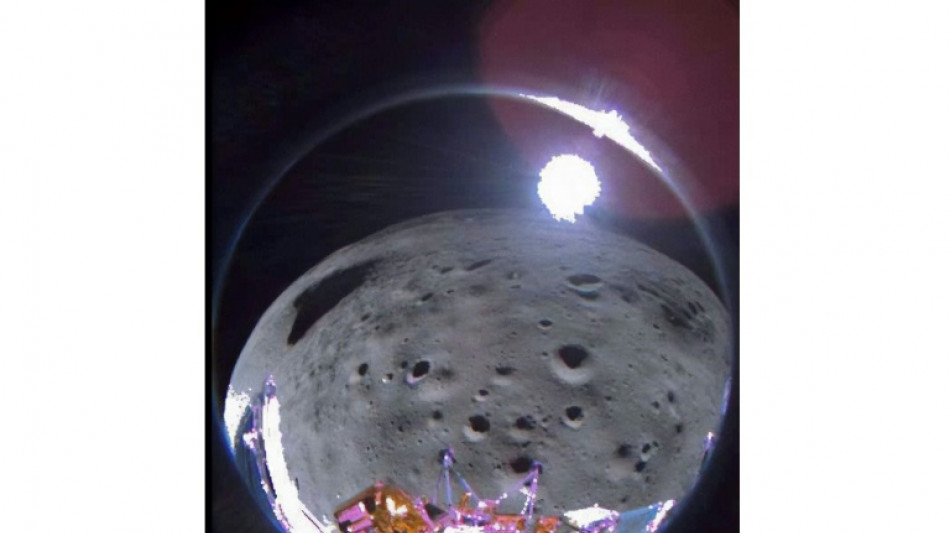
Sideways American lander sends first images back from Moon / Photo: Handout - Intuitive Machines/AFP

 'Act before it's too late': Tokyo residents fight for more trees

 'Disappointing' as South Korea flag mishap sees Games end on sour note

 Pre-COP host Tuvalu at frontline of climate change

 Hungary's dwindling paprika producers battle to save signature spice

 Cornell president vows review in wake of alleged student gang rape

 Latvian partial election results suggest pro-European choice

 In Egypt's Sinai, Gazan builds school for children displaced by war

 Trump tariffs a mixed bag for US auto industry

 Yemen government forces say struck Houthi targets

 Music links past, present for Pedro Pascal's cellist in 'Behemoth!'

 ALEX BODI ȘI AMBASADORUL REPUBLICII SUDANUL DE SUD, GUM DOMINIC MATIOK, DISCUTĂ LA BERLIN DESPRE POSIBILITATEA ÎNFIINȚĂRII UNUI CONSULAT ONORIFIC LA BUCUREȘTI

 Dodgers step up World Series three-peat bid with 5-3 win over Braves

 Spain break down Czechs as England outclass Croatia in Nations League

 Yamal on target as Spain hold off Czech Republic

 Latvian exit polls suggest pro-European choice

 Lula, Bolsonaro wrap up campaigns ahead of knife-edge election

 Tuchel hails 'complete' England after Croatia demolition

 Fury to invite Trump to lead ring walk before Joshua showdown

 Fashion industry in 'precarious moment', says Vivienne Westwood supremo

 Seventh heaven for England in Nations League rout of Croatia

 Storms, flooding cause chaos on Greek holiday island of Crete

 #IAmJaneDoe: online support campaign in US university rape case

 Brazil shine on Selecao's first visit to India

 Zverev sets up Djokovic quarter-final at China Open, Rybakina out

 Happier at home, Bordeaux hammer Lyon in Top 14

An American lunar lander that tipped over during touchdown has sent back its first images from the farthest south any vessel has ever landed on the Moon.
The uncrewed Odysseus, built by Houston-based Intuitive Machines, returned the United States to Earth's cosmic neighbor last week after a five-decade absence, in a first for the private sector.
But one of its legs caught on the surface as it came down, making it pitch over in the final act of a drama-packed journey that was saved by an improvised fix.
"Odysseus continues to communicate with flight controllers in Nova Control from the lunar surface," Intuitive Machines said Monday in an update on X, formerly Twitter.
The post included two pictures: one from the hexagon-shaped spaceship's descent, and the other taken 35 seconds after it fell over, revealing the pockmarked regolith of the Malapert A impact crater.
NASA is planning to return astronauts to the Moon later this decade, and paid Intuitive Machines around $120 million for the mission, as part of a new initiative to delegate cargo missions to the private sector and stimulate a "lunar economy."
Odysseus carries a suite of NASA instruments designed to improve scientific understanding of the lunar south pole, where the space agency plans to send astronauts under its Artemis program.
Unlike during Apollo, the plan is to build long-term habitats, harvesting polar ice for drinking water and for rocket fuel for onward missions to Mars.
- 'Success with minor footnotes' -
Astronomer and space missions expert Jonathan McDowell told AFP the fact Odysseus was lying on its side didn't overly concern him.
It's a "success with minor footnotes -- I'd give it an A minus," he said, adding that one would "prefer it to be upright, and they've certainly got some things to figure out for future missions," but overall things are moving in the right direction for NASA's Commercial Lunar Payload Services (CLPS) initiative.
On Friday, Intuitive Machines revealed its engineers had forgotten to toggle a safety switch that prevented the spaceship's laser-guided landing system from engaging, which forced them to upload a software patch and rely on an experimental NASA system that saved the day.
"Rocket science is hard not because any one thing is super hard, but because you have to do a million easy things all right," said McDowell of the "embarrassing" oversight.
Flight controllers will continue to download data until the lander's solar panels are no longer exposed to light, which is now estimated to be Tuesday morning, said Intuitive Machines.
It is a slightly shorter mission duration than initially planned as a result of the spacecraft's awkward orientation.
Japan's space agency also landed a spaceship wonkily on the Moon last month, but produced a surprise on Monday by waking up its SLIM lander following the lunar night, which lasts around two Earth weeks.
McDowell said the two falls might indicate the current generation of landers are too top heavy and consequently too easy to tip over in low gravity, unlike the short, squat landers built by the United States and Soviet Union during the Cold War.
F.Moura--PC



