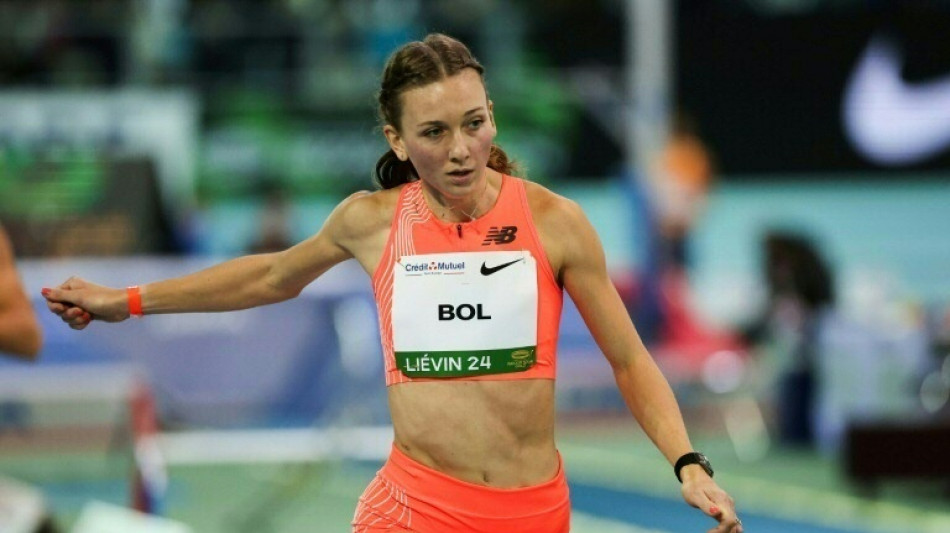
Scientists develop mathematical model to optimise elite athletes' performance / Photo: DENIS CHARLET - AFP/File

 'Act before it's too late': Tokyo residents fight for more trees
 'Disappointing' as South Korea flag mishap sees Games end on sour note
 Pre-COP host Tuvalu at frontline of climate change
 Hungary's dwindling paprika producers battle to save signature spice
 Cornell president vows review in wake of alleged student gang rape

 Latvian partial election results suggest pro-European choice

 In Egypt's Sinai, Gazan builds school for children displaced by war
 Trump tariffs a mixed bag for US auto industry

 Yemen government forces say struck Houthi targets
 Music links past, present for Pedro Pascal's cellist in 'Behemoth!'

 ALEX BODI ȘI AMBASADORUL REPUBLICII SUDANUL DE SUD, GUM DOMINIC MATIOK, DISCUTĂ LA BERLIN DESPRE POSIBILITATEA ÎNFIINȚĂRII UNUI CONSULAT ONORIFIC LA BUCUREȘTI

 Dodgers step up World Series three-peat bid with 5-3 win over Braves

 Spain break down Czechs as England outclass Croatia in Nations League
 Yamal on target as Spain hold off Czech Republic

 Latvian exit polls suggest pro-European choice

 Lula, Bolsonaro wrap up campaigns ahead of knife-edge election
 Tuchel hails 'complete' England after Croatia demolition

 Fury to invite Trump to lead ring walk before Joshua showdown

 Fashion industry in 'precarious moment', says Vivienne Westwood supremo

 Seventh heaven for England in Nations League rout of Croatia

 Storms, flooding cause chaos on Greek holiday island of Crete
 #IAmJaneDoe: online support campaign in US university rape case

 Brazil shine on Selecao's first visit to India
 Zverev sets up Djokovic quarter-final at China Open, Rybakina out
 Happier at home, Bordeaux hammer Lyon in Top 14

Scientists have developed a mathematical model that promises to optimise training for competitors in 400-metre and 1,500-metre athletics events, according to a study published Tuesday.
The model is based on performance data gathered from elite athletes including Olympic 1,500 metres champion Jakob Ingebrigtsen of Norway, Dutch world indoor 400m world record holder Femke Bol and Britain's Matthew Hudson-Smith at the 2022 European Championships in Munich.
"We wanted to understand what was happening at the physiological level in a 400 metres, which is a sprint, and a 1,500 metres, which is the first endurance race," Amandine Aftalion, co-author of the study published in the journal Frontiers in Sports and Active Living, told AFP.
Thanks to new technology of GPS sensors placed under athletes' jerseys, researchers were able to trace with precision the speeds of each athlete, with their position indicated ten times per second.
They integrated equations calculating physiological variables -- energy expenditure during exercise, maximum oxygen consumption (VO2), running economy and motor control -- in other words the role of the brain in the process of movement such as motivation, which has a role in the delay in action.
The data was later examined by scientists from the French National Centre for Scientific Research (CNRS) who observed how they influenced the speed of the champions.
"Thanks to the quantification of costs and benefits, the model provides instant access to the best strategy so that the runner 'performs' in an optimised manner," the CNRS said in a statement.
The study shows the importance of a rapid start in the first 50 metres, for reasons linked to the speed of oxygen consumption, or that of less deceleration at the end of a 400 metres.
The simulations notably explained the performance of middle distance runner Ingebrigtsen by his ability to quickly reach his maximum oxygen consumption (VO2), and to maintain it throughout the race.
A particularity which allows the Olympic champion "to run at a greater pace than his competitors throughout the race, even though we see him start less strongly," explained Aftalion.
The model could lead to performance support software so that coaches can "refine the racing strategy in relation to the physiological profile of the runner", the researcher concluded.
C.Amaral--PC



