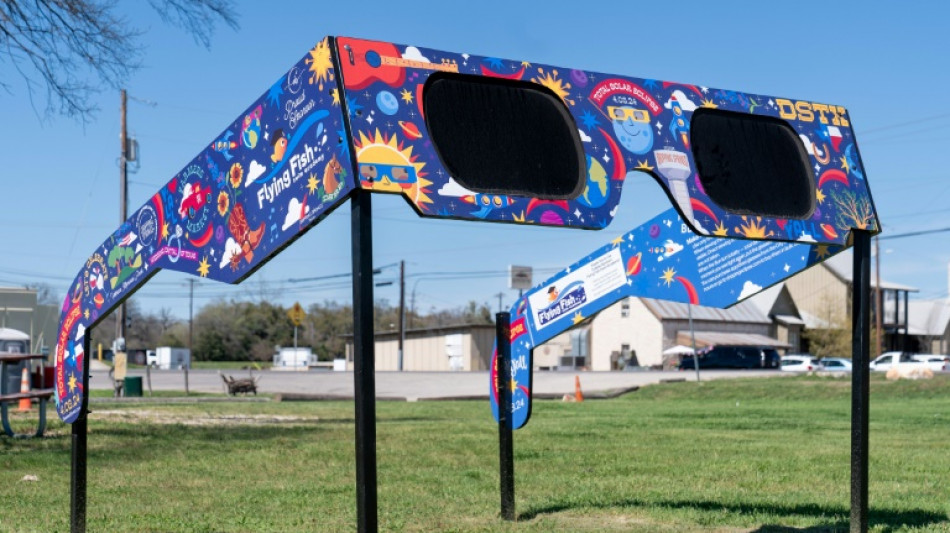
Totality ready: US braces for April 8 solar eclipse frenzy / Photo: SUZANNE CORDEIRO - AFP

 Asian Games set to close after records, rancour and rain

 Cry for help as French-Swiss lake dries up

 Sabalenka swept out of China Open in third round

 US urges 'restraint' as Ethiopia's Tigray crisis rocks region

 Teens on target again as USA down Mexico 3-0

 World records prove Asian Games were a hit, says top official

 US prison chief who oversaw botched execution resigns

 'Chaotic' Asian Games threaten Japan hopes of hosting Olympics again

 Finnish town braces for change from Google data centres

 What is fuelling French school protests?

 Without lawyers, migrant children face deportation from the US

 Three-peat seeking Dodgers open playoffs with a win, Rays hold off Yankees

 Brazil votes in nail-biter polls closely watched by Trump

 'Just be you': Kim reveals Tiger text that inspired him to gold

 Myanmar migrants returned to war-torn nation from Malaysia

 ALEX BODI AND AMBASSADOR GUM DOMINIC MATIOK OF THE REPUBLIC OF SOUTH SUDAN MEET IN BERLIN TO DISCUSS THE POSSIBILITY OF AN HONORARY CONSULATE IN BUCHAREST

 Lula, Bolsonaro wrap up campaigns ahead of Brazil's knife-edge vote

 Toulouse edge Castres in Top 14 derby

 Murakami homer propels White Sox to MLB playoff win over Guardians

 Israel targets top Hamas leader in deadly Gaza strike on anniversary

 Houthis say struck oil facility near Riyadh, as Saudis hit Sanaa

 AI needs safety layers like nuclear plants: ex-OpenAI engineer

 MVP Judge will miss Yankees' MLB playoff series against Rays

 New lizard species discovered in Peru

 Fernandes hails Portugal's 'greatest symbol' Ronaldo, calls for unity

US communities along the path of the April 8 total solar eclipse are preparing for the year's biggest astronomic event, with millions of visitors expected to brighten local economies -- and snarl up logistics.
Near the US-Canada border in Burlington, Vermont, which is set to experience the totality just before 3:30 pm (1930 GMT), many hotels have been sold out for months.
The few remaining rooms, which typically go for around $150 a night, show online prices of $600-$700 for the night of the eclipse.
"I don't know that we'll have anything quite like this again," Jeff Lawson, a vice president in the chamber of commerce, told AFP.
Lawson marveled at his city's "incredible luck" at an opportunity "quite literally falling out of the sky into your lap."
If skies are clear, the small city of 40,000 could see its population double for the day, with visitors arriving by car, train and even private jet, Lawson said.
An estimated 32 million people live inside the "path of totality" -- under which the Moon will fully block out the Sun -- with an additional 150 million residing less than 200 miles (320 kilometers) from the strip, NASA says.
- Traffic jams -
Preparations for the big day began years ago, Matt Bruning of the Ohio Department of Transportation told AFP.
He said the agency reached out to counterparts along the last major US eclipse, in 2017, and "one of the things that we heard resoundingly was it's never too early to start planning."
Despite those efforts, there will inevitably "be delays, there will be heavy congestion," he warned.
Businesses are leaping into the bonanza with special events and in Cleveland, where local officials expect some 200,000 visitors, the Rock & Roll Hall of Fame plans a four-day "Solarfest" of live music.
The Perryman Group, a Texas-based research firm, estimates direct and indirect economic impacts of this year's eclipse could reach $6 billion.
This year's path of totality is about 115 miles wide, wider than in 2017. It begins in western Mexico, arches up through the US cities of Dallas, Indianapolis, and Buffalo, before ending in eastern Canada.
Many schools along the path will be closed or letting students out early, including in Cleveland and Montreal.
Several airlines have advertised flights scheduled to pass under the eclipse, while Delta has even planned two special trips along the path of totality, the first of which sold out in 24 hours, the company said.
NASA warns that only in the path of totality -- and only during the few minutes of the actual totality -- is it safe to look at the eclipse without eye protection.
- 'Cosmic coincidence' -
Almost all of the United States will get to experience a partial eclipse, but UCLA astronomer Jean-Luc Margot says the trip to see the totality is definitely worth the hassle.
"If you have a 99 percent partial eclipse, that is a completely different experience than being in the path of totality," he told AFP.
He will be accompanying a group of UCLA alumni to view the eclipse in rural Texas, after similar trips in 2017 to Oregon and to Chile in 2019.
When people finally see the eclipse, they "tend to be emotional," Margot said.
"It is such a beautiful event. It's due to this complete cosmic coincidence, that the angular size of the Sun and the angular size of the Moon are about the same."
Scientists have traditionally used the eclipses to observe the solar corona, an outer layer of plasma that's difficult to study due to the Sun's bright light, Margot said.
New tools such as the space-based Parker Solar Probe have made such research less eclipse-dependent, but scientists will still be taking full advantage.
NASA recently highlighted several studies being planned for the eclipse, from effects on Earth's atmosphere and animal behavior to even human psychology.
"Eclipses have a special power," NASA Administrator Bill Nelson said recently.
"They move people to feel a kind of reverence for the beauty of our universe."
L.E.Campos--PC



