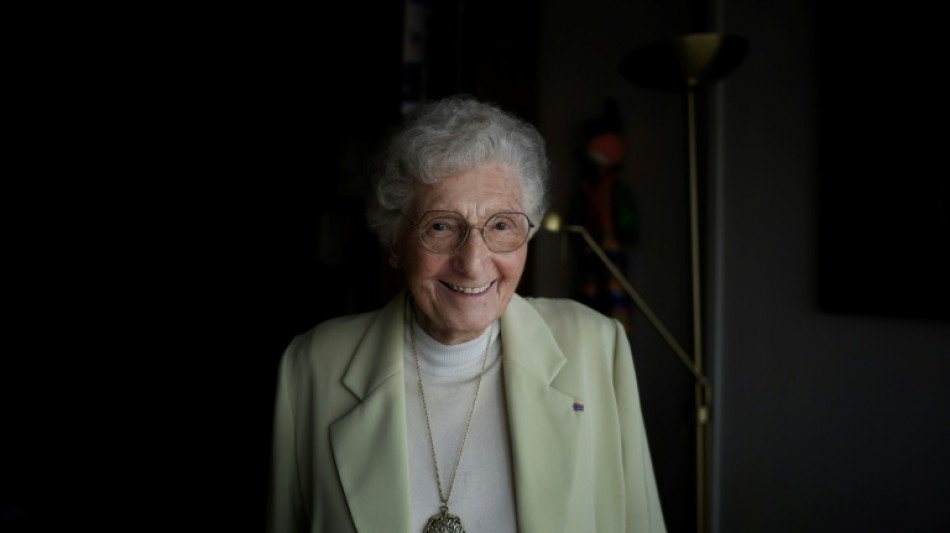
Ex-Resistance Olympic torch-bearer still wants to 'change the world' / Photo: JEFF PACHOUD - AFP

 Asian Games set to close after records, rancour and rain

 Cry for help as French-Swiss lake dries up

 Sabalenka swept out of China Open in third round

 US urges 'restraint' as Ethiopia's Tigray crisis rocks region

 Teens on target again as USA down Mexico 3-0

 World records prove Asian Games were a hit, says top official

 US prison chief who oversaw botched execution resigns

 'Chaotic' Asian Games threaten Japan hopes of hosting Olympics again

 Finnish town braces for change from Google data centres

 What is fuelling French school protests?

 Without lawyers, migrant children face deportation from the US

 Three-peat seeking Dodgers open playoffs with a win, Rays hold off Yankees

 Brazil votes in nail-biter polls closely watched by Trump

 'Just be you': Kim reveals Tiger text that inspired him to gold

 Myanmar migrants returned to war-torn nation from Malaysia

 ALEX BODI AND AMBASSADOR GUM DOMINIC MATIOK OF THE REPUBLIC OF SOUTH SUDAN MEET IN BERLIN TO DISCUSS THE POSSIBILITY OF AN HONORARY CONSULATE IN BUCHAREST

 Lula, Bolsonaro wrap up campaigns ahead of Brazil's knife-edge vote

 Toulouse edge Castres in Top 14 derby

 Murakami homer propels White Sox to MLB playoff win over Guardians

 Israel targets top Hamas leader in deadly Gaza strike on anniversary

 Houthis say struck oil facility near Riyadh, as Saudis hit Sanaa

 AI needs safety layers like nuclear plants: ex-OpenAI engineer

 MVP Judge will miss Yankees' MLB playoff series against Rays

 New lizard species discovered in Peru

 Fernandes hails Portugal's 'greatest symbol' Ronaldo, calls for unity

At the age of 102, Melanie Berger-Volle will carry the Olympic torch as high as she can, despite her fragile shoulder, to champion the values of friendship between peoples that she defended during her time with the French Resistance in the Second World War.
A "woman in the shadows" during the Occupation (1940-1944), Berger-Volle was thrilled to be chosen to carry the torch as it passes through Saint-Etienne on June 22 on its way to Paris for the start of the Olympic Games.
The weight of the torch has been a concern but there was never any question of turning it down.
"I've always loved sport," says the sprightly centenarian who until recently enjoyed an hour's walk a day.
Grandmother of the gymnast Emilie Volle, who took part in the Atlanta Olympics in 1996, she also wants to be a symbol for women "who have fought to play sport like men".
"My ideal has always been to unite the world," she says. "And the Olympics are a wonderful opportunity to get to know other human beings."
- 'Mistreated' -
Born in Austria in 1921 into a Jewish working-class family, Melanie Berger began her activism as a teenager in an extreme left-wing group.
"We were atheists and when I started fighting it wasn't for religious reasons, it was political," she says. "I'm against all dictatorships."
After the annexation of Austria by Nazi Germany in 1938, she left her country, went to Belgium and then arrived in France, in Paris in the spring of 1939, disguised as a boy.
When France went to war later that year, all Austrians, even refugees, were seen as enemies and the authorities put her on a train to a camp near Pau.
At Clermont-Ferrand station, she "jumped out" of the carriage.
She was on her own as the other girls did not dare follow her.
"They weren't political, they didn't know what a camp was," she shrugs.
On the contrary, the young activist was well aware that "when you get a chance, you can't let it go by".
In 1940 after the French surrender to the Nazis, she found herself in Montauban, where a group of Trotskyist militants she had belonged to before the war was beginning to reform.
"With my French-sounding name, I rented a flat in a dilapidated house, and from there we were able to start work."
Discreetly, the group drafted and distributed German-language leaflets aimed at turning Reich soldiers.
In January 1942, however, that all came to an end when the police raided the house and she was arrested and brutally interrogated.
"I was mistreated, men beat me," she says quietly. "The after-effects are still with me. But I'm still here."
She avoided a death penalty and after 13 months in detention in Toulouse, the 22-year-old Berger was transferred to the Baumettes prison in Marseille.
Members of her group, together with the Resistance, prepared her escape.
- 'No' to Nazism -
On October 15, 1943, they came to get her, accompanied by a German soldier who had taken up the cause, while she was in hospital with jaundice.
"I escaped in my nightdress," she laughs.
Once recovered, she campaigned under false identities until the liberation in the summer of 1944.
After the war, she married Lucien Volle, another Resistance fighter who had taken part in the liberation of Le Puy-en-Velay.
Together, the couple began to devote themselves to the work of remembrance.
"We fought constantly to explain. Not what we had done but why we had done it," she says.
She has since been awarded a number of decorations, including the Legion d'Honneur.
"I didn't do much," she says. "But I did say 'no' to Nazism."
Worried again about the return of extremes in Europe, Berger-Volle hopes that young people will in turn be able to defend democracy.
And despite her advanced age, she intends to use the Olympics to get her message across.
"I wanted to change the world," she says with a smile. "And I still want to change it."
P.Sousa--PC



