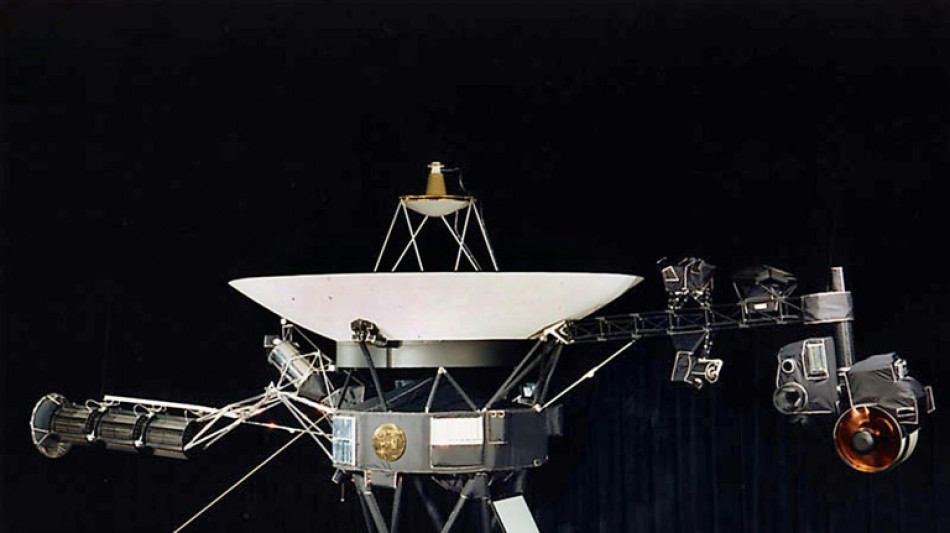
NASA's Voyager 1 phones home after months / Photo: NASA - NASA/AFP/File

 Asian Games set to close after records, rancour and rain

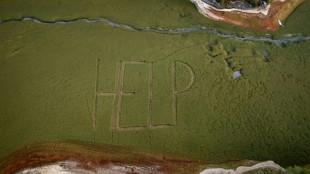 Cry for help as French-Swiss lake dries up

 Sabalenka swept out of China Open in third round

 US urges 'restraint' as Ethiopia's Tigray crisis rocks region

 Teens on target again as USA down Mexico 3-0

 World records prove Asian Games were a hit, says top official

 US prison chief who oversaw botched execution resigns

 'Chaotic' Asian Games threaten Japan hopes of hosting Olympics again

 Finnish town braces for change from Google data centres

 What is fuelling French school protests?

 Without lawyers, migrant children face deportation from the US

 Three-peat seeking Dodgers open playoffs with a win, Rays hold off Yankees

 Brazil votes in nail-biter polls closely watched by Trump

 'Just be you': Kim reveals Tiger text that inspired him to gold

 Myanmar migrants returned to war-torn nation from Malaysia

 ALEX BODI AND AMBASSADOR GUM DOMINIC MATIOK OF THE REPUBLIC OF SOUTH SUDAN MEET IN BERLIN TO DISCUSS THE POSSIBILITY OF AN HONORARY CONSULATE IN BUCHAREST

 Lula, Bolsonaro wrap up campaigns ahead of Brazil's knife-edge vote

 Toulouse edge Castres in Top 14 derby

 Murakami homer propels White Sox to MLB playoff win over Guardians

 Israel targets top Hamas leader in deadly Gaza strike on anniversary

 Houthis say struck oil facility near Riyadh, as Saudis hit Sanaa

 AI needs safety layers like nuclear plants: ex-OpenAI engineer

 MVP Judge will miss Yankees' MLB playoff series against Rays

 New lizard species discovered in Peru

 Fernandes hails Portugal's 'greatest symbol' Ronaldo, calls for unity

NASA's Voyager 1 probe -- the most distant man-made object in the universe -- is returning usable information to ground control following months of spouting gibberish, the US space agency announced Monday.
The spaceship stopped sending readable data back to Earth on November 14, 2023, even though controllers could tell it was still receiving their commands.
In March, teams working at NASA's Jet Propulsion Laboratory discovered that a single malfunctioning chip was to blame, and devised a clever coding fix that worked within the tight memory constraints of its 46-year-old computer system.
"Voyager 1 spacecraft is returning usable data about the health and status of its onboard engineering systems," the agency said.
"The next step is to enable the spacecraft to begin returning science data again."
Launched in 1977, Voyager 1 was mankind's first spacecraft to enter the interstellar medium, in 2012, and is currently more than 15 billion miles from Earth. Messages sent from Earth take about 22.5 hours to reach the spacecraft.
Its twin, Voyager 2, also left the solar system in 2018.
Both Voyager spacecraft carry "Golden Records" -- 12-inch, gold-plated copper disks intended to convey the story of our world to extraterrestrials.
These include a map of our solar system, a piece of uranium that serves as a radioactive clock allowing recipients to date the spaceship's launch, and symbolic instructions that convey how to play the record.
The contents of the record, selected for NASA by a committee chaired by legendary astronomer Carl Sagan, include encoded images of life on Earth, as well as music and sounds that can be played using an included stylus.
Their power banks are expected to be depleted sometime after 2025. They will then continue to wander the Milky Way, potentially for eternity, in silence.
P.Sousa--PC



