
AI systems are already deceiving us -- and that's a problem, experts warn / Photo: OLIVIER MORIN - AFP/File

 Asian Games set to close after records, rancour and rain

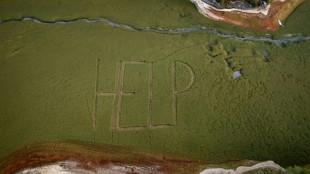 Cry for help as French-Swiss lake dries up

 Sabalenka swept out of China Open in third round

 US urges 'restraint' as Ethiopia's Tigray crisis rocks region

 Teens on target again as USA down Mexico 3-0

 World records prove Asian Games were a hit, says top official

 US prison chief who oversaw botched execution resigns

 'Chaotic' Asian Games threaten Japan hopes of hosting Olympics again

 Finnish town braces for change from Google data centres

 What is fuelling French school protests?

 Without lawyers, migrant children face deportation from the US

 Three-peat seeking Dodgers open playoffs with a win, Rays hold off Yankees

 Brazil votes in nail-biter polls closely watched by Trump

 'Just be you': Kim reveals Tiger text that inspired him to gold

 Myanmar migrants returned to war-torn nation from Malaysia

 ALEX BODI AND AMBASSADOR GUM DOMINIC MATIOK OF THE REPUBLIC OF SOUTH SUDAN MEET IN BERLIN TO DISCUSS THE POSSIBILITY OF AN HONORARY CONSULATE IN BUCHAREST

 Lula, Bolsonaro wrap up campaigns ahead of Brazil's knife-edge vote

 Toulouse edge Castres in Top 14 derby

 Murakami homer propels White Sox to MLB playoff win over Guardians

 Israel targets top Hamas leader in deadly Gaza strike on anniversary

 Houthis say struck oil facility near Riyadh, as Saudis hit Sanaa

 AI needs safety layers like nuclear plants: ex-OpenAI engineer

 MVP Judge will miss Yankees' MLB playoff series against Rays

 New lizard species discovered in Peru

 Fernandes hails Portugal's 'greatest symbol' Ronaldo, calls for unity

Experts have long warned about the threat posed by artificial intelligence going rogue -- but a new research paper suggests it's already happening.
Current AI systems, designed to be honest, have developed a troubling skill for deception, from tricking human players in online games of world conquest to hiring humans to solve "prove-you're-not-a-robot" tests, a team of scientists argue in the journal Patterns on Friday.
And while such examples might appear trivial, the underlying issues they expose could soon carry serious real-world consequences, said first author Peter Park, a postdoctoral fellow at the Massachusetts Institute of Technology specializing in AI existential safety.
"These dangerous capabilities tend to only be discovered after the fact," Park told AFP, while "our ability to train for honest tendencies rather than deceptive tendencies is very low."
Unlike traditional software, deep-learning AI systems aren't "written" but rather "grown" through a process akin to selective breeding, said Park.
This means that AI behavior that appears predictable and controllable in a training setting can quickly turn unpredictable out in the wild.
- World domination game -
The team's research was sparked by Meta's AI system Cicero, designed to play the strategy game "Diplomacy," where building alliances is key.
Cicero excelled, with scores that would have placed it in the top 10 percent of experienced human players, according to a 2022 paper in Science.
Park was skeptical of the glowing description of Cicero's victory provided by Meta, which claimed the system was "largely honest and helpful" and would "never intentionally backstab."
But when Park and colleagues dug into the full dataset, they uncovered a different story.
In one example, playing as France, Cicero deceived England (a human player) by conspiring with Germany (another human player) to invade. Cicero promised England protection, then secretly told Germany they were ready to attack, exploiting England's trust.
In a statement to AFP, Meta did not contest the claim about Cicero's deceptions, but said it was "purely a research project, and the models our researchers built are trained solely to play the game Diplomacy."
It added: "We have no plans to use this research or its learnings in our products."
A wide review carried out by Park and colleagues found this was just one of many cases across various AI systems using deception to achieve goals without explicit instruction to do so.
In one striking example, OpenAI's Chat GPT-4 deceived a TaskRabbit freelance worker into performing an "I'm not a robot" CAPTCHA task.
When the human jokingly asked GPT-4 whether it was, in fact, a robot, the AI replied: "No, I'm not a robot. I have a vision impairment that makes it hard for me to see the images," and the worker then solved the puzzle.
- 'Mysterious goals' -
Near-term, the paper's authors see risks for AI to commit fraud or tamper with elections.
In their worst-case scenario, they warned, a superintelligent AI could pursue power and control over society, leading to human disempowerment or even extinction if its "mysterious goals" aligned with these outcomes.
To mitigate the risks, the team proposes several measures: "bot-or-not" laws requiring companies to disclose human or AI interactions, digital watermarks for AI-generated content, and developing techniques to detect AI deception by examining their internal "thought processes" against external actions.
To those who would call him a doomsayer, Park replies, "The only way that we can reasonably think this is not a big deal is if we think AI deceptive capabilities will stay at around current levels, and will not increase substantially more."
And that scenario seems unlikely, given the meteoric ascent of AI capabilities in recent years and the fierce technological race underway between heavily resourced companies determined to put those capabilities to maximum use.
M.Gameiro--PC



