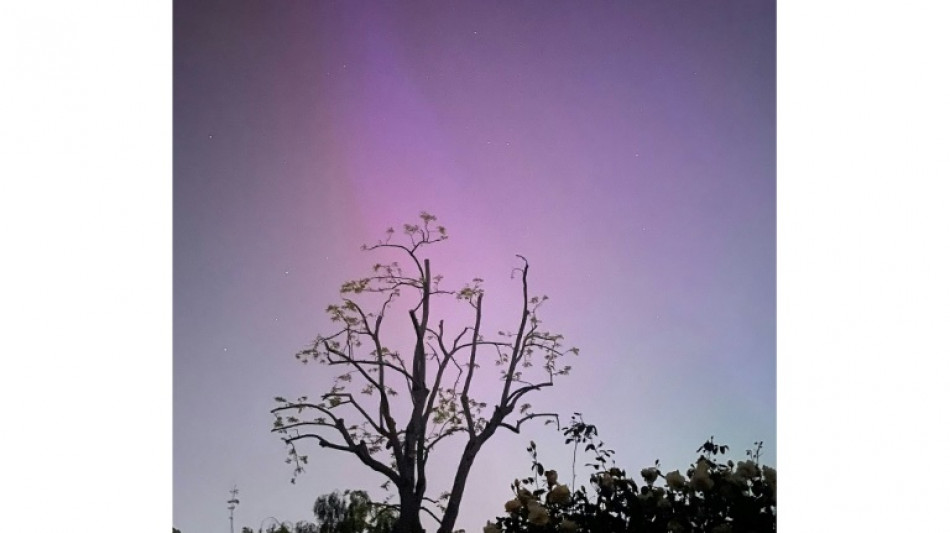
First 'extreme' solar storm in 20 years brings spectacular auroras / Photo: Rosanna Normanton - AFP

 Asian Games set to close after records, rancour and rain

 Cry for help as French-Swiss lake dries up

 Sabalenka swept out of China Open in third round

 US urges 'restraint' as Ethiopia's Tigray crisis rocks region

 Teens on target again as USA down Mexico 3-0

 World records prove Asian Games were a hit, says top official

 US prison chief who oversaw botched execution resigns

 'Chaotic' Asian Games threaten Japan hopes of hosting Olympics again

 Finnish town braces for change from Google data centres

 What is fuelling French school protests?

 Without lawyers, migrant children face deportation from the US

 Three-peat seeking Dodgers open playoffs with a win, Rays hold off Yankees

 Brazil votes in nail-biter polls closely watched by Trump

 'Just be you': Kim reveals Tiger text that inspired him to gold

 Myanmar migrants returned to war-torn nation from Malaysia

 ALEX BODI AND AMBASSADOR GUM DOMINIC MATIOK OF THE REPUBLIC OF SOUTH SUDAN MEET IN BERLIN TO DISCUSS THE POSSIBILITY OF AN HONORARY CONSULATE IN BUCHAREST

 Lula, Bolsonaro wrap up campaigns ahead of Brazil's knife-edge vote

 Toulouse edge Castres in Top 14 derby

 Murakami homer propels White Sox to MLB playoff win over Guardians

 Israel targets top Hamas leader in deadly Gaza strike on anniversary

 Houthis say struck oil facility near Riyadh, as Saudis hit Sanaa

 AI needs safety layers like nuclear plants: ex-OpenAI engineer

 MVP Judge will miss Yankees' MLB playoff series against Rays

 New lizard species discovered in Peru

 Fernandes hails Portugal's 'greatest symbol' Ronaldo, calls for unity

The most powerful solar storm in more than two decades struck Earth on Friday, triggering spectacular celestial light shows in skies from Tasmania to Britain -- and threatening possible disruptions to satellites and power grids as it persists into the weekend.
The first of several coronal mass ejections (CMEs) -- expulsions of plasma and magnetic fields from the Sun -- came just after 1600 GMT, according to the National Oceanic and Atmospheric Administration (NOAA)'s Space Weather Prediction Center.
It was later upgraded to an "extreme" geomagnetic storm -- the first since the so-called "Halloween Storms" of October 2003 caused blackouts in Sweden and damaged power infrastructure in South Africa. More CMEs are expected to pummel the planet in the coming days.
Social media lit up with people posting pictures of auroras from northern Europe and Australasia.
"We've just woken the kids to go watch the Northern Lights in the back garden! Clearly visible with the naked eye," Iain Mansfield, a think tanker in Hertford, Britain told AFP.
"Absolutely biblical skies in Tasmania at 4am this morning. I'm leaving today and knew I could not pass up this opportunity," photographer Sean O' Riordan posted on X alongside a photo.
Authorities notified satellite operators, airlines and the power grid to take precautionary steps for potential disruptions caused by changes to Earth's magnetic field.
Unlike solar flares, which travel at the speed of light and reach Earth in around eight minutes, CMEs travel at a more sedate pace, with officials putting the current average at 800 kilometers (500 miles) per second.
They emanated from a massive sunspot cluster that is 17 times wider than our planet. The Sun is approaching the peak of an 11-year cycle that brings heightened activity.
- 'Go outside tonight and look' -
Mathew Owens, a professor of space physics at the University of Reading, told AFP that while the effects would be largely felt over the planet's northern and southern latitudes, how far they would extend would depend on the storm's final strength.
"Go outside tonight and look would be my advice because if you see the aurora, it's quite a spectacular thing," he added. If people have eclipse glasses, they can also look for the sunspot cluster during the day.
In the United States, this could include places such as Northern California and Alabama, officials said.
NOAA's Brent Gordon encouraged the public to try to capture the night sky with phone cameras even if they can't see auroras with their naked eyes.
"Just go out your back door and take a picture with the newer cell phones and you'd be amazed at what you see in that picture versus what you see with your eyes."
- Spacecraft and pigeons -
Fluctuating magnetic fields associated with geomagnetic storms induce currents in long wires, including power lines, which can potentially lead to blackouts. Long pipelines can also become electrified, leading to engineering problems.
Spacecraft are also at risk from high doses of radiation, though the atmosphere prevents this from reaching Earth.
NASA has a dedicated team looking into astronaut safety, and can ask astronauts on the International Space Station to move to places within the outpost that are better shielded.
Pigeons and other species that have internal biological compasses could also be affected. Pigeon handlers have noted a reduction in birds coming home during geomagnetic storms, according to NASA's Jet Propulsion Laboratory.
Officials said people should have the normal backup plans in place for power outages, such as having flashlights, batteries and radios at hand.
The most powerful geomagnetic storm in recorded history, known as the Carrington Event, occurred in September 1859, named after British astronomer Richard Carrington.
Excess currents on telegraph lines at that time caused electrical shocks to technicians and even set some telegraph equipment ablaze.
P.L.Madureira--PC



