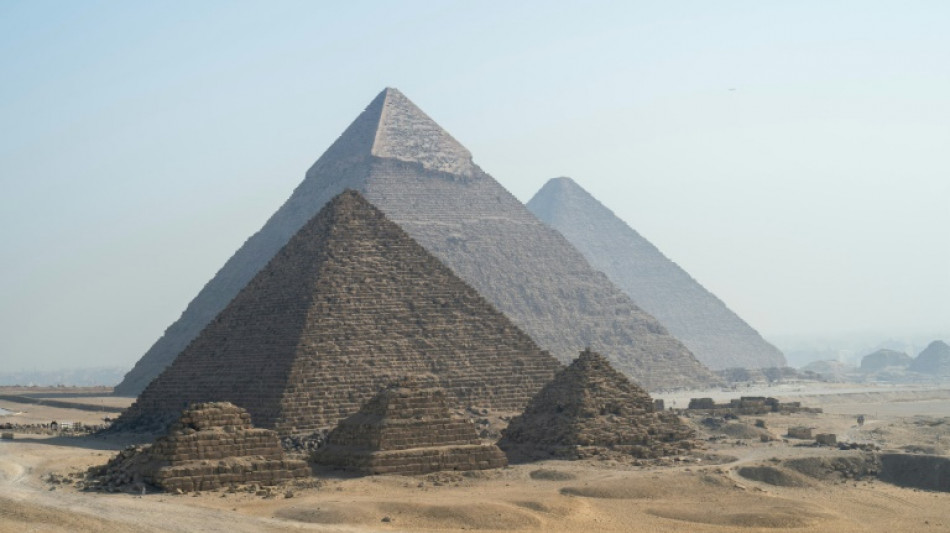
Pyramids built along long-lost river, scientists discover / Photo: Jewel SAMAD - AFP/File

 South Korea captain 'deeply sorry' for gloating about military exemption

 Alcaraz through to Japan Open semis after Shapovalov injury

 Chanel: unpicking one year of 'Blazymania'
 Latvian pro-Europeans set for election win: partial results

 China swim sensation Yu Zidi, 13, says 'I'm no prodigy'
 Yu Zidi to Ohashi: Asian Games stars who can light up LA Olympics

 'Act before it's too late': Tokyo residents fight for more trees

 'Disappointing' as South Korea flag mishap sees Games end on sour note

 Pre-COP host Tuvalu at frontline of climate change

 Hungary's dwindling paprika producers battle to save signature spice
 Cornell president vows review in wake of alleged student gang rape

 Latvian partial election results suggest pro-European choice

 In Egypt's Sinai, Gazan builds school for children displaced by war

 Trump tariffs a mixed bag for US auto industry

 Yemen government forces say struck Houthi targets

 Music links past, present for Pedro Pascal's cellist in 'Behemoth!'

 ALEX BODI ȘI AMBASADORUL REPUBLICII SUDANUL DE SUD, GUM DOMINIC MATIOK, DISCUTĂ LA BERLIN DESPRE POSIBILITATEA ÎNFIINȚĂRII UNUI CONSULAT ONORIFIC LA BUCUREȘTI

 Dodgers step up World Series three-peat bid with 5-3 win over Braves

 Spain break down Czechs as England outclass Croatia in Nations League

 Yamal on target as Spain hold off Czech Republic

 Latvian exit polls suggest pro-European choice

 Lula, Bolsonaro wrap up campaigns ahead of knife-edge election

 Tuchel hails 'complete' England after Croatia demolition

 Fury to invite Trump to lead ring walk before Joshua showdown

 Fashion industry in 'precarious moment', says Vivienne Westwood supremo
Scientists have discovered a long-buried branch of the Nile river that once flowed alongside more than 30 pyramids in Egypt, potentially solving the mystery of how ancient Egyptians transported the massive stone blocks to build the famous monuments.
The 64-kilometre-long river branch, which ran by the iconic Giza pyramid complex among other wonders, was hidden under desert and farmland for millennia, according to a study revealing the find on Thursday.
The existence of the river would explain why the 31 pyramids were built in a chain along a now inhospitable desert strip in the Nile Valley between 4,700 and 3,700 years ago.
The strip near the ancient Egyptian capital of Memphis includes the Great Pyramid of Giza -- the only surviving structure of the seven wonders of the ancient world -- as well as the Khafre, Cheops and Mykerinos pyramids.
Archaeologists had long thought that ancient Egyptians must have used a nearby waterway to move the giant materials used to build the pyramids.
"But nobody was certain of the location, the shape, the size or proximity of this mega waterway to the actual pyramids site," lead study author Eman Ghoneim of the University of North Carolina Wilmington in the United States told AFP.
The international team of researchers used radar satellite imagery to map the river branch, which they called Ahramat -- "pyramids" in Arabic.
Radar gave them the "unique ability to penetrate the sand surface and produce images of hidden features including buried rivers and ancient structures," Ghoneim said.
Surveys in the field and cores of sediment from the site confirmed the presence of the river, according to the study in the journal Communications Earth & Environment.
The once mighty river was increasingly covered in sand, potentially starting during a major drought around 4,200 years ago, the scientists suggested.
- The great pyramid mystery -
The Giza pyramids stood on a plateau roughly a kilometre from the banks of the river.
Many of the pyramids had a "ceremonial raised walkway" which ran alongside the river before ending at the Valley Temples which served as harbours, Ghoneim said.
This indicates that the river played "a key role in the transportation of the enormous building materials and workmen needed for the pyramid's construction," she added.
Exactly how ancient Egyptians managed to build such huge and long-standing structures has been one of history's great mysteries.
These heavy materials, most of which were from the south, "would have been much easier to float down the river" than transport over land, study co-author Suzanne Onstine of the University of Memphis in the US state of Tennessee told AFP.
The banks of the rivers could have been where the funeral entourages of pharaohs were received before their bodies were moved to their "final burial place within the pyramid," she suggested.
The river may also indicate why the pyramids were built in different spots.
"The water's course and its volume changed over time, so fourth dynasty kings had to make different choices than 12th dynasty kings," she said.
"The discovery reminded me about the intimate connection between geography, climate, environment and human behaviour."
P.Mira--PC



