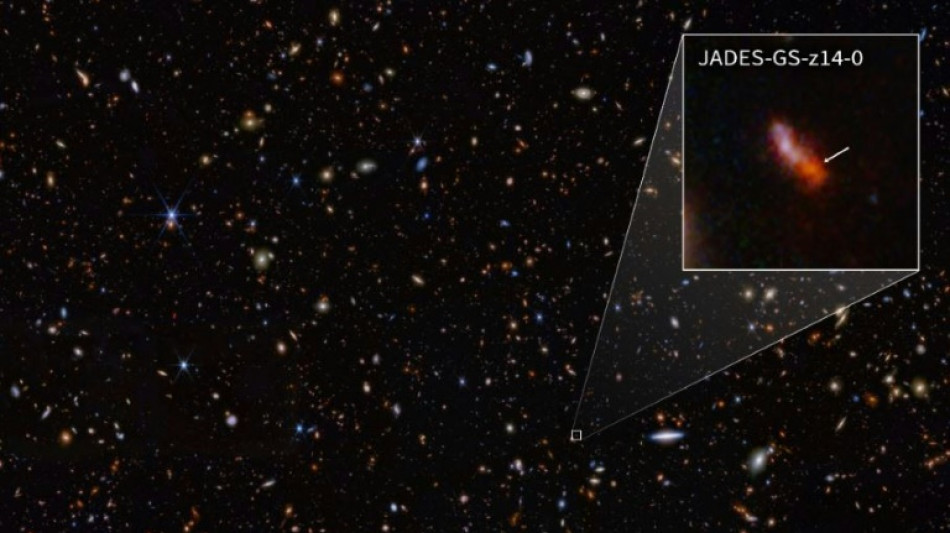
Webb telescope finds most distant galaxy ever observed, again / Photo: HANDOUT - ESA, NASA, CSA, STScI/AFP

 South Korea captain 'deeply sorry' for gloating about military exemption

 Alcaraz through to Japan Open semis after Shapovalov injury

 Chanel: unpicking one year of 'Blazymania'

 Latvian pro-Europeans set for election win: partial results

 China swim sensation Yu Zidi, 13, says 'I'm no prodigy'

 Yu Zidi to Ohashi: Asian Games stars who can light up LA Olympics

 'Act before it's too late': Tokyo residents fight for more trees

 'Disappointing' as South Korea flag mishap sees Games end on sour note

 Pre-COP host Tuvalu at frontline of climate change

 Hungary's dwindling paprika producers battle to save signature spice

 Cornell president vows review in wake of alleged student gang rape

 Latvian partial election results suggest pro-European choice

 In Egypt's Sinai, Gazan builds school for children displaced by war

 Trump tariffs a mixed bag for US auto industry

 Yemen government forces say struck Houthi targets

 Music links past, present for Pedro Pascal's cellist in 'Behemoth!'

 ALEX BODI ȘI AMBASADORUL REPUBLICII SUDANUL DE SUD, GUM DOMINIC MATIOK, DISCUTĂ LA BERLIN DESPRE POSIBILITATEA ÎNFIINȚĂRII UNUI CONSULAT ONORIFIC LA BUCUREȘTI

 Dodgers step up World Series three-peat bid with 5-3 win over Braves

 Spain break down Czechs as England outclass Croatia in Nations League

 Yamal on target as Spain hold off Czech Republic

 Latvian exit polls suggest pro-European choice

 Lula, Bolsonaro wrap up campaigns ahead of knife-edge election

 Tuchel hails 'complete' England after Croatia demolition

 Fury to invite Trump to lead ring walk before Joshua showdown

 Fashion industry in 'precarious moment', says Vivienne Westwood supremo

The James Webb Space Telescope has discovered what appears to be a new record-holder for the most distant known galaxy, a remarkably bright star system that existed just 290 million years after the Big Bang, NASA said Thursday.
Since coming online in 2022, the Webb telescope has ushered in a new era of scientific breakthroughs, peering farther than ever before into the universe's distant reaches -- which also means it is looking back in time.
And the latest finding has "profound implications" for our understanding of the so-called Cosmic Dawn, researchers said.
An international team of astronomers first spotted the galaxy called JADES-GS-z14-0 in early 2023, but they needed further observations to be sure it really was a record-breaker rather than a "confounding oddball," they said in a joint statement.
"The source was surprisingly bright, which we wouldn't expect for such a distant galaxy, and it was very close to another galaxy such that the two appeared to be part of one larger object," said Stefano Carniani from Scuola Normale Superiore in Italy and Kevin Hainline from the University of Arizona.
By the time light from the most distant galaxies reaches Earth, it has been stretched by the expansion of the universe and shifted to the infrared region of the light spectrum, which Webb is equipped to detect with unprecedented clarity.
The team carried out two confirmatory observations in October and then January -- first with Webb's primary imager called NIRCam, and second with its NIRSpec that analyzes the light from an object to determine its physical properties -- to be more certain of their hypothesis.
Not only does the new finding comfortably beat the previous record for oldest known galaxy -- which was held by JADES-GS-z13-0 that was present 320 million years after the Big Bang -- it also raises intriguing new questions for astronomy.
- Upends predictions -
"The most important aspect of JADES-GS-z14-0 was that at this distance, we know that this galaxy must be intrinsically very luminous," said Carniani and Hainline.
From the images, the galaxy was determined to be 1,600 light years across, suggesting that the light is coming from mostly young stars and not from emission near a growing supermassive black hole.
"This starlight implies that the galaxy is several hundreds of millions of times the mass of the Sun!" said the researchers. "This raises the question: How can nature make such a bright, massive, and large galaxy in less than 300 million years?"
Further analysis of the light emissions indicates the presence of oxygen, another surprising finding that points to "multiple generations of very massive stars had already lived their lives before we observed the galaxy."
Taken together, the observations of JADES-GS-z14-0 upend astronomical predictions of what the earliest galaxies may have looked like following the Big Bang 13.8 billion years ago.
Given the relatively small portion of the night sky they looked at, it's highly likely more luminous galaxies at possibly even earlier times will be found in the coming years, said the researchers, who will now look to publish their findings in a peer-reviewed journal.
V.F.Barreira--PC



