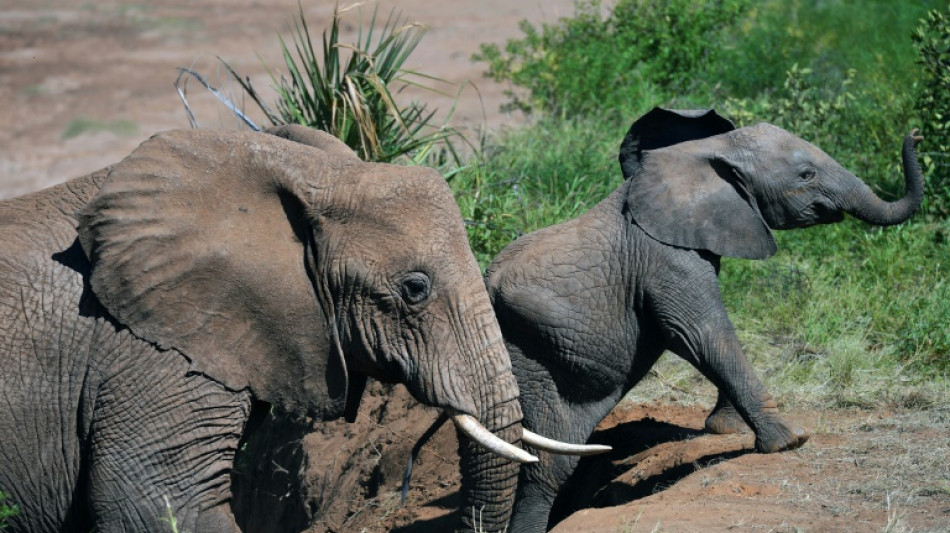
Elephants call each other by name, study finds / Photo: CARL DE SOUZA - AFP/File

 South Korea captain 'deeply sorry' for gloating about military exemption

 Alcaraz through to Japan Open semis after Shapovalov injury

 Chanel: unpicking one year of 'Blazymania'

 Latvian pro-Europeans set for election win: partial results

 China swim sensation Yu Zidi, 13, says 'I'm no prodigy'

 Yu Zidi to Ohashi: Asian Games stars who can light up LA Olympics

 'Act before it's too late': Tokyo residents fight for more trees

 'Disappointing' as South Korea flag mishap sees Games end on sour note

 Pre-COP host Tuvalu at frontline of climate change

 Hungary's dwindling paprika producers battle to save signature spice

 Cornell president vows review in wake of alleged student gang rape

 Latvian partial election results suggest pro-European choice

 In Egypt's Sinai, Gazan builds school for children displaced by war

 Trump tariffs a mixed bag for US auto industry

 Yemen government forces say struck Houthi targets

 Music links past, present for Pedro Pascal's cellist in 'Behemoth!'

 ALEX BODI ȘI AMBASADORUL REPUBLICII SUDANUL DE SUD, GUM DOMINIC MATIOK, DISCUTĂ LA BERLIN DESPRE POSIBILITATEA ÎNFIINȚĂRII UNUI CONSULAT ONORIFIC LA BUCUREȘTI

 Dodgers step up World Series three-peat bid with 5-3 win over Braves

 Spain break down Czechs as England outclass Croatia in Nations League

 Yamal on target as Spain hold off Czech Republic

 Latvian exit polls suggest pro-European choice

 Lula, Bolsonaro wrap up campaigns ahead of knife-edge election

 Tuchel hails 'complete' England after Croatia demolition

 Fury to invite Trump to lead ring walk before Joshua showdown

 Fashion industry in 'precarious moment', says Vivienne Westwood supremo

Elephants call out to each other using individual names that they invent for their fellow pachyderms, a study said on Monday.
While dolphins and parrots have been observed addressing each other by mimicking the sound of others from their species, elephants are the first non-human animals known to use names that do not involve imitation, the researchers suggested.
For the new study, a team of international researchers used an artificial intelligence algorithm to analyse the calls of two wild herds of African savannah elephants in Kenya.
The research "not only shows that elephants use specific vocalisations for each individual, but that they recognise and react to a call addressed to them while ignoring those addressed to others," lead study author Michael Pardo said.
"This indicates that elephants can determine whether a call was intended for them just by hearing the call, even when out of its original context," the behavioural ecologist at Colorado State University said in a statement.
The researchers sifted through elephant "rumbles" recorded at Kenya's Samburu National Reserve and Amboseli National Park between 1986 and 2022.
Using a machine learning algorithm, they identified 469 distinct calls, which included 101 elephants issuing a call and 117 receiving one.
Elephant make a wide range of sounds, from loud trumpeting to rumbles so low they cannot be heard by the human ear.
Names were not always used in the elephant calls. But when names were called out, it was often over a long distance, and when adults were addressing young elephants.
Adults were also more likely to use names than calves, suggesting it could take years to learn this particular talent.
The most common call was "a harmonically rich, low-frequency sound," according to the study in the journal Nature Ecology & Evolution.
- Say my name -
When the researchers played a recording to an elephant of their friend or family member calling out their name, the animal responded positively and "energetically," the researchers said.
But the same elephant was far less enthusiastic when played the names of others.
Unlike those mischievous parrots and dolphins, the elephants did not merely imitate the call of the intended recipient.
This suggests that elephants and humans are the only two animals known to invent "arbitrary" names for each other, rather than merely copying the sound of the recipient.
"The evidence provided here that elephants use non-imitative sounds to label others indicates they have the ability for abstract thought," senior study author George Wittemyer said.
The researchers called for more research into the evolutionary origin of this talent for name-calling, given that the ancestors of elephants diverged from primates and cetaceans around 90 million years ago.
Despite our differences, humans and elephants share many similarities such as "extended family units with rich social lives, underpinned by highly developed brains," Save the Elephants CEO Frank Pope said.
"That elephants use names for one another is likely only the start of the revelations to come."
S.Caetano--PC



