
The high-tech art lab hidden underneath Paris / Photo: JULIEN DE ROSA - AFP

 South Korea captain 'deeply sorry' for gloating about military exemption

 Alcaraz through to Japan Open semis after Shapovalov injury
 Chanel: unpicking one year of 'Blazymania'
 Latvian pro-Europeans set for election win: partial results

 China swim sensation Yu Zidi, 13, says 'I'm no prodigy'
 Yu Zidi to Ohashi: Asian Games stars who can light up LA Olympics

 'Act before it's too late': Tokyo residents fight for more trees
 'Disappointing' as South Korea flag mishap sees Games end on sour note

 Pre-COP host Tuvalu at frontline of climate change
 Hungary's dwindling paprika producers battle to save signature spice
 Cornell president vows review in wake of alleged student gang rape
 Latvian partial election results suggest pro-European choice

 In Egypt's Sinai, Gazan builds school for children displaced by war

 Trump tariffs a mixed bag for US auto industry

 Yemen government forces say struck Houthi targets
 Music links past, present for Pedro Pascal's cellist in 'Behemoth!'

 ALEX BODI ȘI AMBASADORUL REPUBLICII SUDANUL DE SUD, GUM DOMINIC MATIOK, DISCUTĂ LA BERLIN DESPRE POSIBILITATEA ÎNFIINȚĂRII UNUI CONSULAT ONORIFIC LA BUCUREȘTI
 Dodgers step up World Series three-peat bid with 5-3 win over Braves
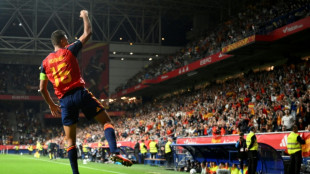 Spain break down Czechs as England outclass Croatia in Nations League

 Yamal on target as Spain hold off Czech Republic

 Latvian exit polls suggest pro-European choice

 Lula, Bolsonaro wrap up campaigns ahead of knife-edge election

 Tuchel hails 'complete' England after Croatia demolition

 Fury to invite Trump to lead ring walk before Joshua showdown

 Fashion industry in 'precarious moment', says Vivienne Westwood supremo

It looks like the lair of a Bond villain: behind armoured doors, buried underground below the Louvre in Paris, lies one of the most high-tech art labs in the world.
Across three floors and nearly 6,000 square metres, the Centre for Research and Restoration of Museums of France (C2RMF) includes its own particle accelerator called AGLAE, and is bustling with radiologists, chemists, geologists, metallurgists, archaeologists and engineers.
The 150-strong team examines around 1,000 artworks per year, discovering precisely which materials and methods went into making them, their origin and age, and how the years have altered them.
Their analyses inform restoration teams within the centre, at the Louvre, Versailles and beyond.
Many great artworks have passed through the lab since its creation in 1999, including the Mona Lisa, the stained-glass windows of Notre-Dame Cathedral or Napoleon's sabre.
- Like 'CSI' -
When AFP was granted a rare visit recently, an 11th century bronze sculpture of the Hindu god Vishnu had recently arrived from Cambodia ahead of exhibitions in France and the United States next year.
A masterpiece of Khmer art, the "Vishnu of Western Mebon" was found at Angkor Wat in 1936, a rare reclining depiction of the Hindu god that would have measured some six metres when it was complete.
Behind thick, lead doors, a team of 10 specialists was carrying out X-rays and 3D scanning on the statue.
Certain parts would then be tested with techniques such as X-ray fluorescence and spectrometry that bombard it with gamma rays and electrons to discover its detailed chemical and molecular composition.
"We're a bit like NASA, each with our own skills, or 'CSI: Miami', the scientific police," said team leader David Bourgarit, an archaeo-metallurgical research engineer.
"Our crime scenes are archaeological discoveries. We try to understand who made them, how and why, like a police investigation," he added.
He pointed to little white dots around the eyebrows of the statue that he said were said were another metal, "denser than copper", which will require further analysis to identify.
The team also wants to identity the clay used to make the initial mould for the statue, traces of which are still inside.
That should allow them to pinpoint exactly where it was made by comparing to earth samples.
Some fragments may also pass through AGLAE (the French acronym for the Grand Louvre Accelerator of Elemental Analysis), installed in the 1990s and the only one in the world to work exclusively on artworks.
In a room packed with machinery, the straight-line accelerator gives off a powerful roar as it creates and blasts particles at artworks and artefacts.
It allows the scientists to ascertain the amounts and combinations of elements in the objects, adding another layer of analysis for dating and verifying their authenticity.
L.Carrico--PC



