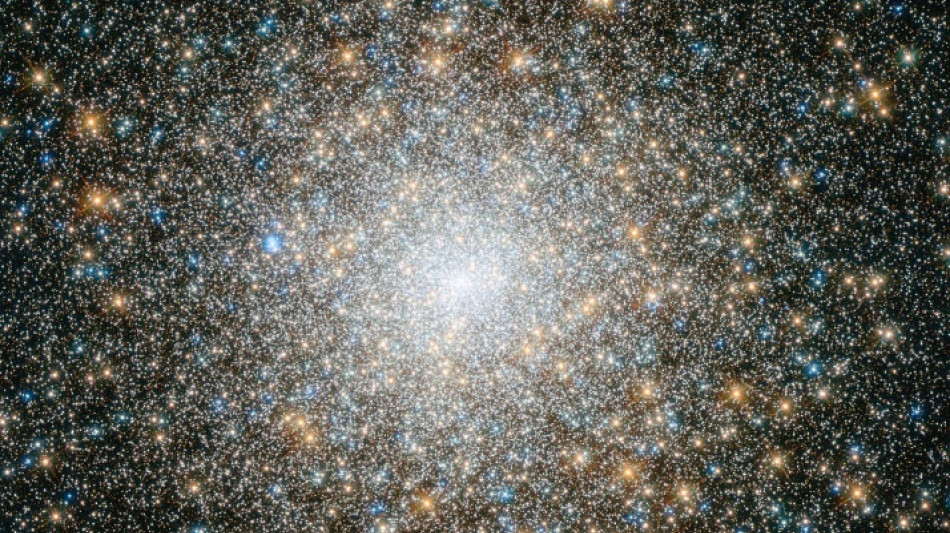
Webb spots giant star clusters shaping galaxy in early universe / Photo: - - ESA/HUBBLE/AFP/File

 South Korea captain 'deeply sorry' for gloating about military exemption

 Alcaraz through to Japan Open semis after Shapovalov injury

 Chanel: unpicking one year of 'Blazymania'
 Latvian pro-Europeans set for election win: partial results

 China swim sensation Yu Zidi, 13, says 'I'm no prodigy'

 Yu Zidi to Ohashi: Asian Games stars who can light up LA Olympics

 'Act before it's too late': Tokyo residents fight for more trees

 'Disappointing' as South Korea flag mishap sees Games end on sour note

 Pre-COP host Tuvalu at frontline of climate change

 Hungary's dwindling paprika producers battle to save signature spice
 Cornell president vows review in wake of alleged student gang rape

 Latvian partial election results suggest pro-European choice

 In Egypt's Sinai, Gazan builds school for children displaced by war

 Trump tariffs a mixed bag for US auto industry

 Yemen government forces say struck Houthi targets

 Music links past, present for Pedro Pascal's cellist in 'Behemoth!'

 ALEX BODI ȘI AMBASADORUL REPUBLICII SUDANUL DE SUD, GUM DOMINIC MATIOK, DISCUTĂ LA BERLIN DESPRE POSIBILITATEA ÎNFIINȚĂRII UNUI CONSULAT ONORIFIC LA BUCUREȘTI

 Dodgers step up World Series three-peat bid with 5-3 win over Braves

 Spain break down Czechs as England outclass Croatia in Nations League

 Yamal on target as Spain hold off Czech Republic

 Latvian exit polls suggest pro-European choice

 Lula, Bolsonaro wrap up campaigns ahead of knife-edge election

 Tuchel hails 'complete' England after Croatia demolition

 Fury to invite Trump to lead ring walk before Joshua showdown

 Fashion industry in 'precarious moment', says Vivienne Westwood supremo

The James Webb space telescope has discovered massive clusters of stars in the early universe so huge and densely packed that they influenced how their galaxy formed, astronomers said on Monday.
The five clumps of stars, known as globular proto-clusters, are the earliest ever observed, dating back to 460 million years after the Big Bang when the universe was three percent its current age.
They were spotted in the Cosmic Gems Arc, an infant galaxy discovered by the Hubble telescope in 2018.
Looking into space means looking back in time, and the galaxy exists in what is called the epoch of reionisation, when the first stars and galaxies emerged and lit up the universe.
It is difficult to see that far back, but the Webb telescope's ability to detect infrared wavelengths has allowed it peer farther back into this cosmic dawn than ever before.
The discovery of the five globular proto-clusters marks "the first time we have been able to observe this type of object at this distance," said Adelaide Claeyssens, a co-author of the new study in the journal Nature.
It should help scientists better understand the "formation of star clusters that we can see in the nearby universe -- which are now very old -- and their influence on the formation of galaxies," the Stockholm University astronomer told AFP.
- Black hole seeds? -
There is nothing like these clusters in the universe we see around us, said lead study author Angela Adamo, also from Stockholm University.
Our home galaxy, the Milky Way, is now home to around 170 globular clusters.
But there were once thousands of them, before they were broken up and scattered when the galaxy expanded, Adamo told AFP.
Those that did survive are relative lightweights, making up an "insignificant" mass compared to all the other stars in the galaxy.
However the five clusters in the Cosmic Gems Arc are true heavyweights, representing nearly a third of their galaxy's total mass.
The young stars are also packed closely together.
Imagine there were a million stars jammed into the four light years of space that separate the Sun and its nearest star Proxima Centauri, Adamo said.
A separate study recently suggested that stars near the heart of globular proto-clusters are up to 10,000 more massive than the Sun.
Adamo said that such huge stars produce immense amounts of radiation, which means they "shape how galaxies form stars" and how gas is distributed around the galaxies.
And at the end of their short and violent lives, some of these behemoth stars likely create black holes, she added.
Some could even become the seeds that grow into the supermassive black holes squatting at the centre of galaxies, Adamo speculated.
To find out more, the researchers want to study more globular proto-clusters near the cosmic dawn. The James Webb Space telescope will help in this hunt, Adamo said.
But it will be the European Southern Observatory's Extremely Large Telescope, expected to start scanning the skies in 2028, that will help scientists "understand the physical processes within this galaxy," Adamo said.
So we have to wait a few more years to find out more about what happened over 13.2 billion years ago.
E.Borba--PC



