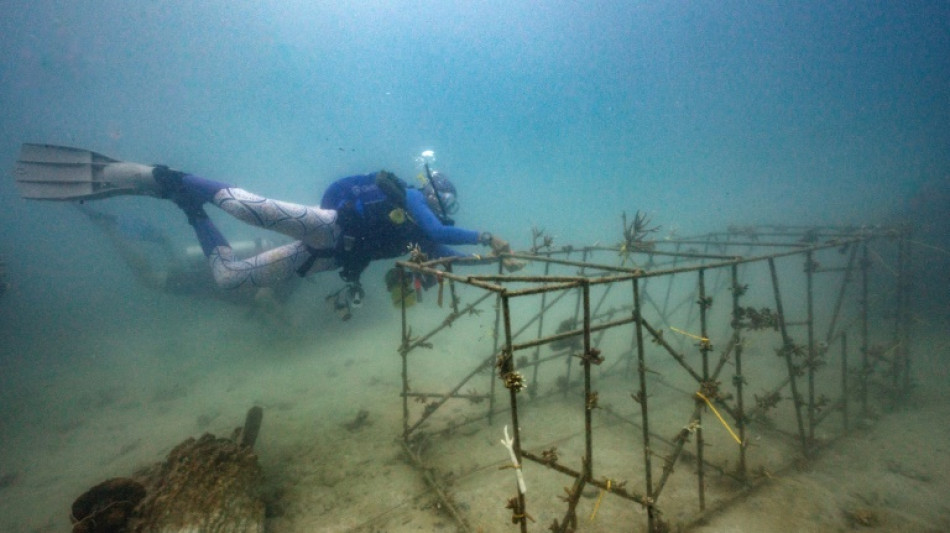
How restoration can help coral reefs / Photo: Lillian SUWANRUMPHA - AFP

 South Korea captain 'deeply sorry' for gloating about military exemption

 Alcaraz through to Japan Open semis after Shapovalov injury

 Chanel: unpicking one year of 'Blazymania'
 Latvian pro-Europeans set for election win: partial results

 China swim sensation Yu Zidi, 13, says 'I'm no prodigy'

 Yu Zidi to Ohashi: Asian Games stars who can light up LA Olympics

 'Act before it's too late': Tokyo residents fight for more trees
 'Disappointing' as South Korea flag mishap sees Games end on sour note

 Pre-COP host Tuvalu at frontline of climate change

 Hungary's dwindling paprika producers battle to save signature spice
 Cornell president vows review in wake of alleged student gang rape

 Latvian partial election results suggest pro-European choice

 In Egypt's Sinai, Gazan builds school for children displaced by war

 Trump tariffs a mixed bag for US auto industry

 Yemen government forces say struck Houthi targets

 Music links past, present for Pedro Pascal's cellist in 'Behemoth!'

 ALEX BODI ȘI AMBASADORUL REPUBLICII SUDANUL DE SUD, GUM DOMINIC MATIOK, DISCUTĂ LA BERLIN DESPRE POSIBILITATEA ÎNFIINȚĂRII UNUI CONSULAT ONORIFIC LA BUCUREȘTI

 Dodgers step up World Series three-peat bid with 5-3 win over Braves

 Spain break down Czechs as England outclass Croatia in Nations League

 Yamal on target as Spain hold off Czech Republic

 Latvian exit polls suggest pro-European choice

 Lula, Bolsonaro wrap up campaigns ahead of knife-edge election
 Tuchel hails 'complete' England after Croatia demolition

 Fury to invite Trump to lead ring walk before Joshua showdown

 Fashion industry in 'precarious moment', says Vivienne Westwood supremo

Record-high sea temperatures are bleaching coral reefs worldwide and putting a new focus on attempts to restore these key marine ecosystems.
Here is an overview of how coral restoration is being done around the world:
- How is coral sourced? -
Restoration begins with obtaining coral, sometimes by breaking it off from a healthy reef. These pieces can be broken into smaller bits in a process called microfragmentation.
Each piece can become a new coral.
Another option involves collecting "fragments of opportunity" -- coral pieces broken off by natural causes such as storms.
Conservationists can also propagate from egg bundles collected during reef spawning, though this is perhaps the most difficult approach.
Spawning is brief, generally happening just once a year, and is affected by many factors, including the lunar phase and water temperature.
- What happens next? -
Coral microfragments generally go into a "nursery" until they grow sturdy enough to be transplanted to an existing reef or an artificial structure.
Fragments of opportunity are treated similarly. If big enough, they can be transplanted directly to natural or artificial reefs.
Bundles of coral eggs and sperm collected during spawning will develop into larvae that can then be settled onto reefs or, more commonly, grown on artificial foundations before being transplanted to their final homes.
- What else is involved? -
Other techniques are used to bolster coral restoration, including mineral accretion technology.
This involves sending a low-voltage electrical current through seawater to encourage minerals to dissolve and crystallise on artificial reef structures, speeding up coral growth.
The technique has had mixed results, with some studies reporting better growth and more resilient corals, but others finding no significant benefits.
Other interventions include substrate stabilisation, which shores up reef foundations, and algae removal.
- What corals are used? -
Restoration projects heavily favour quick-growing branching corals.
The delicate branches of these corals are more susceptible to becoming fragments of opportunity, and are also easier to microfragment than massive or encrusting corals.
Their fast-growing nature gives restoration projects quicker results, though focusing on only one type of coral can reduce ecosystem diversity.
- Does it work? -
Coral restoration projects report survival rates of around 60-70 percent, according to a study published in 2020.
But around half the projects in the study failed to properly measure whether they achieved the goals stated at the outset, including reef function.
Monitoring was also often brief, at a median of just one year, far less than the time needed for a reef to form, according to the authors.
Still, the projects can produce real benefits.
A 2024 study of artificial reefs in Indonesia found that within four years the structures had a coral carbonate budget -- a measure of reef wellbeing -- that was nearly equal to nearby healthy natural reef.
- What are other considerations? -
Some experts worry that coral restoration is too often presented as panacea for reviving reefs, and point out that transplants will only survive if the surrounding conditions are right.
That means first addressing climate change, which causes the warm temperatures that lead to coral bleaching.
"Well-designed and managed restoration projects have an important role to play, but there is only so much they can do if radical action on the climate is not taken almost immediately," warned Lisa Bostrom-Einarsson, the marine ecologist who led the 2020 study.
And other stressors, from blast fishing to sedimentation, must also be tackled for reefs to have a future.
Reef restoration also rarely offers a one-for-one replacement of destroyed ecosystems.
The Indonesia reefs examined in the 2024 study are still largely made up of transplanted corals, with little sign yet that "natural recruits" are taking root and building reef diversity.
Building reefs through microfragmentation also limits genetic diversity and can put reefs at risk if disease takes hold.
Still, well-done restoration offers considerable benefits, including coastal protection and boosting marine life.
That also helps local communities dependent on fishing or tourism.
"Restoration will not save corals at the current rate we're losing them," said Gavin Miller, a marine scientist with the Global Reef organisation in Thailand.
"It's more about these localised impacts and the scale and the awareness that you can raise from there."
R.Veloso--PC



