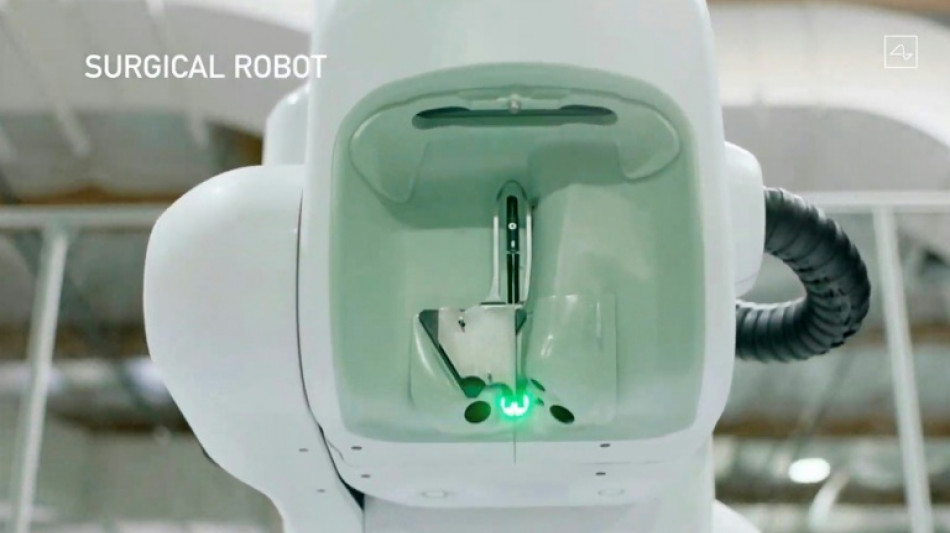
Musk's Neuralink eyes more test subjects for its brain tech / Photo: - - Neuralink/AFP/File

 South Korea captain 'deeply sorry' for gloating about military exemption
 Alcaraz through to Japan Open semis after Shapovalov injury
 Chanel: unpicking one year of 'Blazymania'

 Latvian pro-Europeans set for election win: partial results

 China swim sensation Yu Zidi, 13, says 'I'm no prodigy'

 Yu Zidi to Ohashi: Asian Games stars who can light up LA Olympics

 'Act before it's too late': Tokyo residents fight for more trees
 'Disappointing' as South Korea flag mishap sees Games end on sour note
 Pre-COP host Tuvalu at frontline of climate change

 Hungary's dwindling paprika producers battle to save signature spice

 Cornell president vows review in wake of alleged student gang rape

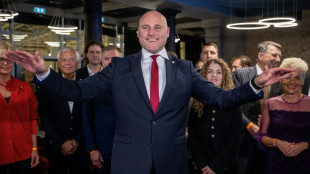 Latvian partial election results suggest pro-European choice

 In Egypt's Sinai, Gazan builds school for children displaced by war

 Trump tariffs a mixed bag for US auto industry

 Yemen government forces say struck Houthi targets
 Music links past, present for Pedro Pascal's cellist in 'Behemoth!'

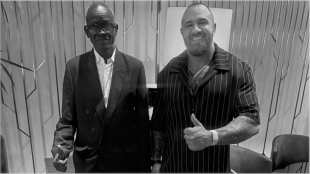
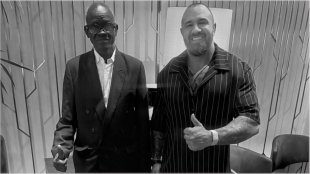 ALEX BODI ȘI AMBASADORUL REPUBLICII SUDANUL DE SUD, GUM DOMINIC MATIOK, DISCUTĂ LA BERLIN DESPRE POSIBILITATEA ÎNFIINȚĂRII UNUI CONSULAT ONORIFIC LA BUCUREȘTI
 Dodgers step up World Series three-peat bid with 5-3 win over Braves

 Spain break down Czechs as England outclass Croatia in Nations League

 Yamal on target as Spain hold off Czech Republic

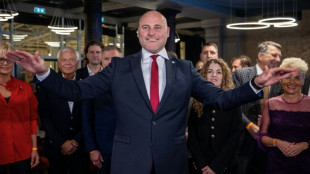 Latvian exit polls suggest pro-European choice

 Lula, Bolsonaro wrap up campaigns ahead of knife-edge election

 Tuchel hails 'complete' England after Croatia demolition
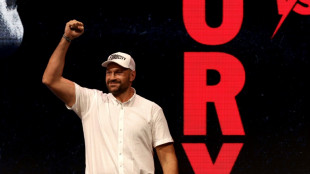 Fury to invite Trump to lead ring walk before Joshua showdown

 Fashion industry in 'precarious moment', says Vivienne Westwood supremo

Elon Musk on Wednesday said his Neuralink startup is "moving on" to a second test patient as its tech for linking brains and computers improves.
Musk and members of the Neuralink team fielded questions during an update streamed on X, formerly Twitter, discussing where it is on the path to making its brain implants commonplace.
"We're only just moving now to our second Neuralink patient," Musk said. "But we hope to have, if things go well, high single digits this year."
Musk's neurotechnology company in January installed a brain implant in Noland Arbaugh, which the billionaire head of Tesla and X touted as a success.
Arbaugh was left paralyzed from the shoulders down by a diving accident eight years ago.
Since the implant operation, he has told of playing chess and the video game "Civilization," as well as taking Japanese and French lessons by controlling a computer screen cursor with his brain.
Musk and members of the Neuralink team detailed fixing an issue that saw Arbaugh's ability to move a computer cursor with his mind greatly reduced.
Neuralink's technology works through a device about the size of five stacked coins that is placed inside the human brain by a robotic surgeon.
Threads connecting the implant to Arbaugh's brain had "retracted," becoming less effective at picking up signals.
Threads will be implanted deeper in the brain and at varying depths, with ramped-up precision to maximize effectiveness, according to the Neuralink team.
Musk promised "it's only going to get better from here."
One goal is to escalate the bandwidth of the link between the brain and computer, allowing more data to move faster, according to Musk.
"Quite important for human-AI symbiosis is just being able to communicate at a speed AI can follow," Musk said of brains being connected to computers with artificial intelligence.
Musk envisions Neuralink implants going beyond restoring sight to the blind to giving people infrared or ultraviolet vision or letting them share concepts with others telepathically.
"We want to give people superpowers," Musk said. "Not just that we're restoring your prior functionality, but that you actually have functionality far greater than a normal human."
Musk spoke of developing an automated process in which Neuralink's surgery robot could quickly install custom implants in people seeking "upgrades."
"It's very sort of 'Cyberpunk' or 'Deus Ex,' if you play those games," Musk said of the idea.
"An exciting possibility long term also is to take parts of the Optimus humanoid robot and combine that with a Neuralink - you could have basically cybernetic superpowers," he said.
Musk cofounded Neuralink in 2016.
The ambition is to supercharge human capabilities, treat neurological disorders like ALS or Parkinson's, and maybe one day achieve a symbiotic relationship between humans and AI.
Musk is not alone in trying to make advances in the field, which is officially known as brain-machine or brain-computer interface research.
V.Dantas--PC



