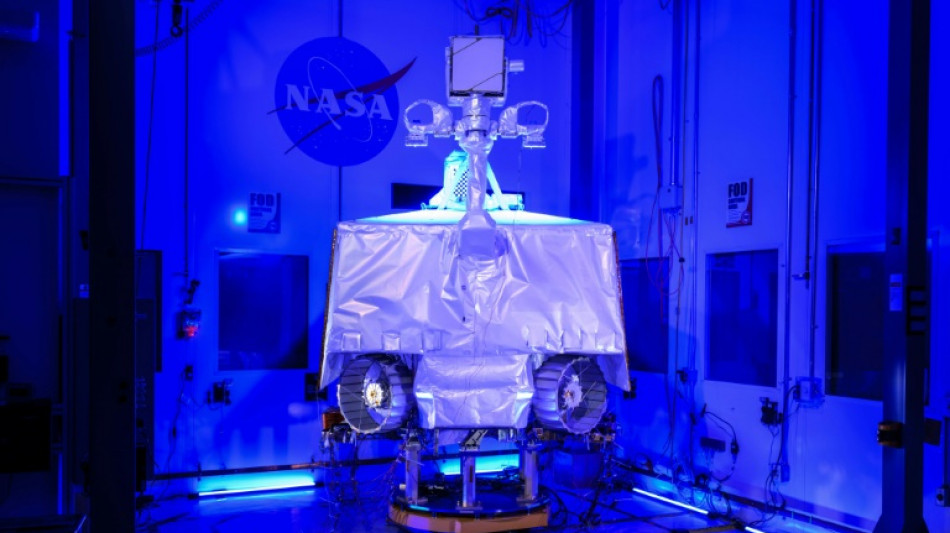
NASA cans lunar rover after spending $450 million building it / Photo: Handout - NASA/AFP

 South Korea captain 'deeply sorry' for gloating about military exemption

 Alcaraz through to Japan Open semis after Shapovalov injury

 Chanel: unpicking one year of 'Blazymania'

 Latvian pro-Europeans set for election win: partial results

 China swim sensation Yu Zidi, 13, says 'I'm no prodigy'

 Yu Zidi to Ohashi: Asian Games stars who can light up LA Olympics

 'Act before it's too late': Tokyo residents fight for more trees

 'Disappointing' as South Korea flag mishap sees Games end on sour note

 Pre-COP host Tuvalu at frontline of climate change

 Hungary's dwindling paprika producers battle to save signature spice

 Cornell president vows review in wake of alleged student gang rape

 Latvian partial election results suggest pro-European choice

 In Egypt's Sinai, Gazan builds school for children displaced by war

 Trump tariffs a mixed bag for US auto industry

 Yemen government forces say struck Houthi targets

 Music links past, present for Pedro Pascal's cellist in 'Behemoth!'

 ALEX BODI ȘI AMBASADORUL REPUBLICII SUDANUL DE SUD, GUM DOMINIC MATIOK, DISCUTĂ LA BERLIN DESPRE POSIBILITATEA ÎNFIINȚĂRII UNUI CONSULAT ONORIFIC LA BUCUREȘTI

 Dodgers step up World Series three-peat bid with 5-3 win over Braves

 Spain break down Czechs as England outclass Croatia in Nations League

 Yamal on target as Spain hold off Czech Republic

 Latvian exit polls suggest pro-European choice

 Lula, Bolsonaro wrap up campaigns ahead of knife-edge election

 Tuchel hails 'complete' England after Croatia demolition

 Fury to invite Trump to lead ring walk before Joshua showdown

 Fashion industry in 'precarious moment', says Vivienne Westwood supremo

NASA announced Wednesday that cost overruns and delays have forced it to cancel a planned Moon rover it already spent $450 million to develop, marking a significant setback for the agency's lunar exploration program.
The Volatiles Investigating Polar Exploration Rover (VIPER) was intended to explore the lunar south pole in search of ice and other resources, paving the way for planned crewed missions by American astronauts under the Artemis program later this decade.
"Decisions like this are never easy," said Nicky Fox, NASA's associate administrator of the science mission directorate.
"But in this case, the projected remaining expenses for VIPER would have resulted in having to either cancel or disrupt many other missions."
The mobile robot, which NASA had hoped would venture into the Moon's permanently shadowed craters, where ice reserves have endured for billions of years, was originally planned to launch in 2023.
But in 2022, the US space agency requested a launch delay to late 2024 to allow more time for preflight testing of the Griffin lander vehicle, supplied by the Pittsburgh-based company Astrobotic under the new Commercial Lunar Payload Services (CLPS) program, a public-private venture.
The launch readiness date of the rover then slipped back further to September 2025, while the cost was projected to rise to $609.6 million.
Joel Kearns, deputy associate administrator for exploration in NASA's science mission directorate, added that Congress had been notified of the agency's decision.
The rover was "completely assembled" but had not yet undergone certain tests that would certify it could withstand launch, flying through the vacuum of space, and experiencing extreme temperatures, said Kearns.
But it was still possible the rover could be re-used in future missions, either in whole or in component parts, if NASA could reach a suitable agreement with industry partners who might be interested, he said.
Astrobotic, which in January launched the Peregrine lander that failed to reach the Moon, is still on track to launch in late 2025, but it will now carry a "mass simulator" or heavy weight in place of a NASA rover.
Kearns insisted that despite the setback, the United States was not falling behind in its space rivalry with China, which in June succeeded in returning the first ever samples from the far side of the Moon.
"We congratulate China's national space agency for the seemingly very successful Chang'e-6 mission," he said.
But he added that, by partnering with the space industry under the CLPS program, "we think that we're going to have a more robust science program and a more robust lunar landing capability in the United States."
P.Sousa--PC