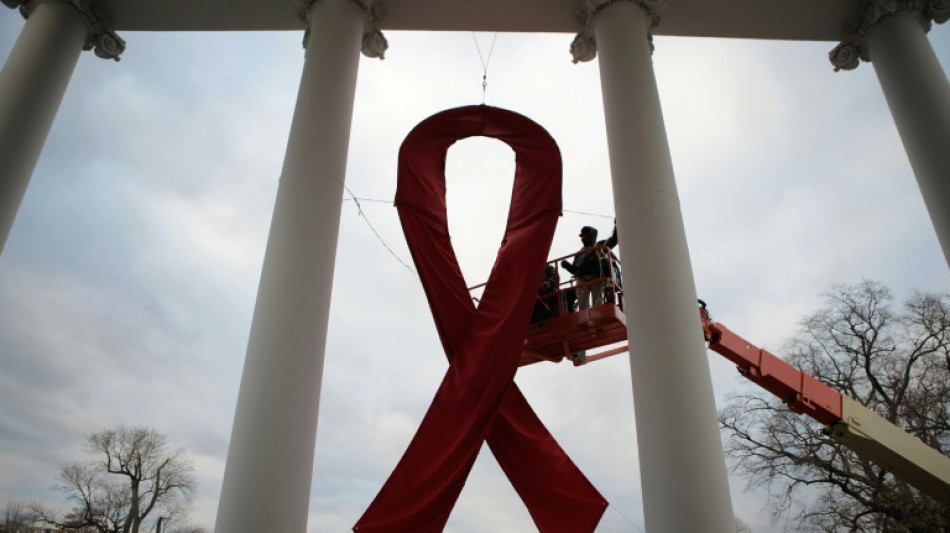
Seventh person likely 'cured' of HIV, doctors announce / Photo: CHIP SOMODEVILLA - GETTY IMAGES NORTH AMERICA/AFP/File

 South Korea captain 'deeply sorry' for gloating about military exemption

 Alcaraz through to Japan Open semis after Shapovalov injury

 Chanel: unpicking one year of 'Blazymania'

 Latvian pro-Europeans set for election win: partial results

 China swim sensation Yu Zidi, 13, says 'I'm no prodigy'

 Yu Zidi to Ohashi: Asian Games stars who can light up LA Olympics

 'Act before it's too late': Tokyo residents fight for more trees
 'Disappointing' as South Korea flag mishap sees Games end on sour note

 Pre-COP host Tuvalu at frontline of climate change

 Hungary's dwindling paprika producers battle to save signature spice

 Cornell president vows review in wake of alleged student gang rape

 Latvian partial election results suggest pro-European choice

 In Egypt's Sinai, Gazan builds school for children displaced by war

 Trump tariffs a mixed bag for US auto industry

 Yemen government forces say struck Houthi targets

 Music links past, present for Pedro Pascal's cellist in 'Behemoth!'

 ALEX BODI ȘI AMBASADORUL REPUBLICII SUDANUL DE SUD, GUM DOMINIC MATIOK, DISCUTĂ LA BERLIN DESPRE POSIBILITATEA ÎNFIINȚĂRII UNUI CONSULAT ONORIFIC LA BUCUREȘTI

 Dodgers step up World Series three-peat bid with 5-3 win over Braves

 Spain break down Czechs as England outclass Croatia in Nations League

 Yamal on target as Spain hold off Czech Republic

 Latvian exit polls suggest pro-European choice

 Lula, Bolsonaro wrap up campaigns ahead of knife-edge election

 Tuchel hails 'complete' England after Croatia demolition

 Fury to invite Trump to lead ring walk before Joshua showdown

 Fashion industry in 'precarious moment', says Vivienne Westwood supremo

A 60-year-old German man is likely the seventh person to be effectively cured from HIV after receiving a stem cell transplant, doctors announced on Thursday.
The painful and risky procedure is for people who have both HIV and aggressive leukaemia, so is not an option for almost all of the nearly 40 million people living with the deadly virus across the world.
The German man, whose wished to remain anonymous, was dubbed the "next Berlin patient".
The original Berlin patient, Timothy Ray Brown, was the first person declared cured of HIV back in 2008. Brown died from cancer in 2020.
The second man from Berlin to achieve long-term HIV remission was announced ahead of the 25th International AIDS Conference being held in the German city of Munich next week.
He was first diagnosed with HIV in 2009, according to the research abstract being presented at the conference.
The man received a bone marrow transplant for his leukaemia in 2015. The procedure, which has a 10 percent risk of death, essentially replaces a person's immune system.
Then he stopped taking anti-retroviral drugs -- which reduce the amount of HIV in the blood -- in late 2018.
Nearly six years later, he appears to be both HIV and cancer free, the medical researchers said.
Christian Gaebler, a doctor-researcher at Berlin's Charite university hospital treating the patient, told AFP that the team cannot be "absolutely certain" every last trace of HIV has been eradicated.
But "the patient's case is highly suggestive of an HIV cure," Gaebler added. "He feels well and is enthusiastic about contributing to our research efforts."
- 'Promising' for wider cure -
International AIDS Society President Sharon Lewin said researchers hesitate to use the word "cure" because it is not clear how long they need to follow up such cases.
But more than five years in remission means the man "would be close" to being considered cured, she told a press conference.
There is an important difference between the man's case and the other HIV patients who have reached long-term remission, she said.
All but one of the other patients received stem cells from donors with a rare mutation in which part of their CCR5 gene was missing, blocking HIV from entering their body's cells.
Those donors had inherited two copies of the mutated CCR5 gene -- one from each parent -- making them "essentially immune" to HIV, Lewin said.
But the new Berlin patient is the first to have received stem cells from a donor who had inherited only one copy of the mutated gene.
Around 15 percent of people from European origin have one mutated copy, compared to one percent for both.
Researchers hope the latest success means there will be a much larger potential donor pool in the future.
The new case is also "promising" for the wider search for an HIV cure that works for all patients, Lewin said.
This is "because it suggests that you don't actually have to get rid of every single piece of CCR5 for gene therapy to work," she added.
The Geneva patient, whose case was announced at last year's AIDS conference, is the other exception among the seven. He received a transplant from a donor without any CCR5 mutations -- yet still achieved long-term remission.
This showed that the effectiveness of the procedure was not just down to the CCR5 gene, Lewin said.
A.Magalhes--PC



