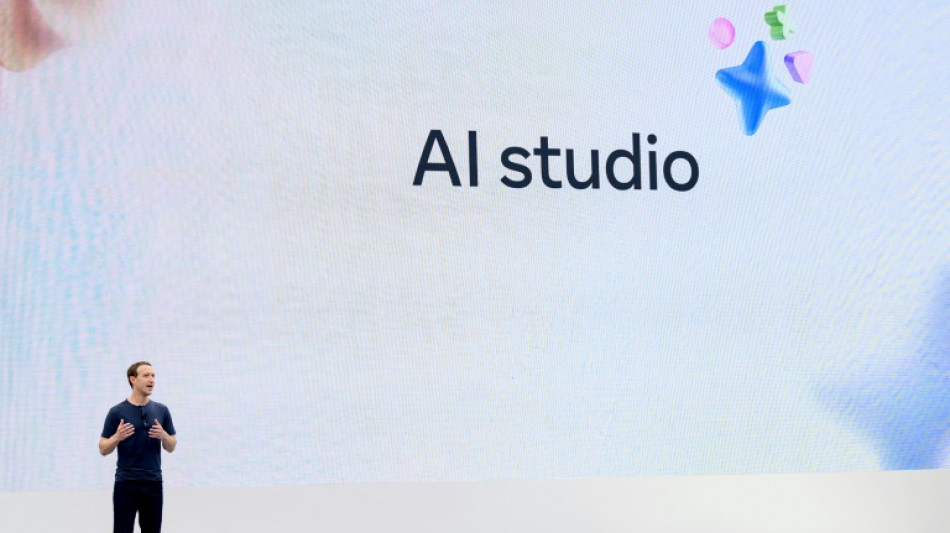
Mark Zuckerberg, AI's 'open source' evangelist / Photo: JOSH EDELSON - AFP

 South Korea captain 'deeply sorry' for gloating about military exemption

 Alcaraz through to Japan Open semis after Shapovalov injury

 Chanel: unpicking one year of 'Blazymania'

 Latvian pro-Europeans set for election win: partial results

 China swim sensation Yu Zidi, 13, says 'I'm no prodigy'

 Yu Zidi to Ohashi: Asian Games stars who can light up LA Olympics

 'Act before it's too late': Tokyo residents fight for more trees

 'Disappointing' as South Korea flag mishap sees Games end on sour note

 Pre-COP host Tuvalu at frontline of climate change

 Hungary's dwindling paprika producers battle to save signature spice

 Cornell president vows review in wake of alleged student gang rape

 Latvian partial election results suggest pro-European choice

 In Egypt's Sinai, Gazan builds school for children displaced by war

 Trump tariffs a mixed bag for US auto industry

 Yemen government forces say struck Houthi targets

 Music links past, present for Pedro Pascal's cellist in 'Behemoth!'

 ALEX BODI ȘI AMBASADORUL REPUBLICII SUDANUL DE SUD, GUM DOMINIC MATIOK, DISCUTĂ LA BERLIN DESPRE POSIBILITATEA ÎNFIINȚĂRII UNUI CONSULAT ONORIFIC LA BUCUREȘTI

 Dodgers step up World Series three-peat bid with 5-3 win over Braves

 Spain break down Czechs as England outclass Croatia in Nations League

 Yamal on target as Spain hold off Czech Republic

 Latvian exit polls suggest pro-European choice

 Lula, Bolsonaro wrap up campaigns ahead of knife-edge election

 Tuchel hails 'complete' England after Croatia demolition

 Fury to invite Trump to lead ring walk before Joshua showdown

 Fashion industry in 'precarious moment', says Vivienne Westwood supremo

Mark Zuckerberg, the founder of Facebook and CEO of Meta, has become an unexpected evangelist for open source technology when it comes to developing artificial intelligence, pitting him against OpenAI and Google.
The 40-year-old tech tycoon laid out his vision in an open letter titled "Open Source AI is the Path Forward" this week. Here is what you need to know about the open versus closed model AI debate.
What is 'open source'?
The history of computer technology has long pitted open source aficionados against companies clinging to their intellectual property.
"Open source" refers to software development where the program code is made freely available to the public, allowing developers to tinker and build on it as they wish.
Many of the internet's foundational technologies, such as the Linux operating system and the Apache web server, are products of open source development.
However, open source is not without challenges. Maintaining large projects, ensuring consistent quality, and managing a wide range of contributors can be complex.
Finally, almost by definition, keeping open source projects financially sustainable is a challenge.
Why is Meta AI 'open source'?
Zuckerberg is probably the last person you would expect to embrace open source.
The company maintains total control over its Instagram and Facebook platforms, leaving little to no leeway for outside developers or researchers to tinker around.
The Cambridge Analytica scandal, in which an outside vendor was revealed in 2018 to be using the platform to gather user information for nefarious practices, only made the company more protective.
Meta's sudden embrace of the open source ethos is driven by its bitterness towards Apple, whose iPhone rules keep a tight control on what Meta and all outside apps can do on their devices.
"One of my formative experiences has been building our services constrained by what Apple will let us build on their platforms," Zuckerberg said.
“Between the way they tax developers, the arbitrary rules they apply, and all the product innovations they block from shipping, it's clear that Meta and many other companies would be freed up if...competitors were not able to constrain what we could build,” he wrote.
That concern has now spread to generative AI, but this time it is Microsoft-backed OpenAI and Google that are the closed-fence culprits that charge developers and keep a tight lid on their AI technology.
Doubters argue that Meta is embracing open source because it came late to the AI party, and is seeking to blow open the field with free access to a powerful model.
- What is Llama? -
Meta's open source LLaMA 3.1 (for Large Language Model Meta AI) is the company’s latest version of its generative AI technology that can spew out human standard content in just seconds.
Performance-wise, it can be compared to OpenAI’s GPT-4 or Google’s Gemini, and like those models is "trained" before deployment by ingesting data from the internet.
But unlike those models, developers can access the technology for free, and make adaptations as they see fit for their specific use cases.
Meta says that LLaMA 3.1 is as good as the best models out there, but unlike its main rivals, it only deals with text, with the company saying it will later match the others with images, audio and video.
- Security threat -
In the rivalry over generative AI, defenders of the closed model argue that the Meta way is dangerous, as it allows bad actors to weaponize the powerful technology.
In Washington, lobbyists argue over the distinction, with opponents to open source insisting that models like Llama can be weaponized by countries like China.
Meta argues that transparency assures a more level playing field and that a world of closed models will ensure that only a few big companies, and a powerhouse nation like China, will be in control.
Startups, universities, and small businesses will "miss out on opportunities," Zuckerberg said.
C.Amaral--PC



