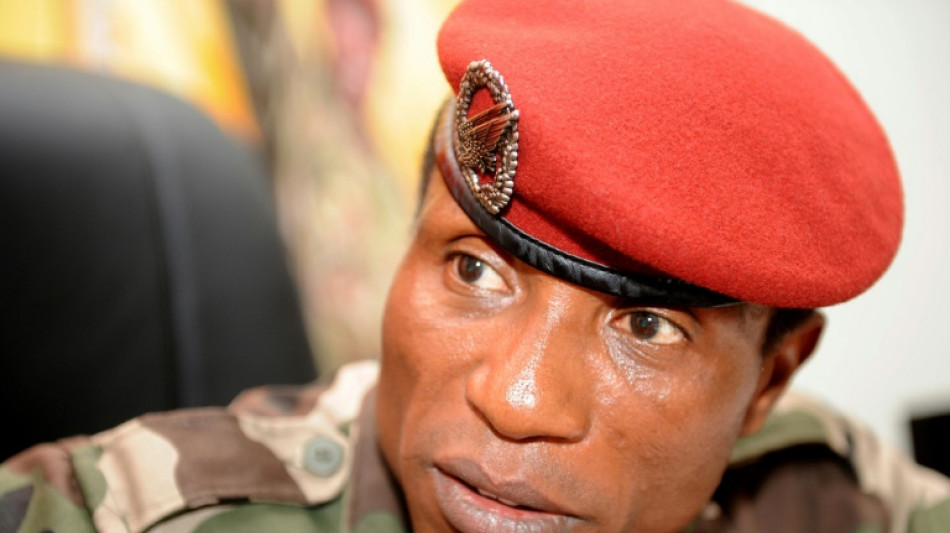
The bloodied trajectory of Guinean ex-dictator Dadis Camara / Photo: SEYLLOU DIALLO - AFP/File

 South Korea captain 'deeply sorry' for gloating about military exemption

 Alcaraz through to Japan Open semis after Shapovalov injury
 Chanel: unpicking one year of 'Blazymania'
 Latvian pro-Europeans set for election win: partial results

 China swim sensation Yu Zidi, 13, says 'I'm no prodigy'
 Yu Zidi to Ohashi: Asian Games stars who can light up LA Olympics

 'Act before it's too late': Tokyo residents fight for more trees
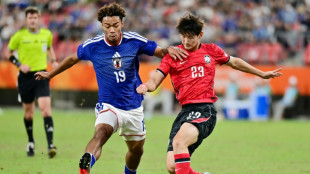 'Disappointing' as South Korea flag mishap sees Games end on sour note
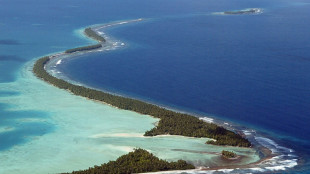 Pre-COP host Tuvalu at frontline of climate change
 Hungary's dwindling paprika producers battle to save signature spice

 Cornell president vows review in wake of alleged student gang rape
 Latvian partial election results suggest pro-European choice

 In Egypt's Sinai, Gazan builds school for children displaced by war
 Trump tariffs a mixed bag for US auto industry
 Yemen government forces say struck Houthi targets
 Music links past, present for Pedro Pascal's cellist in 'Behemoth!'

 ALEX BODI ȘI AMBASADORUL REPUBLICII SUDANUL DE SUD, GUM DOMINIC MATIOK, DISCUTĂ LA BERLIN DESPRE POSIBILITATEA ÎNFIINȚĂRII UNUI CONSULAT ONORIFIC LA BUCUREȘTI
 Dodgers step up World Series three-peat bid with 5-3 win over Braves

 Spain break down Czechs as England outclass Croatia in Nations League
 Yamal on target as Spain hold off Czech Republic

 Latvian exit polls suggest pro-European choice

 Lula, Bolsonaro wrap up campaigns ahead of knife-edge election

 Tuchel hails 'complete' England after Croatia demolition

 Fury to invite Trump to lead ring walk before Joshua showdown

 Fashion industry in 'precarious moment', says Vivienne Westwood supremo

Moussa Dadis Camara once described himself as the "little captain who became president by destiny" but is associated with one of the darkest periods in Guinea's history.
Known during his rule for his absurd television performances in which he would humiliate stooges, the once-obscure officer who became an incongruous head of state is now a convicted criminal, 59, and faces 20 years in jail.
On September 28, 2009 and in the following days, the Red Berets of his presidential guard as well as soldiers, police and militiamen assassinated 156 people who had gathered in and around a stadium for an opposition rally ahead of an upcoming presidential election.
At least 109 women were raped.
Dadis Camara, then a military captain, had seized power with a group of officers in December 2008 immediately after the death of Lansana Conte, Guinea's second post-independence president who had ruled autocratically for 24 years.
He described the takeover as bloodless and emerged as head of a ruling junta, justifying his power grab by claiming no civilian could manage a country marked by corruption and instability since independence from France in 1958.
"I am the father of the nation," he declared in 2009, asserting on several occasions that he had been "chosen by God, who confers power on whomever He wishes".
The ex-dictator remained motionless as the verdict was read out on Wednesday at the Conakry Court, where he was sentenced for crimes against humanity, after the landmark trial. Seven other defendants were handed sentences of up to life imprisonment.
- The 'Dadis Show' -
Dadis Camara's rollercoaster life journey saw him rise from humble beginnings as a low-ranking officer born in a remote corner of southeastern Guinea, far from the centre of political power in Conakry.
He said his illiterate father was a simple peasant.
"I'm a man of the people... I was born in a hut," he once said.
He is known to have joined the armed forces in 1990 and to have served mainly in the army's fuel supply department.
In 2007 he was among army officers who took part in a wave of unrest against the regime of veteran president Conte, aimed notably at gaining payment of salary arrears.
His popular rhetoric earned him the support of many Guineans at the start of his presidency as he often highlighted his modest origins.
Then-Senegalese president Abdoulaye Wade said Dadis Camara gave him the impression of being a "pure young person who wants to do well".
In his frequent appearances on national television, which became known as the "Dadis Show", he would rail against fellow officers, accusing them of systematic corruption.
But he soon showed signs of letting his power go to his head, becoming increasingly erratic and reneging on a promise not to run in a presidential election the junta promised to hold in 2010.
- 'Napoleon' -
That led to the fateful day in Conakry's sports stadium in September 2009, where a large crowd of opposition supporters were attending a rally against Dadis Camara as a potential election candidate.
After the event, which turned most Guineans against him, Dadis Camara expressed little remorse, stating that his army was "uncontrollable", but that it also had "feelings and respect" for him.
He was unceremoniously ousted from power after suffering a head wound in an attempted assassination by his aide de camp in December 2009, formally giving up power in January 2010.
He received treatment in Morocco before fleeing into exile in Burkina Faso, where he converted to Christianity.
After announcing his intention to run for president in 2015, he was indicted in July 2015 by Guinean magistrates for his role in the stadium massacre.
He finally returned to his homeland in September 2022 for his trial, the once mighty head of state humbled by the experience of imprisonment.
In his winding testimony referencing philosophers Heraclitus and Immanuel Kant, Egyptian pharaohs, Napoleon and the memory of his father, Dadis Camara denied any responsibility.
"Many may think, 'Ah, Dadis Camara is crazy'", he said.
"Dadis Camara is not crazy -- Dadis Camara is generous because Dadis Camara recognises his ancestors."
C.Amaral--PC



