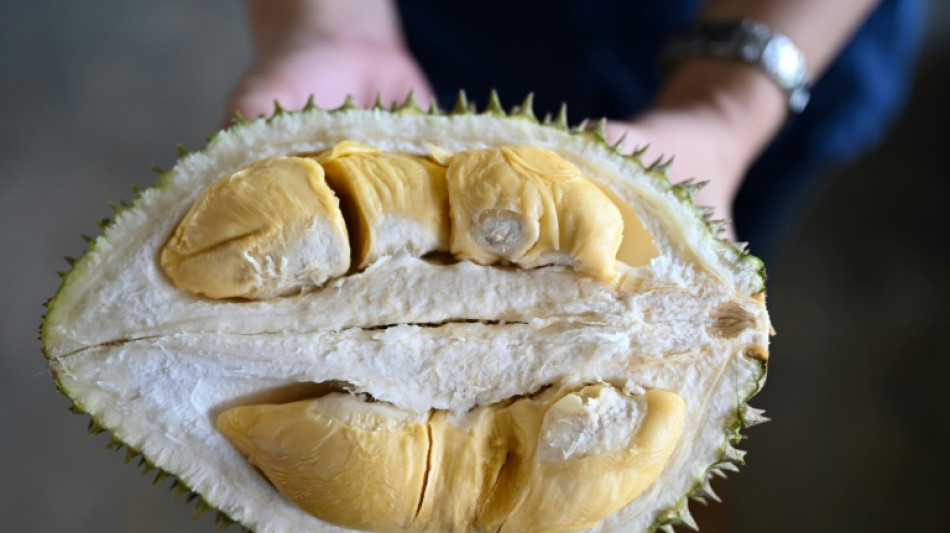
From drones to sensors, Malaysian durian grower goes high-tech / Photo: Mohd RASFAN - AFP

 US regulator finds Boeing 737 MAX software bug 'not a safety concern'

 Ohtani 'managing' injuries as Dodgers launch MLB post-season

 Botched US execution leaves murderer unconscious on ventilator: lawyers

 Cornell rape case exposes sexual violence at US colleges

 France held by Italy in Zidane's homecoming after Olise stunner

 Ethiopian pro-government militia claims Tigray airport as regional tensions spike

 Ohtani shaking off injuries as Dodgers launch MLB post-season

 Sea levels to rise in California as coastal wave surges up west coast

 New rallies urged in France as protests disrupt over 730 schools

 Djokovic survives China Open scare, Sabalenka starts strong

 King Charles to evoke colonial 'darkest days' on Caribbean tour

 Tesla shares jump after global car sales top estimates

 DR Congo Ebola outbreak killed more than 4,000: official figures

 Djokovic survives China Open scare against wildcard world no. 104

 Lula, Bolsonaro trade blows in final scramble for votes in Brazil

 New clashes erupt as protests disrupt over 560 French schools

 NY governor vows to close loophole after alleged Cornell gang rape

 Ethiopia Tigray rebels pushed back as regional tensions spike

 Stocks rise, yields fall as US job numbers disappoint
 Man City verdict a 'big topic' for England players, says Tuchel

 NY attorney general tasked with investigating alleged Cornell gang rape

 China widens military footprint with Laos air base

 G7 talks as US pressures Europe over diesel stocks

 Man City launch appeal against explosive financial ruling

 Swiss president to quit government
Drones spraying pesticide, sensors taking soil readings, sprinklers that squirt fertiliser at the touch of a button -- a Malaysian plantation is using high-tech methods to boost its crop of pungent durians.
Grown across Southeast Asia, fans hail the spiky durian as the "king of fruit" due to its bittersweet flavours and creamy golden flesh, and it is particularly popular in China.
But to its detractors it is the world's smelliest fruit, with an overpowering stench like rotting food that has seen it banned in hotels and on public transport across the region.
In a competitive market, Malaysian grower Top Fruits Plantations has turned to high-tech methods to lift its output.
"It's a much faster way to get more consistent results," managing director Tan Sue Sian told AFP during a recent tour of one of the company's plantations in Batu Pahat, southern Johor state.
Using technology allows farmers to gauge more precisely how much fertiliser and water the trees need, he said.
"When you give what is needed, the fruit will be much more consistent. The shape will be better, and the aroma will be better," added Tan, who has more than 30 years' experience growing durians.
- Sensors essential -
Key in the drive are sensors spread across 400 acres (160 hectares) of Top Fruits' 700-acre Batu Pahat plantation, relaying data on soil quality and content to workers' handheld devices.
The sensors are boxes mounted on poles, connected to the soil with a series of cables. By 2024, the entire plantation should be kitted out with them.
Sprinklers attached to a network of pipes are remotely activated to spray fertiliser onto the trees, while drones hover over the plantation squirting pesticide.
Such methods are unheard of on Malaysian durian farms, where growers typically rely on a large labour force, instinct and educated guesses.
The investment has been hefty -- Top Fruits has spent about four million ringgit ($900,000) over the past three years on the technology.
But it has led to an increase in yields of 40 percent, while its workforce has shrunk by 30 percent.
The company is now able to produce 800 tonnes of durians from its farms every year, with more than 80 per cent of its crop frozen in factories to be exported overseas, much of it to China.
In a bid to further boost their crop, Top Fruits is getting into research by setting up a lab and collaborating with local universities.
E.Raimundo--PC



