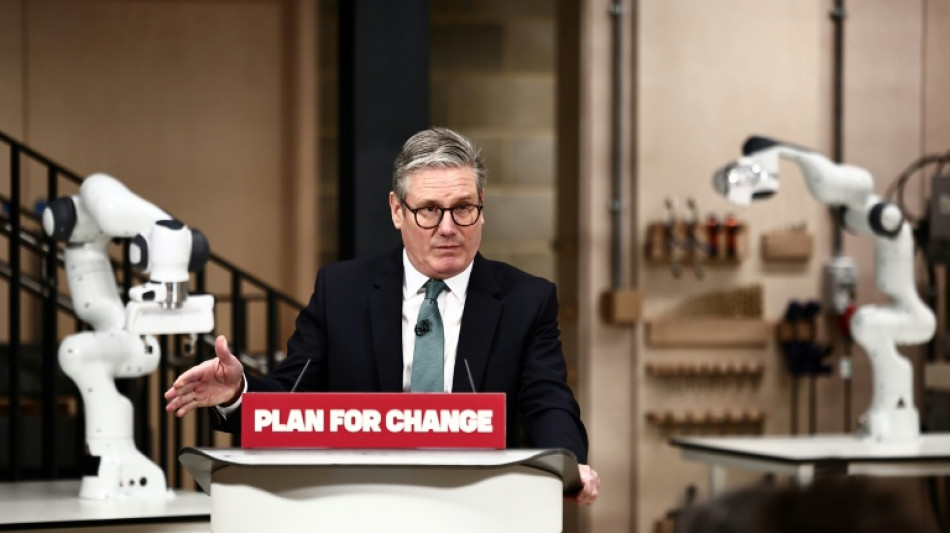
PM vows 'pro-growth' rules to make Britain an 'AI superpower' / Photo: HENRY NICHOLLS - POOL/AFP

 'Act before it's too late': Tokyo residents fight for more trees

 'Disappointing' as South Korea flag mishap sees Games end on sour note

 Pre-COP host Tuvalu at frontline of climate change

 Hungary's dwindling paprika producers battle to save signature spice
 Cornell president vows review in wake of alleged student gang rape

 Latvian partial election results suggest pro-European choice

 In Egypt's Sinai, Gazan builds school for children displaced by war

 Trump tariffs a mixed bag for US auto industry

 Yemen government forces say struck Houthi targets

 Music links past, present for Pedro Pascal's cellist in 'Behemoth!'

 ALEX BODI ȘI AMBASADORUL REPUBLICII SUDANUL DE SUD, GUM DOMINIC MATIOK, DISCUTĂ LA BERLIN DESPRE POSIBILITATEA ÎNFIINȚĂRII UNUI CONSULAT ONORIFIC LA BUCUREȘTI

 Dodgers step up World Series three-peat bid with 5-3 win over Braves

 Spain break down Czechs as England outclass Croatia in Nations League

 Yamal on target as Spain hold off Czech Republic

 Latvian exit polls suggest pro-European choice

 Lula, Bolsonaro wrap up campaigns ahead of knife-edge election

 Tuchel hails 'complete' England after Croatia demolition

 Fury to invite Trump to lead ring walk before Joshua showdown

 Fashion industry in 'precarious moment', says Vivienne Westwood supremo

 Seventh heaven for England in Nations League rout of Croatia

 Storms, flooding cause chaos on Greek holiday island of Crete

 #IAmJaneDoe: online support campaign in US university rape case

 Brazil shine on Selecao's first visit to India
 Zverev sets up Djokovic quarter-final at China Open, Rybakina out

 Happier at home, Bordeaux hammer Lyon in Top 14

Prime Minister Keir Starmer on Monday laid out his vision to harness the power of artificial intelligence to boost Britain's flagging economy, promising "pro-growth" regulations amid concerns about the technology's unchecked use.
Speaking following the launch of a government "action plan", Starmer pledged to ease red tape to attract billions of pounds of AI investment to Britain.
The "AI Opportunities Action Plan" includes 50 recommendations that the government will implement to boost AI-driven efficiency in the public sector, from education and healthcare to detecting potholes.
"Mark my words, Britain will be one of the great AI superpowers," Starmer said at an event at the UCL campus in east London, hailing the technology which is raising complex questions for governments around the world.
The UK -- which has the third-largest AI industry after the United States and China -- will be "pro-growth and pro-innovation on regulation", Starmer said.
"I think it is important to recognise that we've got freedom now in relation to regulation, to do it in the way that we think is best for the UK," said Starmer, calling for AI to be "tested" before it is "regulated".
"We don't need to walk down a US or an EU path on AI regulation", the prime minister wrote in the Financial Times ahead of the speech, calling for a "distinctively British approach".
Starmer's position marks a shift from the EU's heavy-handed regulation of the sector, especially regarding data protection laws, which has faced criticism from tech giants.
In the US, incoming President Donald Trump's desire to deregulate the economy and his team of Silicon Valley-linked advisors could influence policies on AI regulation.
- Data library -
The UK's latest plans include the creation of a national data library which would make public data sets, including anonymised National Health Service records, "available to AI researchers and innovators".
The data library would be bolstered by a "clear and trusted copyright regime", Starmer added. "It is important that we keep control of that data."
"But I don't think that we should have a defensive stance here that will inhibit the sort of breakthroughs that we need."
The latest plans come amid concerns surrounding AI's role in spreading online misinformation and deepfake pornography, as well as fears robots could one day outsmart humans if left unchecked.
The government outlined plans for the creation of "dedicated AI growth zones" designed to speed up planning proposals for data centres and other AI infrastructure.
It also hopes to increase server capacity twentyfold by 2030, including by building "a brand new supercomputer with enough AI power to play itself at chess half a million times a second".
The new supercomputer pledge comes months after Starmer axed a previous supercomputer project in Edinburgh planned by the previous government, citing a lack of funds.
- 'Economic mismanagement' -
Starmer's administration estimated that AI could be worth £47 billion ($57 billion) to the UK each year over a decade.
It announced that three tech companies -- Vantage Data Centres, Nscale and Kyndryl -- had committed to spending £14 billion on AI in the UK, leading to the creation of more than 13,000 jobs.
Starmer has put firing up Britain's economy at the heart of his agenda since taking office last July. In his speech, Starmer staked economic growth on advancements in AI, saying the technology "would turbocharge every single element of our plan for change".
But weaker-than-expected growth, rising borrowing costs and a falling pound is complicating his task, meaning he could be forced to make spending cuts or hike taxes this year.
Shadow Science Secretary Alan Mak accused Labour of insufficiently funding its AI ambitions.
"AI does have the potential to transform public services, but Labour's economic mismanagement and uninspiring plan will mean Britain is left behind," Mak said.
There are also concerns that the sector-wide implementation of AI could result in job losses.
"It's a disruptive technology, like many other previous technological waves," senior cabinet minister Pat McFadden told Times Radio.
"But I think it's too pessimistic to simply talk about job losses," he added.
The government is expected to wrap up next month a consultation to clarify the application of copyright law to AI, which it says aims to protect the creative industry.
X.M.Francisco--PC



