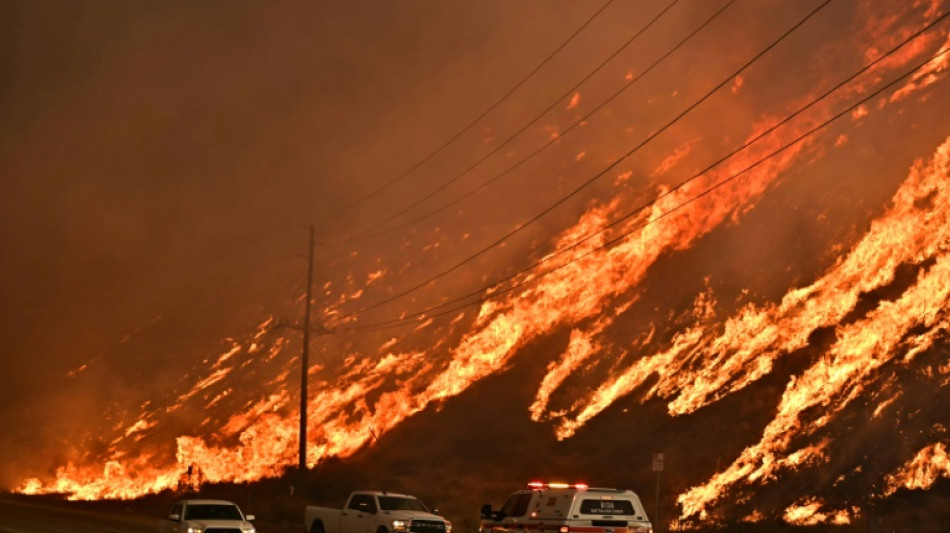
The pioneering science linking climate to weather disasters / Photo: Frederic J. Brown - AFP

 Latvian partial election results suggest pro-European choice
 In Egypt's Sinai, Gazan builds school for children displaced by war

 Trump tariffs a mixed bag for US auto industry

 Yemen government forces say struck Houthi targets

 Music links past, present for Pedro Pascal's cellist in 'Behemoth!'

 ALEX BODI ȘI AMBASADORUL REPUBLICII SUDANUL DE SUD, GUM DOMINIC MATIOK, DISCUTĂ LA BERLIN DESPRE POSIBILITATEA ÎNFIINȚĂRII UNUI CONSULAT ONORIFIC LA BUCUREȘTI

 Dodgers step up World Series three-peat bid with 5-3 win over Braves

 Spain break down Czechs as England outclass Croatia in Nations League

 Yamal on target as Spain hold off Czech Republic

 Latvian exit polls suggest pro-European choice
 Lula, Bolsonaro wrap up campaigns ahead of knife-edge election
 Tuchel hails 'complete' England after Croatia demolition

 Fury to invite Trump to lead ring walk before Joshua showdown

 Fashion industry in 'precarious moment', says Vivienne Westwood supremo
 Seventh heaven for England in Nations League rout of Croatia

 Storms, flooding cause chaos on Greek holiday island of Crete

 #IAmJaneDoe: online support campaign in US university rape case

 Brazil shine on Selecao's first visit to India
 Zverev sets up Djokovic quarter-final at China Open, Rybakina out
 Happier at home, Bordeaux hammer Lyon in Top 14

 Lula, Bolsonaro in final push for votes ahead of knife-edge election

 Boisterous fashion week barnstorms 'sleepy' Nigerian capital

 UAE investigators say flydubai co-pilot was planning 'terrorist act'

 Rahul smacks century in India v Windies ODI

 Daryz seeks to join exclusive club of dual Arc winners

Extreme weather is becoming more destructive as the world warms, but how can we say that climate change intensified the fires in Los Angeles, typhoons in the Philippines, or flooding in Spain?
That question was once difficult question to answer. But thanks to the pioneering field of attribution science, experts can quickly examine the possible influence of global warming on a specific weather event.
The fast-growing field began two decades ago and is now firmly established, but it is still sometimes hampered by a lack of data.
- Real-world impact -
After disaster strikes, an attribution study can quickly help tell governments, industry and ordinary people if climate change played a role.
"It's important for citizens, for decision-makers, and it's also very important for scientists, because with each case study, we learn new things about our models, our observations and the problems we encounter with them," said Robert Vautard, a leading scientist with the UN's climate expert panel, who has supported the development of attribution studies.
In the future, these studies could also play a growing role in legal disputes.
Already a 2021 scientific study was used by a Peruvian farmer in his battle against German electricity giant RWE, which he accused of playing a role in the melting of a glacier.
That research found the glacier's retreat was "entirely attributable" to global warming.
- Different approaches -
The main questions attribution studies seek to answer are: did the warmer climate make a flood, heatwave, fire or storm more likely, and did it increase its ferocity?
Several groups have developed methods that have been independently validated by other researchers.
The most active and influential group of researchers is World Weather Attribution (WWA), whose work is often reported in the media.
Using computer models, scientists can compare a simulation of a particular weather event against a world in which warming caused by the burning of fossil fuels and other human activities was not present.
In their most recent study, WWA researchers found that climate change increased the risk of the Los Angeles wildfires, which have killed at least 29 people and destroyed more than 10,000 homes since igniting on January 7.
Tinderbox conditions fuelling the blazes were approximately 35 percent more likely due to global warming caused by burning fossil fuels, they found, reducing rainfall, drying out vegetation and extending the overlap between flammable drought conditions and powerful Santa Ana winds.
Other organisations running attribution studies include Britain's Met Office, which also compares today's climate with simulations of a world with a climate more like the one before the Industrial Revolution.
Yet others use more broad-brush techniques, including ClimaMeter, which describes itself as "an experimental rapid framework for understanding extreme weather events".
The group uses historical observational data, rather than more complex computer models, as well as news reports and AI tools like ChatGPT, although it admits that its method is less effective at analysing very unusual events.
- No single cause -
Scientists stress that climate change should not be considered the sole cause of an extreme event and its impacts.
"For instance, if a heavy smoker develops lung cancer, we would not say the cigarettes caused the cancer -- but we might say the damage caused by the cigarettes made it more likely," WWA explains on its website.
Researchers also look at political or social factors that make a weather disaster more deadly or destructive -- poor quality construction, for example, or badly maintained infrastructure.
Some types of extremes have a well-established link with climate change, such as heatwaves or heavy rainfall.
"More and more, we're starting to have events that we can clearly say would have had a near-zero probability without our influence on the climate," said Sonia Seneviratne, a climate scientist who has worked with WWA.
"Events are now becoming so extreme that it's easier to detect this influence," she notes.
Other phenomena like droughts, snowstorms, tropical storms and forest fires can result from a combination of factors and are more complex.
- Search for data -
Another limitation that worries researchers is the scarcity of observational data and measurements in certain parts of the world, particularly in Africa.
That dearth makes it harder to study impacts, leading to inconsistency between different analyses.
"The lack of observed data is penalising in certain regions. There is also a lack of model data, i.e. high-resolution climate simulations," said Aurelien Ribes, a climate scientist at the French meteorological research agency CNRM.
He stressed the need for consistency and said that "any future use of this data in legal or compensation proceedings will have to be based on more systematic approaches".
R.J.Fidalgo--PC



