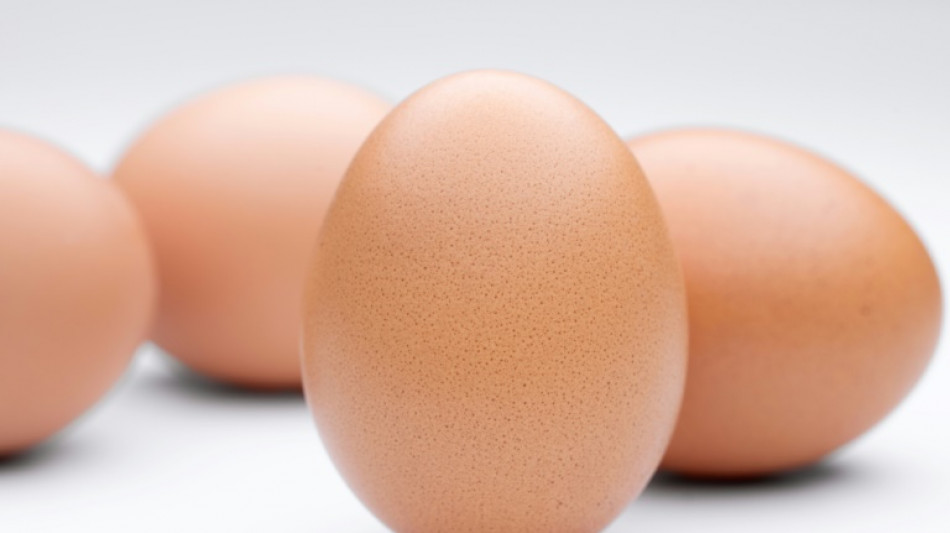
Scientists claim to have cracked how to cook the perfect egg / Photo: JOEL SAGET - AFP/File

 Latvian partial election results suggest pro-European choice

 In Egypt's Sinai, Gazan builds school for children displaced by war

 Trump tariffs a mixed bag for US auto industry

 Yemen government forces say struck Houthi targets

 Music links past, present for Pedro Pascal's cellist in 'Behemoth!'

 ALEX BODI ȘI AMBASADORUL REPUBLICII SUDANUL DE SUD, GUM DOMINIC MATIOK, DISCUTĂ LA BERLIN DESPRE POSIBILITATEA ÎNFIINȚĂRII UNUI CONSULAT ONORIFIC LA BUCUREȘTI

 Dodgers step up World Series three-peat bid with 5-3 win over Braves

 Spain break down Czechs as England outclass Croatia in Nations League

 Yamal on target as Spain hold off Czech Republic

 Latvian exit polls suggest pro-European choice

 Lula, Bolsonaro wrap up campaigns ahead of knife-edge election

 Tuchel hails 'complete' England after Croatia demolition

 Fury to invite Trump to lead ring walk before Joshua showdown

 Fashion industry in 'precarious moment', says Vivienne Westwood supremo

 Seventh heaven for England in Nations League rout of Croatia

 Storms, flooding cause chaos on Greek holiday island of Crete

 #IAmJaneDoe: online support campaign in US university rape case

 Brazil shine on Selecao's first visit to India

 Zverev sets up Djokovic quarter-final at China Open, Rybakina out

 Happier at home, Bordeaux hammer Lyon in Top 14

 Lula, Bolsonaro in final push for votes ahead of knife-edge election

 Boisterous fashion week barnstorms 'sleepy' Nigerian capital

 UAE investigators say flydubai co-pilot was planning 'terrorist act'

 Rahul smacks century in India v Windies ODI

 Daryz seeks to join exclusive club of dual Arc winners

Hard-boiled, soft-boiled or poached. Scientists have studied how to cook the perfect egg and have come up with a new recipe that they say optimises its taste and nutritional quality.
Cooking an egg is a delicate art because the yolk and the white do not cook at the same temperature.
The yolk begins to solidify at 65 degrees Celsius (149 degrees Fahrenheit) and the white at 85C.
To avoid ending up with a soft-boiled egg, chefs have to choose a "compromise temperature", said the authors of a study published on Thursday in the journal Communications Engineering.
In the case of a hard-boiled egg -- cooked for 12 minutes at 100C -- all parts of the egg have a final temperature of 100C, well above the ideal cooking temperature, particularly for the yolk.
In the case of egg sous vide, which is cooked between 60 and 70C, the final egg is at a temperature of 65C.
But while this is the ideal temperature for the yolk, it is much too low for the proteins in the egg white to stick together.
As for the soft-boiled egg, cooked for six minutes at 100C, the authors say the egg yolk is undercooked.
The Italian polymer specialists approached the problem by simulating the process with the help of computational fluid dynamics software, which was used to simulate and analyse the flow of fluids and their interactions with solid surfaces.
- Recyclable materials -
The solution, they suggest, is to use a saucepan of boiling water at 100C and a saucepan of water at 30C and to transfer the egg from one to the other every two minutes for exactly 32 minutes in total.
"It is found that a stationary state at the centre of the yolk is reached at a constant temperature of 67C," namely the mean value between the temperatures of the saucepan of boiling water and the saucepan of lukewarm water, Pellegrino Musto, one of the study's authors, told AFP.
"Conversely, the albumen alternatively sees temperatures in the range 100–87C and 30–55C during the hot and cold cycles respectively," which allows all the layers of the egg white to reach cooking temperature, added Musto, research director at the National Research Council of Italy's Institute for Polymers, Composites and Biomaterials.
The authors then tested this method of "cooking in cycles" and found that the result was "more similar to the soft boiled when analysing the texture of its albumen, while it is very similar to the sous videsample when considering its yolk," the study says.
Cooking in cycles also has a "better advantage over conventional cooking methods in terms of nutritional content", the authors said.
The chemical analysis showed that the yolks of eggs cooked in cycles contained more polyphenols -- healthy micronutrients -- than hard-boiled eggs, soft-boiled eggs or sous videeggs.
Musto said in an email that the result was "(partially) unexpected" and proposed that "temperature degradation of bioactive molecules" at higher temperatures could be a possible cause.
The study has also found practical application, with one of the study's authors, Ernesto Di Maio, using the cyclic cooking method "regularly for his family and friends, who appreciate it a lot".
However, Musto pointed out that the study would have applications beyond the kitchen, especially with regard to recyclability, which he said was the main theme of the research group.
"A well designed thermal profile may allow the development of layered structures within an object made from a single material" that is entirely recyclable, Musto said.
"The resulting object will have layered properties as if it were a multi-material object," Musto said, adding that these are "very difficult to recycle" except in rare circumstances.
F.Cardoso--PC



