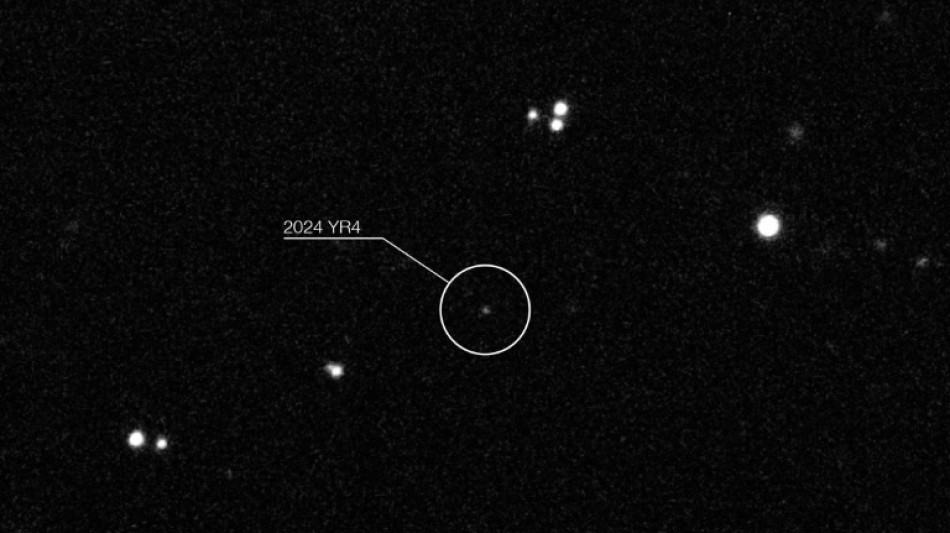
Rising odds asteroid that briefly threatened Earth will hit Moon / Photo: Handout - European Southern Observatory/AFP/File

 ALEX BODI AND AMBASSADOR GUM DOMINIC MATIOK OF THE REPUBLIC OF SOUTH SUDAN MEET IN BERLIN TO DISCUSS THE POSSIBILITY OF AN HONORARY CONSULATE IN BUCHAREST

 Lula, Bolsonaro wrap up campaigns ahead of Brazil's knife-edge vote

 Toulouse edge Castres in Top 14 derby

 Murakami homer propels White Sox to MLB playoff win over Guardians

 Israel targets top Hamas leader in deadly Gaza strike on anniversary

 Houthis say struck oil facility near Riyadh, as Saudis hit Sanaa

 AI needs safety layers like nuclear plants: ex-OpenAI engineer

 MVP Judge will miss Yankees' MLB playoff series against Rays

 New lizard species discovered in Peru

 Fernandes hails Portugal's 'greatest symbol' Ronaldo, calls for unity

 Grandidier-Nkanang double takes Pau to Top 14 summit despite Vannes fightback

 Trainer Scott gets perfect Arc boost with top notch double

 Ex-PM says Putin cannot admit 'mistake' over Ukraine

 Houthis say Saudi Arabia launches dozens of strikes on Yemen capital
 Qatar and Abu Dhabi F1 Grand Prix to go ahead - F1 boss

 South Korea lift gloom with smash-and-grab Games football gold

 Ireland news conference before Israel game cut short amid tensions
 Protests over housing flare in Spain after relief measures rejected
 Zverev thrashes Shang to set up Djokovic quarter-final at China Open

 Turkey football ref chief jailed pending trial for graft
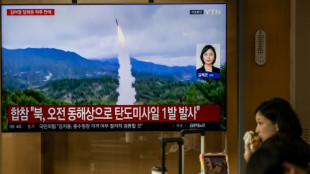 North Korea says test of intermediate-range strategic missile included use of AI

 Rampant Sayers leads Hong Kong to third men's rugby gold in a row

 Ethiopia's Tigray rebels abandon regional capital as govt advances

 Bulgaria's Tsar Samuel returns 'home' after 1,000 years
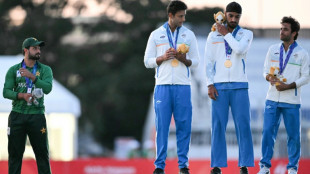
 'Glad it's over': Kim powers to Games gold and military exemption

An huge asteroid that was briefly feared to strike Earth now has a nearly four percent chance of smashing into the Moon, according to new data from the James Webb Space Telescope.
The asteroid, thought to be capable of levelling a city, set a new record in February for having the highest chance -- 3.1 percent -- of hitting our home planet than scientists have ever measured.
Earth's planetary defence community leapt into action and further observations quickly ruled out that the asteroid -- called 2024 YR4 -- will strike Earth on December 22, 2032.
But the odds that it will instead crash into Earth's satellite have been steadily rising.
After the Webb telescope turned its powerful gaze towards the asteroid last month, the chance of a Moon shot is now at 3.8 percent, NASA said.
"There is still a 96.2 percent chance that the asteroid will miss the Moon," NASA said in a statement on Thursday.
Richard Moissl, head of the European Space Agency's planetary defence office, told AFP that this aligned with their internal estimates of around four percent.
The new Webb data also shed light on the size of the space rock, which was previously estimated to be between 40 and 90 metres (131 to 295 feet).
It is now believed to be 53 to 67 metres, roughly the height of a 15-storey building.
This is significant because it is bigger than the 50-metre threshold for activating planetary defence plans.
If the asteroid still had a more than one percent chance of hitting Earth, "the development of one or more deflection missions would already be starting now", Moissl said.
There are a range of ideas for how Earth could fend off an oncoming asteroid, including nuclear weapons and lasers.
But only one has been tested on an actual asteroid. In 2022, NASA's DART mission successfully altered a harmless asteroid's trajectory by smashing a spacecraft into it.
- 'Perfect opportunity' -
While no one wanted to need to test Earth's defences on the potentially hugely destructive asteroid 2024 YR4, many scientists are hoping it will strike the Moon.
"The possibility of getting a chance for an observation of a sizeable Moon impact is indeed an interesting scenario from a scientific point of view," Moissl said.
It could offer up a range of information that would be "valuable for planetary defence purposes," he added.
Mark Burchell, a space scientist at the UK's University of Kent, told New Scientist that a Moon hit would be "a great experiment and a perfect opportunity".
And on Earth, "telescopes would certainly see it, I would say, and binoculars might see it," he added.
The asteroid is the smallest object ever targeted by the Webb telescope.
Webb's measurements of the space rock's thermal data indicate that it "does not share properties observed in larger asteroids", the European Space agency said in a statement.
"This is likely a combination of its fast spin and lack of fine-grained sand on its surface," it said, adding that this was more common in fist-sized asteroids.
More information will come when Webb again observes the asteroid again next month.
E.Raimundo--PC



