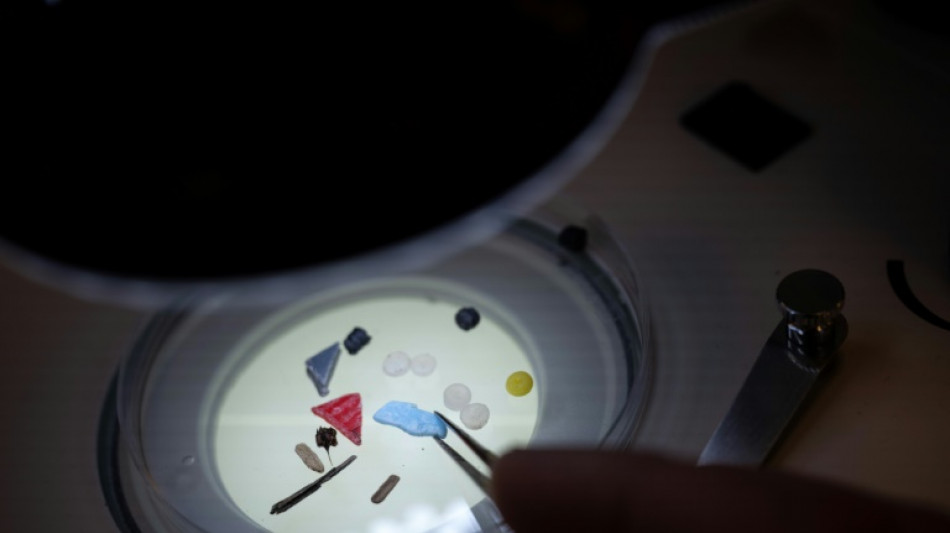
'Alarming' microplastic pollution in Europe's great rivers / Photo: Ben Stansall - AFP/File

 ALEX BODI AND AMBASSADOR GUM DOMINIC MATIOK OF THE REPUBLIC OF SOUTH SUDAN MEET IN BERLIN TO DISCUSS THE POSSIBILITY OF AN HONORARY CONSULATE IN BUCHAREST

 Lula, Bolsonaro wrap up campaigns ahead of Brazil's knife-edge vote

 Toulouse edge Castres in Top 14 derby

 Murakami homer propels White Sox to MLB playoff win over Guardians

 Israel targets top Hamas leader in deadly Gaza strike on anniversary

 Houthis say struck oil facility near Riyadh, as Saudis hit Sanaa

 AI needs safety layers like nuclear plants: ex-OpenAI engineer

 MVP Judge will miss Yankees' MLB playoff series against Rays

 New lizard species discovered in Peru

 Fernandes hails Portugal's 'greatest symbol' Ronaldo, calls for unity

 Grandidier-Nkanang double takes Pau to Top 14 summit despite Vannes fightback

 Trainer Scott gets perfect Arc boost with top notch double

 Ex-PM says Putin cannot admit 'mistake' over Ukraine

 Houthis say Saudi Arabia launches dozens of strikes on Yemen capital

 Qatar and Abu Dhabi F1 Grand Prix to go ahead - F1 boss

 South Korea lift gloom with smash-and-grab Games football gold

 Ireland news conference before Israel game cut short amid tensions

 Protests over housing flare in Spain after relief measures rejected

 Zverev thrashes Shang to set up Djokovic quarter-final at China Open

 Turkey football ref chief jailed pending trial for graft

 North Korea says test of intermediate-range strategic missile included use of AI

 Rampant Sayers leads Hong Kong to third men's rugby gold in a row

 Ethiopia's Tigray rebels abandon regional capital as govt advances

 Bulgaria's Tsar Samuel returns 'home' after 1,000 years

 'Glad it's over': Kim powers to Games gold and military exemption

"Alarming" levels of microplastic have been found in major rivers across Europe according to scientists in 14 studies published simultaneously Monday.
"The pollution is present in all European rivers" studied, said French scientist Jean-François Ghiglione, who coordinated the large-scale operation across nine major rivers from the Thames to the Tiber.
"Alarming" pollution of on average "three microplastics per cubic metre of water" was observed in all of them, according to the results published in the journal of Environmental Science and Pollution Research.
This is far from the 40 microplastics per cubic metre recorded in the world's 10 most polluted rivers -- the Yellow River, Yangtze, Mekong, Ganges, Nile, Niger, Indus, Amur, Pearl and Hai -- which irrigate countries where most plastic is produced or plastic waste is processed.
But this does not take into account the volume of water flowing.
- 3,000 particles per second -
On the Rhone in Valence, France, the fast flow means there are "3,000 plastic particles every second", said Ghiglione. The Seine in Paris has around 900 per second.
"The mass of microplastics invisible to the naked eye is more significant than that of the visible ones," said Ghiglione -- a result that "surprised" researchers. This was confirmed by analytical advances made during the studies, which began in 2019.
"Large microplastics float and are collected at the surface, while invisible ones are distributed throughout the water column and are ingested by many animals and organisms," said Ghiglione, head of research in marine microbial ecotoxicology at the French National Centre for Scientific Research (CNRS).
Samples were collected from the mouths of the rivers Elbe, Ebro, Garonne, Loire, Rhone, Rhine, Seine, Thames and the Tiber by some 40 chemists, biologists and physicists from 19 research laboratories.
The researchers then made their way upstream until they reached the first major city on each of the waterways.
"Microplastics are smaller than a grain of rice," said Alexandra Ter Halle, a chemist at the CNRS in Toulouse, who took part in the analysis.
- 'Mermaid tears' -
The particles are less than five millimetres in size, with the smallest invisible to the naked eye.
These include synthetic textile fibres from washing clothes and microplastics released from car tyres or when unscrewing plastic bottle caps.
Researchers also found virgin plastic pellets, the raw granules used to manufacture plastic products.
One of the studies identified a virulent bacterium on a microplastic in the Loire in France, capable of causing infections in humans.
Another unexpected finding was that a quarter of microplastics discovered in rivers are not derived from waste but come from industrial plastic pellets.
These granules, dubbed "mermaid tears", can also sometimes be found scattered along beaches after maritime incidents.
"What we see is the pollution is diffuse and established" and "comes from everywhere" in the rivers, he added.
"The international scientific coalition we are part of (as part of international UN negotiations on reducing plastic pollution) is calling for a major reduction in the production of primary plastic because we know that plastic production is directly linked to pollution," he said.
A.Aguiar--PC



