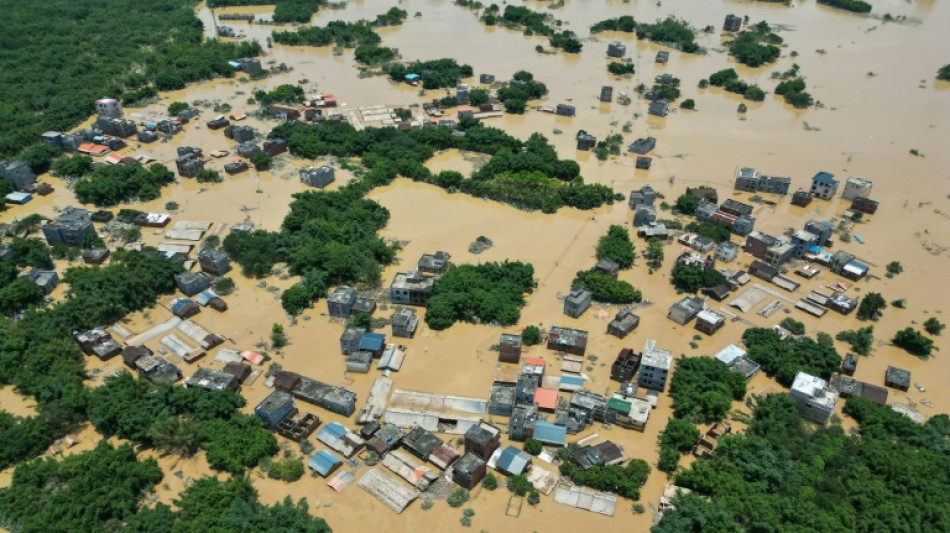
What is causing record floods and heatwaves in China? / Photo: STR - AFP/File

 Japan Olympic chief says 'lot more' athletes at Games than expected
 Asian carmakers besting US rivals at home, China poised to strike

 Widgets & Web Offers All-Inclusive Investor Relations Websites for Public Companies, IPOs and SPACs

 Adams named new US captain to 2030 World Cup

 China a better influence in Latin America than US: poll

 Judge pauses construction of border project in Texas national park

 Belgium's De Bruyne fires double to sink Turkey, France held by Italy
 US jobs data boosts stocks as oil prices dip

 US Supreme Court to hear high-stakes climate case
 Trump expected to name intel chief Clayton as AI czar: reports

 Argentina unveils passports-for-investment scheme

 Brazil election debate chaos sparks censorship row

 England's Carse charged by cricket body over nightclub incident

 Amazon vows $1 bn for data center towns, decries 'myths'

 Oil prices drop on G7 fuel release, US jobs data boosts stocks

 G7 agrees deal to ease global energy supply concerns

 Spain's government dealt blow as lawmakers reject housing bills

 Food, medicine shortages deepen in Russian-occupied Oleshky

 Man City whistleblower Rui Pinto facing 'dire consequences' - lawyers
 Russia 'tearing Kyiv apart', mayor says, as strikes paralyse traffic

 Taiwan boxer Lin wins Games gold as Japan edge North Korea on penalties

 Japan tame North Korea to win Games gold after shootout drama

 US posts weak job growth data in September

 Ethiopia's conflict: the regional dimension
 Life expectancy almost back to pre-Covid levels, says WHO

Record floods in southern China this month displaced more than half a million people, while searing heat buckled roads in other parts of the country.
Authorities have issued extreme weather warnings in multiple regions, while experts warned that these phenomena were more evidence of the impact of climate change.
- How bad are the floods? -
Summer floods are common in China, especially in the low-lying Pearl River delta region in the south.
This year, however, the National Climate Center forecast that flooding will be "relatively worse" and "more extreme" than before.
Water levels at one location in Guangdong province "surpassed historical records" this week, according to the ministry of water resources, while parts of neighbouring Fujian province and Guangxi region also reported record rainfall.
More than half a million people were evacuated this month because of the flood threat.
In the cities of Guangzhou and Shaoguan in Guangdong province, heavy rainfall turned roads into rivers and people had to be taken to safety in lifeboats.
Authorities in the province estimated the economic damage from the floods to be more than a quarter of a billion dollars.
- What about the heatwave? -
Seven provinces in northern and central China Wednesday warned millions of residents not to go outdoors as temperatures hit 40 degrees Celsius (104 degrees Fahrenheit).
State broadcaster CCTV this week showed footage of cement roads cracked under extreme heat in central Henan province.
Meanwhile, power demand surged to record levels in several cities in the north this week as residents cranked up the air conditioning to beat the heat.
In China's second-most populous province Shandong, home to more than 100 million people, electricity use topped 93 million kilowatts on Tuesday, beating the 2020 high of 90 million kilowatts, CCTV said.
- What is the economic cost? -
China's central economic planner estimates that extreme weather will shave off one to three percent of the country's GDP every year.
The floods in China last year cost $25 billion -- the world's second-worst flood-related loss after Europe, a study published in April by reinsurer Swiss Re showed.
Chinese Premier Li Keqiang warned Wednesday that floods and heatwaves will affect the production of staple grains, vegetables and pork and push up inflation.
- Why is this happening? -
"Extreme weather and climate events in the country have become more frequent, severe and widespread," China Meteorological Administration said Wednesday.
It followed a warning in March from Xiao Chan, deputy director of the National Climate Center: "Global warming and La Nina events are contributing to abnormally high temperatures and extreme rain in China."
As the Earth's atmosphere gets warmer, it holds more moisture, making downpours more intense.
La Nina refers to the large-scale cooling of surface temperatures in the central and eastern equatorial Pacific Ocean, causing devastating floods in South China, India and Bangladesh.
- What is China doing about it? -
China has built a network of massive dams and "sponge cities" with permeable pavements to try and limit the devastation during the annual flood season.
"But the most damaging recent floods have occurred in areas historically less at risk," said Scott Moore, a researcher at the University of Pennsylvania focusing on China's environmental policy.
"This is a classic climate change effect: increased extreme weather in different regions and at different times of year than the historical average."
China is the world's biggest coal-burning nation and top emitter of greenhouse gases that lead to climate change.
It aims to become carbon neutral by 2060, but local governments have pushed up investments in both renewables and coal in recent months.
Beijing has also not yet outlined precisely how it intends to achieve its emissions targets.
Environmentalists have warned that without specifying the size of the peak or setting an absolute cap, China can essentially keep increasing emissions until 2030.
- Focus on forecasting? -
A new roadmap for climate change adaptation published by the Chinese government last week says the focus should now shift to predicting extreme weather more accurately using sensors and satellites.
"The usefulness of weather forecasts caps out around 10 days, beyond which their accuracy rapidly drops to that of a coin flip," think tank Trivium China said in a research note.
"Climate monitoring and forecasting is a whole different ballgame", helping to predict severe floods and droughts at least a month in advance.
C.Cassis--PC



