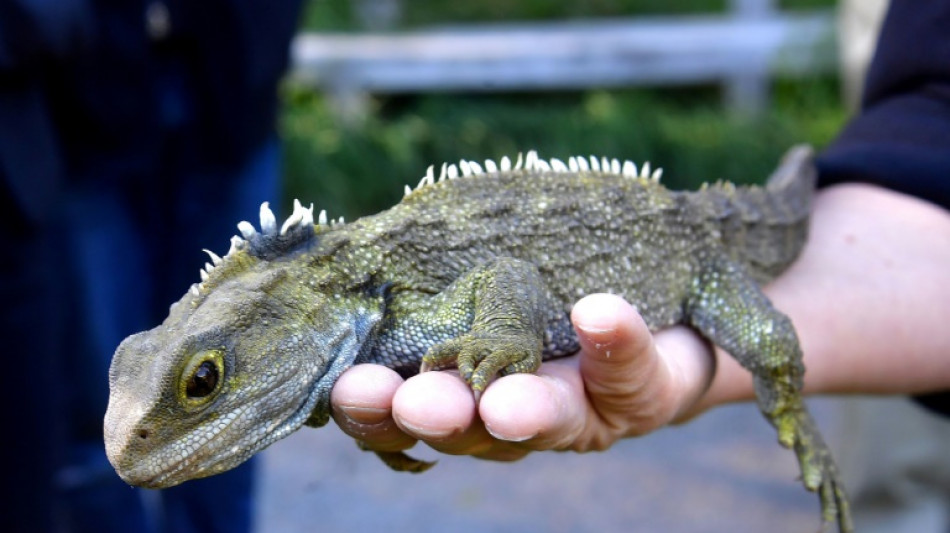
Oldest known lizard ancestor discovered in England / Photo: Marty MELVILLE - POOL/AFP/File

 Lula, Bolsonaro in final push for votes ahead of knife-edge election

 Boisterous fashion week barnstorms 'sleepy' Nigerian capital

 UAE investigators say flydubai co-pilot was planning 'terrorist act'

 Rahul smacks century in India v Windies ODI

 Daryz seeks to join exclusive club of dual Arc winners

 Russia warns diplomats to leave Kyiv over new strikes threat

 Olympic champ Zheng rebukes rowdy home crowd at China Open

 World No.1 Sinner pulls out of Shanghai Masters to delay return

 Red Bull's Verstappen grabs pole position for Bahrain GP

 India beat Pakistan in blockbuster as golfer Kim wins 'crazy' gold

 India beat arch-rivals Pakistan to win Asian Games cricket gold

 Ethiopia's Tigray rebels abandon regional capital as govt advances: journalist

 Tom Kim powers to Games gold and exemption from military service

 Split loyalties for Indian football fans at Brazil friendly

 India-Pakistan blockbuster brings cricket fever to Japan baseball field

 Wong waiting on Rafa after winning Asian Games tennis gold

 With Russia next door and rising costs, Latvia goes to the polls

 Penalty hero rues empty seats as Games hosts Japan win football gold

 North Korea fires ballistic missile after Seoul's apology demand

 US regulator finds Boeing 737 MAX software bug 'not a safety concern'

 Ohtani 'managing' injuries as Dodgers launch MLB post-season

 Botched US execution leaves murderer unconscious on ventilator: lawyers

 Cornell rape case exposes sexual violence at US colleges
 France held by Italy in Zidane's homecoming after Olise stunner

 Ethiopian pro-government militia claims Tigray airport as regional tensions spike

Scientists announced Wednesday they have discovered the oldest-known member of the lizard family in southwest England, a tiny creature that used its surprisingly large teeth to hunt cockroaches 242 million years ago.
The ancient reptile, which lived during the Middle Triassic epoch shortly before the rise of the dinosaurs, was so small its entire body could fit in the palm of a human hand.
"The new animal is unlike anything yet discovered and has made us all think again about the evolution of the lizard, snakes and the tuatara," the latter of which is a New Zealand reptile, Dan Marke of the University of Bristol said in a statement.
The skeleton of the oldest known member of the lepidosauria order, a family of reptiles, was found at a fossil-rich beach in Devon, southwest England, in 2015.
But figuring out what it actually was took the scientists years, and the discovery was announced in a study in the journal Nature on Wednesday.
"The new fossil shows almost none of what we expected," said Marke, the study's lead author.
Modern lizards and snakes have a partially hinged skull and plenty of teeth on the roof of their mouth -- but this ancient ancestor had neither.
"Not only this but it possesses some spectacularly large teeth compared to its closest relatives," the palaeobiologist said.
It also has a bone running from cheek to jaw, a feature it shares only with the unique tuatara that is often referred to as a "living fossil".
"The new beast" used these teeth "to pierce and shear the hard cuticles of its insect prey, pretty much as the tuatara does today," said study co-author Michael Benton, also from Bristol University.
The fossil was difficult to study because it is so small -- the skull is just 1.5 centimetres (0.6 of an inch) wide -- and was preserved in a large rock.
So the British researchers scanned it using the European Synchrotron Radiation Facility, which works as a kind of huge microscope producing X-rays 100 billion times brighter than those used in hospitals.
The Synchrotron allowed the scientists to "zoom in on large objects and obtain very high-resolution images," said Vincent Fernandez, a palaeontologist at the facility in France.
The scientists named the lizard ancestor Agriodontosaurus helsbypetrae, after the Helsby Sandstone Formation where it was discovered.
X.Brito--PC



