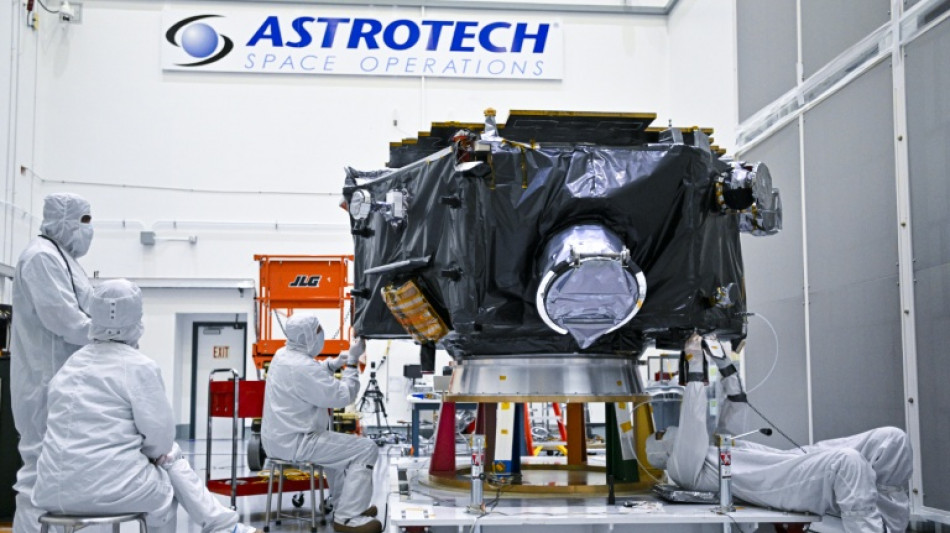
NASA launches mission to study space weather / Photo: Miguel J. Rodriguez Carrillo - AFP

 Lula, Bolsonaro in final push for votes ahead of knife-edge election

 Boisterous fashion week barnstorms 'sleepy' Nigerian capital

 UAE investigators say flydubai co-pilot was planning 'terrorist act'

 Rahul smacks century in India v Windies ODI

 Daryz seeks to join exclusive club of dual Arc winners

 Russia warns diplomats to leave Kyiv over new strikes threat

 Olympic champ Zheng rebukes rowdy home crowd at China Open

 World No.1 Sinner pulls out of Shanghai Masters to delay return

 Red Bull's Verstappen grabs pole position for Bahrain GP

 India beat Pakistan in blockbuster as golfer Kim wins 'crazy' gold

 India beat arch-rivals Pakistan to win Asian Games cricket gold

 Ethiopia's Tigray rebels abandon regional capital as govt advances: journalist

 Tom Kim powers to Games gold and exemption from military service

 Split loyalties for Indian football fans at Brazil friendly

 India-Pakistan blockbuster brings cricket fever to Japan baseball field

 Wong waiting on Rafa after winning Asian Games tennis gold

 With Russia next door and rising costs, Latvia goes to the polls

 Penalty hero rues empty seats as Games hosts Japan win football gold

 North Korea fires ballistic missile after Seoul's apology demand

 US regulator finds Boeing 737 MAX software bug 'not a safety concern'

 Ohtani 'managing' injuries as Dodgers launch MLB post-season

 Botched US execution leaves murderer unconscious on ventilator: lawyers

 Cornell rape case exposes sexual violence at US colleges

 France held by Italy in Zidane's homecoming after Olise stunner

 Ethiopian pro-government militia claims Tigray airport as regional tensions spike

The United States launched three spacecraft on Wednesday in an effort to better monitor space weather such as solar storms, which can interfere with technology and power systems on Earth.
The three probes blasted off from Florida's Kennedy Space Center aboard a Falcon 9 rocket, built by the private company SpaceX.
Once in space, the probes will begin a long journey to reach the Lagrange 1 point -- a spot approximately 1.5 million kilometers (930,000 miles) from the Sun that offers a stable vantage point for observation.
The "Interstellar Mapping and Acceleration Probe" (IMAP) will use its instruments to study the Sun's high-energy particles and the protective magnetic bubble surrounding our solar system known as the heliosphere, data that can offer insight into space weather and cosmic radiation.
Solar storms are high-radiation events caused by flares on the Sun's surface, and are very difficult to predict.
They can impact activities on Earth, including aviation, mobile communications and power grids -- and potentially endanger astronauts and satellites in space.
The Space Weather Follow-on (SWFO-L1) spacecraft, operated by the National Oceanic and Atmospheric Administration (NOAA), aims to detect the weather patterns in advance.
"It can't stop an incoming threat, but it can give us time to prepare," said Irene Parker of NOAA.
With notice, authorities could shelter astronauts, warn aircraft pilots of forthcoming disruptions of GPS systems and adapt power grids in anticipation.
And the Carruthers Geocorona Observatory, the third passenger on the rocket, will study the Earth's exosphere in a bid to better understand how space weather affects it.
G.Machado--PC



