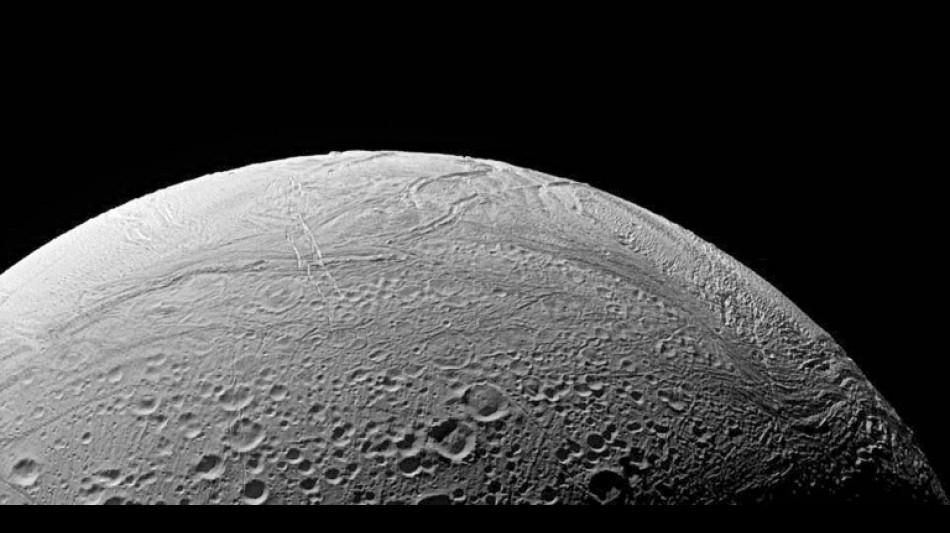
More ingredients for life discovered in ocean on Saturn moon / Photo: HO - AFP/File

 Lula, Bolsonaro in final push for votes ahead of knife-edge election

 Boisterous fashion week barnstorms 'sleepy' Nigerian capital

 UAE investigators say flydubai co-pilot was planning 'terrorist act'

 Rahul smacks century in India v Windies ODI

 Daryz seeks to join exclusive club of dual Arc winners

 Russia warns diplomats to leave Kyiv over new strikes threat

 Olympic champ Zheng rebukes rowdy home crowd at China Open

 World No.1 Sinner pulls out of Shanghai Masters to delay return

 Red Bull's Verstappen grabs pole position for Bahrain GP

 India beat Pakistan in blockbuster as golfer Kim wins 'crazy' gold

 India beat arch-rivals Pakistan to win Asian Games cricket gold

 Ethiopia's Tigray rebels abandon regional capital as govt advances: journalist

 Tom Kim powers to Games gold and exemption from military service

 Split loyalties for Indian football fans at Brazil friendly

 India-Pakistan blockbuster brings cricket fever to Japan baseball field

 Wong waiting on Rafa after winning Asian Games tennis gold

 With Russia next door and rising costs, Latvia goes to the polls

 Penalty hero rues empty seats as Games hosts Japan win football gold

 North Korea fires ballistic missile after Seoul's apology demand

 US regulator finds Boeing 737 MAX software bug 'not a safety concern'

 Ohtani 'managing' injuries as Dodgers launch MLB post-season

 Botched US execution leaves murderer unconscious on ventilator: lawyers

 Cornell rape case exposes sexual violence at US colleges

 France held by Italy in Zidane's homecoming after Olise stunner

 Ethiopian pro-government militia claims Tigray airport as regional tensions spike

The ocean hidden under the icy shell of Saturn's moon Enceladus harbours complex organic molecules, a study said Wednesday, offering further evidence that the small world could have all the right ingredients to host extraterrestrial life.
Just 500 kilometres (310 miles) wide and invisible to the naked eye, the white, scar-covered Enceladus is one of hundreds of moons orbiting the sixth planet from the Sun.
For a long time, scientists believed Enceladus was too far away from the Sun -- and therefore too cold -- to be habitable.
Then the Cassini space probe flew past the moon several times during a 2004-2017 trip to Saturn and its rings, discovering evidence that a vast saltwater ocean is concealed under the moon's kilometres-thick layer of ice.
Since then, scientists have been sifting through the data collected by Cassini, revealing that the ocean has many of the elements thought to be needed to host life, including salt, methane, carbon dioxide and phosphorus.
When the spacecraft passed over the moon's south pole, it discovered jets of water bursting through cracks on the surface.
These jets were propelling tiny ice particles -- smaller than grains of sand -- into space. While some of these ice grains fell back to the moon's surface, others collected around one of Saturn's many rings.
When Cassini flew through Saturn's outermost "E" ring, it was "detecting samples from Enceladus all the time," Nozair Khawaja, a planetary scientist at the Free University of Berlin and lead author of the new study, said in a statement from the European Space agency.
By looking through these samples, scientists had previously identified numerous organic molecules -- including the precursors of amino acids, which are fundamental building blocks of life.
But these ice grains could have been altered after being trapped in the ring for hundreds of years -- or beaten up by blasts of cosmic radiation.
So the scientists wanted to look at some fresh ice grains.
Luckily, they already had access to some.
When Cassini flew directly into the spray spewing from the moon's surface in 2008, grains of ice hit the spacecraft's Cosmic Dust Analyzer at around 18 kilometres a second.
But it took years to complete a detailed chemical analysis of these particles, which was the subject of the study published in the journal Nature Astronomy.
- Back to the moon? -
Study co-author Frank Postberg said the research proves that "the complex organic molecules Cassini detected in Saturn's E ring are not just a product of long exposure to space, but are readily available in Enceladus's ocean".
French astrochemist Caroline Freissinet, who was not involved in the study, told AFP that there was "not much doubt" that these molecules were in the moon's ocean.
But this confirmation provides "another piece in the puzzle," she added.
It also shows that recent technology such as artificial intelligence allows scientists to perform new kinds of analysis on old data, she said.
But to get the best idea about what is happening on Enceladus, a mission would need to land near the icy geysers and collect samples, she added.
The European Space Agency has been studying the potential of a mission that would do just that.
After all, "Enceladus ticks all the boxes to be a habitable environment that could support life," the agency said in the statement.
Khawaja added that "even not finding life on Enceladus would be a huge discovery, because it raises serious questions about why life is not present in such an environment when the right conditions are there."
S.Pimentel--PC



