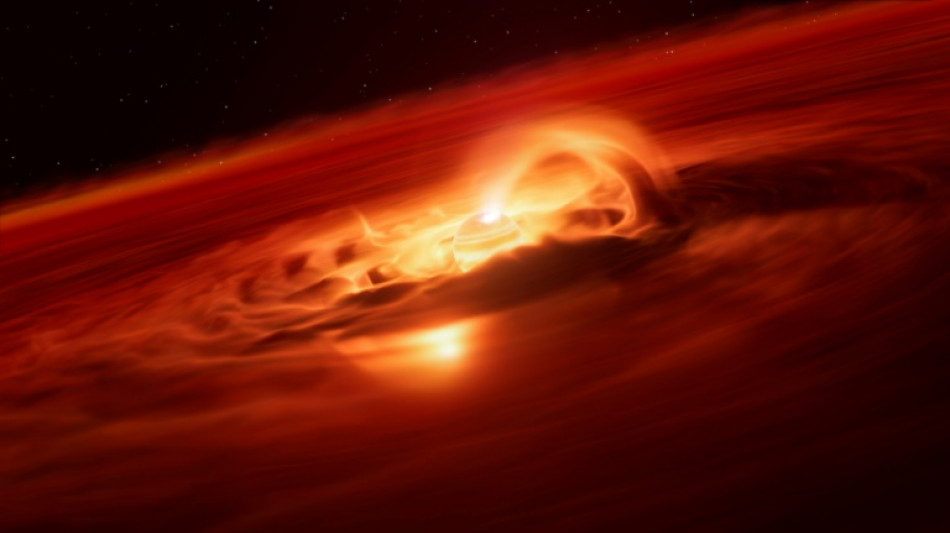
Strange 'rogue' planet spotted guzzling matter like a star / Photo: Handout - European Southern Observatory/AFP

 Lula, Bolsonaro in final push for votes ahead of knife-edge election

 Boisterous fashion week barnstorms 'sleepy' Nigerian capital

 UAE investigators say flydubai co-pilot was planning 'terrorist act'

 Rahul smacks century in India v Windies ODI

 Daryz seeks to join exclusive club of dual Arc winners

 Russia warns diplomats to leave Kyiv over new strikes threat

 Olympic champ Zheng rebukes rowdy home crowd at China Open

 World No.1 Sinner pulls out of Shanghai Masters to delay return

 Red Bull's Verstappen grabs pole position for Bahrain GP

 India beat Pakistan in blockbuster as golfer Kim wins 'crazy' gold

 India beat arch-rivals Pakistan to win Asian Games cricket gold

 Ethiopia's Tigray rebels abandon regional capital as govt advances: journalist

 Tom Kim powers to Games gold and exemption from military service

 Split loyalties for Indian football fans at Brazil friendly

 India-Pakistan blockbuster brings cricket fever to Japan baseball field

 Wong waiting on Rafa after winning Asian Games tennis gold

 With Russia next door and rising costs, Latvia goes to the polls

 Penalty hero rues empty seats as Games hosts Japan win football gold

 North Korea fires ballistic missile after Seoul's apology demand

 US regulator finds Boeing 737 MAX software bug 'not a safety concern'

 Ohtani 'managing' injuries as Dodgers launch MLB post-season

 Botched US execution leaves murderer unconscious on ventilator: lawyers

 Cornell rape case exposes sexual violence at US colleges

 France held by Italy in Zidane's homecoming after Olise stunner

 Ethiopian pro-government militia claims Tigray airport as regional tensions spike

A mysterious "rogue" planet has been observed gobbling six billion tonnes of gas and dust a second -- an unprecedented rate that blurs the line between planets and stars, astronomers said Thursday.
Unlike Earth and other planets in our solar system which orbit the Sun, rogue planets float freely through the universe untethered to a star.
Scientists estimate there could be trillions of rogue planets in our galaxy alone -- but they are difficult to spot because they mostly drift quietly along in perpetual night.
These strange objects intrigue astronomers because they are "neither a star nor a proper planet," Alexander Scholz, an astronomer at Scotland's University of St Andrews and co-author of a new study, told AFP.
"Their origin remains an open question: are they the lowest-mass objects formed like stars, or giant planets ejected from their birth systems?"
The team of researchers behind the new study were stunned to observe an astonishing growth spurt in a rogue planet around 620 light years from Earth in the constellation Chamaeleon.
The planet, officially called Cha 1107-7626, has a mass five to 10 times bigger than Jupiter.
Scholz explained that the object is "still in its infancy," being roughly one or two million years old.
The object grows by sucking in matter from a disc that surrounds it -- a process called accretion.
But what the astronomers saw happen to Cha 1107-7626 "blurs the line between stars and planets," study-co-author Belinda Damian said in a statement.
In August last year, the planet suddenly started devouring matter from its disc at a record-breaking six-billion-tonnes per second -- eight times faster than a few months earlier.
"This is the strongest accretion episode ever recorded for a planetary-mass object," said lead study Victor Almendros-Abad of the Palermo Astronomical Observatory in Italy.
- 'Awe-inspiring' -
By comparing light emitted before and during this binge-eating session, the scientists discovered that magnetic activity was playing a role in driving matter towards the object.
This phenomenon has previously only been observed in stars.
The chemistry in the disc also changed. Water vapour was detected in the disc during the accretion episode, but not beforehand.
This is also something that has previously been observed in stars -- but never for a forming planet.
Lead study author Ray Jayawardhana of Johns Hopkins University said the discovery implies "that some objects comparable to giant planets form the way stars do, from contracting clouds of gas and dust accompanied by discs of their own, and they go through growth episodes just like newborn stars".
No matter how weird, Cha 1107-7626 is still expected to have similar characteristics to huge planets, because it is of similar size.
Scholz said that unlike stars, this object is "not massive enough to ever have fusion reactions in the core".
So, like other planets, "it will cool inevitably as it gets older," he added.
Amelia Bayo, another co-author of the study in The Astrophysical Journal Letters, said "the idea that a planetary object can behave like a star is awe-inspiring".
It "invites us to wonder what worlds beyond our own could be like during their nascent stages," she added.
The observations were made by the European Southern Observatory's Very Large Telescope in Chile, and included data from the James Webb Space Telescope.
A.Aguiar--PC



