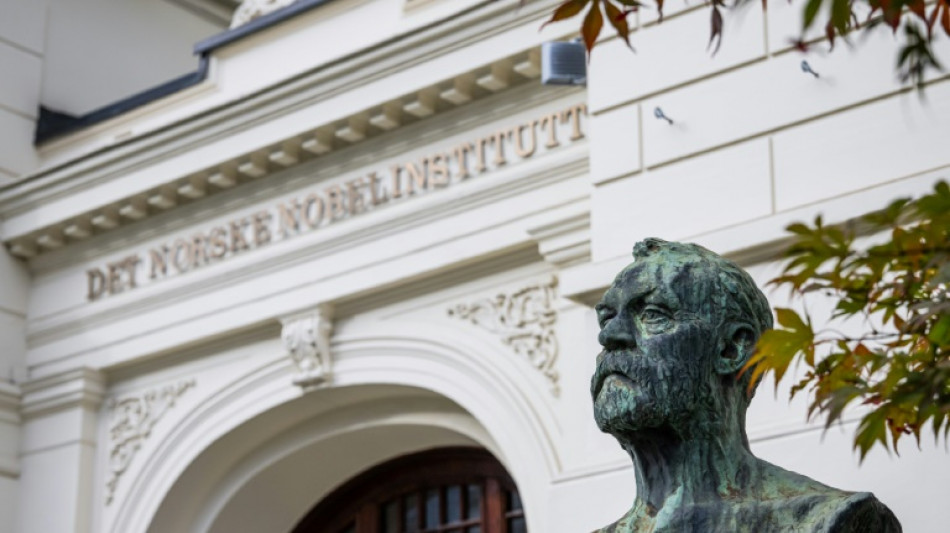
Computer advances and 'invisibility cloak' vie for physics Nobel / Photo: Jonathan NACKSTRAND - AFP/File

 Lula, Bolsonaro in final push for votes ahead of knife-edge election
 Boisterous fashion week barnstorms 'sleepy' Nigerian capital
 UAE investigators say flydubai co-pilot was planning 'terrorist act'

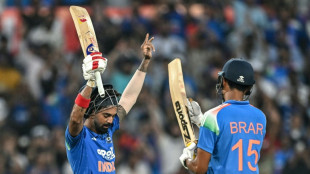 Rahul smacks century in India v Windies ODI
 Daryz seeks to join exclusive club of dual Arc winners
 Russia warns diplomats to leave Kyiv over new strikes threat
 Olympic champ Zheng rebukes rowdy home crowd at China Open
 World No.1 Sinner pulls out of Shanghai Masters to delay return
 Red Bull's Verstappen grabs pole position for Bahrain GP

 India beat Pakistan in blockbuster as golfer Kim wins 'crazy' gold
 India beat arch-rivals Pakistan to win Asian Games cricket gold
 Ethiopia's Tigray rebels abandon regional capital as govt advances: journalist
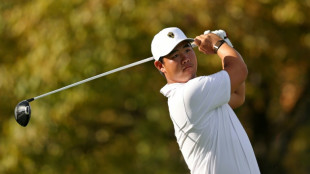 Tom Kim powers to Games gold and exemption from military service
 Split loyalties for Indian football fans at Brazil friendly
 India-Pakistan blockbuster brings cricket fever to Japan baseball field
 Wong waiting on Rafa after winning Asian Games tennis gold
 With Russia next door and rising costs, Latvia goes to the polls
 Penalty hero rues empty seats as Games hosts Japan win football gold

 North Korea fires ballistic missile after Seoul's apology demand

 US regulator finds Boeing 737 MAX software bug 'not a safety concern'

 Ohtani 'managing' injuries as Dodgers launch MLB post-season
 Botched US execution leaves murderer unconscious on ventilator: lawyers
 Cornell rape case exposes sexual violence at US colleges
 France held by Italy in Zidane's homecoming after Olise stunner

 Ethiopian pro-government militia claims Tigray airport as regional tensions spike
A maths theory powering computer image compression, an "invisibility cloak" or the science behind the James Webb Space Telescope are some achievements that could be honoured when the Nobel physics prize is awarded Tuesday.
The award, to be announced at 11:45 am (0945 GMT) in Stockholm, is the second Nobel of the season, after the Medicine Prize was awarded on Monday to a US-Japanese trio for research into the human immune system.
Mary Brunkow and Fred Ramsdell, of the United States, and Japan's Shimon Sakaguchi were recognised by the Nobel jury for identifying immunological "security guards".
Several commentators have speculated this year's physics prize could honour something called wavelet theory.
David Pendlebury, who heads research analysis at the research firm Clarivate, told AFP the mathematical theory "may sound arcane" but stressed it has had a "dramatic impact on daily life" through things such as image compression for pictures and videos on computers.
Belgian physicist Ingrid Daubechies, together with French mathematicians Stephane Mallat and Yves Meyer are seen as potential winners.
Meanwhile, Lars Brostrom, science editor at public broadcaster Sveriges Radio, told AFP it might be time to for the Nobel to lend its weight to "work on something called metamaterials".
In the field, Britain's John B. Pendry, who has become famous for his "invisibility cloak", has often been seen as a contender.
- Quantum information -
"We probably discussed it last year too, and maybe the year before," Brostrom said.
"You usually talk about them, and then people stop talking about them, and then they get the prize," he added.
Brostrom also cited "the people behind the James Webb Space Telescope" as a potential frontrunner, describing it as a "typical case" for a Nobel, where the theories date back decades and then are put into practice, in this case when the telescope was launched into space in late 2021.
Work on "quantum information" and algorithms is also buzzed about.
"Much of the pioneering work in this field was done several decades ago, and has come to fruition in functioning quantum computers and cryptography systems," Hamish Johnston, online editor of science magazine Physics World, wrote.
American mathematician Peter Shor, Canadian cryptographer Gilles Brassard, American physicist Charles H. Bennett, and Israeli-British scientist David Deutsch are likely ones to be honoured, according to the magazine.
- Teeny-scale microscope -
Scientific advances in astrophysics are also among experts' top picks.
Newspaper Dagens Nyheter scientific journalist Maria Gunther speculated that work into how galaxies are formed could be honoured, while noting the work of Mexican-British cosmologist Carlos Frenk, Argentinian astrophysicist Julio Navarro and British scientist Simon White.
For Physics World, the theory of cosmic inflation, which seeks to explain the current nature of the universe through the lens of "exponential expansion of the universe in its very early history" could also be a contender.
The magazine said American theoretical physicist Alan Guth and Russian-American Andrei Linde were clear choices.
Camilla Widebeck, a science journalist with Sveriges Radio, speculated that a microscope for the infinitesimally small -- the atomic force microscope -- could also be awarded.
This instrument is capable of producing 3D images at an extremely small scale, sometimes at atomic resolution, and is significant in nanotechnology.
Swiss physicist Christoph Gerber is mentioned as a key figure in this domain.
Last year, the Nobel Prize in Physics went to British-Canadian Geoffrey Hinton and American John Hopfield for their pioneering work on the foundations of artificial intelligence -- with both of them warning that their discoveries carried profound risks to society and humanity.
The physics prize will be followed by the chemistry prize on Wednesday.
The literature prize will be announced on Thursday, and the highly watched Nobel Peace Prize on Friday.
The economics prize wraps up the 2024 Nobel season on October 14.
The winners will receive their prize -- consisting of a diploma, a gold medal and a $1 million cheque -- from Sweden's King Carl XVI Gustaf at a formal ceremony in Stockholm on December 10.
That date is the anniversary of the death in 1896 of scientist Alfred Nobel, who created the prizes in his will.
G.Machado--PC



