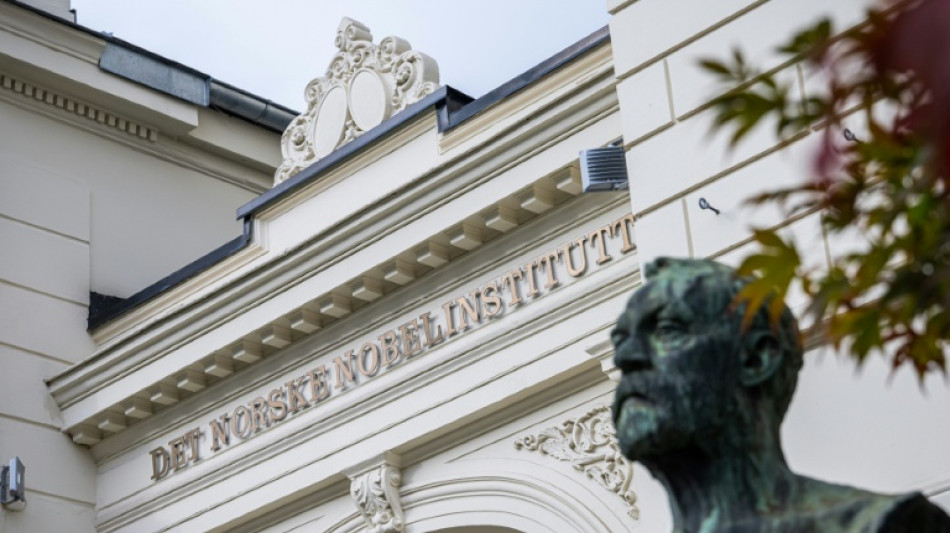
Energy storage and new materials eyed for chemistry Nobel / Photo: Jonathan NACKSTRAND - AFP/File

 Lula, Bolsonaro in final push for votes ahead of knife-edge election

 Boisterous fashion week barnstorms 'sleepy' Nigerian capital

 UAE investigators say flydubai co-pilot was planning 'terrorist act'

 Rahul smacks century in India v Windies ODI

 Daryz seeks to join exclusive club of dual Arc winners

 Russia warns diplomats to leave Kyiv over new strikes threat

 Olympic champ Zheng rebukes rowdy home crowd at China Open

 World No.1 Sinner pulls out of Shanghai Masters to delay return

 Red Bull's Verstappen grabs pole position for Bahrain GP

 India beat Pakistan in blockbuster as golfer Kim wins 'crazy' gold

 India beat arch-rivals Pakistan to win Asian Games cricket gold

 Ethiopia's Tigray rebels abandon regional capital as govt advances: journalist

 Tom Kim powers to Games gold and exemption from military service

 Split loyalties for Indian football fans at Brazil friendly

 India-Pakistan blockbuster brings cricket fever to Japan baseball field

 Wong waiting on Rafa after winning Asian Games tennis gold

 With Russia next door and rising costs, Latvia goes to the polls
 Penalty hero rues empty seats as Games hosts Japan win football gold

 North Korea fires ballistic missile after Seoul's apology demand

 US regulator finds Boeing 737 MAX software bug 'not a safety concern'

 Ohtani 'managing' injuries as Dodgers launch MLB post-season

 Botched US execution leaves murderer unconscious on ventilator: lawyers

 Cornell rape case exposes sexual violence at US colleges

 France held by Italy in Zidane's homecoming after Olise stunner

 Ethiopian pro-government militia claims Tigray airport as regional tensions spike

The development of new compounds and novel ways of storing energy are some of the research fields commentators say could be contenders for the Nobel Prize in Chemistry announced Wednesday.
The winner or winners of the prestigious award are scheduled to be unveiled by the Royal Swedish Academy of Sciences in Stockholm at 11:45 am (0945 GMT).
The chemistry prize follows the physics prize, which on Tuesday honoured Briton John Clarke, Frenchman Michel Devoret and American John Martinis for work putting quantum mechanics into action -- enabling the development of all kinds of digital technology.
Lars Brostrom, science editor at public broadcaster Sveriges Radio, told AFP that he felt the chemistry prize "should go to something that has significance for the climate or the environment".
Commentators have for years buzzed about American-Jordanian Omar Yaghi, and Brostrom said he thinks Yaghi's work could fall under the umbrella of climate.
"Because that chemistry can be a catalyst for all kinds of things related to both climate and the environment," Brostrom said.
Yaghi developed a type of customised porous material known as MOF (metal-organic framework), now used in commercial products that can, among other things, absorb and decontaminate toxins, act as a catalyst or even absorb water from desert air.
- 'Green chemistry prize' -
Yaghi's name has previously been floated alongside Japan's Susumu Kitagawa and Makoto Fujita -- also considered pioneers of the technology.
Another standout in the field of MOFs is West Bank-born American Omar K. Farha, a professor at Northwestern University.
For David Pendlebury, who heads research analysis at the research firm Clarivate, another contender for a "green chemistry prize" is France's Jean-Marie Tarascon for contributions "in new battery technologies".
Clarivate, which bases its Nobel predictions on a researcher's number of citations, spotlighted Tarascon for "fundamental advances and novel applications in energy storage and conversion technology".
Another name often cited among commentators is Taiwanese-American biochemist Chi-Huey Wong, which science magazine Chemistry Views noted is best known for pioneering methods for the "synthesis of complex carbohydrates and glycoproteins, facilitating their application in therapeutic contexts".
Chemistry Views also mentioned US chemical engineer Robert Langer, known for work in "drug delivery systems, biomaterials, and tissue engineering", as a contender.
It also listed Karl Deisseroth, a US psychiatrist and neurologist, who has been mentioned for the past decade as a possible laureate for developing the field of optogenetics, using light to control cells.
Germany's Herbert W. Roesky, known for inorganic chemistry and "synthesis of novel compounds and materials", was also mentioned by the magazine.
- Typical Nobel material -
Brostrom also noted that a name that has started being buzzed about is American chemical engineer Harry B. Gray, whose research has examined "how electrons move in molecules in our living cells".
"That's the kind of fundamental prerequisite for things like photosynthesis and cellular energy use. Typical Nobel Prize material," Brostrom said.
Last year, the chemistry prize went to Americans David Baker and John Jumper, together with Briton Demis Hassabis, for work on cracking the code of the structure of proteins, the building blocks of life, through computing and artificial intelligence.
On Monday, the Nobel Prize in Medicine was awarded to a US-Japanese trio for research into the human immune system.
Mary Brunkow and Fred Ramsdell, of the United States, and Japan's Shimon Sakaguchi were recognised by the Nobel jury for identifying immunological "security guards".
The chemistry prize will be followed by the literature prize on Thursday, and the highly watched Nobel Peace Prize on Friday.
The economics prize wraps up the 2025 Nobel season on October 13.
The Nobel consists of a diploma, a gold medal and a $1.2-million cheque, to be shared if there is more than one winner in a discipline.
The laureates will receive their prizes from Sweden's King Carl XVI Gustaf at a formal ceremony in Stockholm on December 10.
That date is the anniversary of the death in 1896 of scientist Alfred Nobel, who created the prizes in his will.
L.Mesquita--PC



