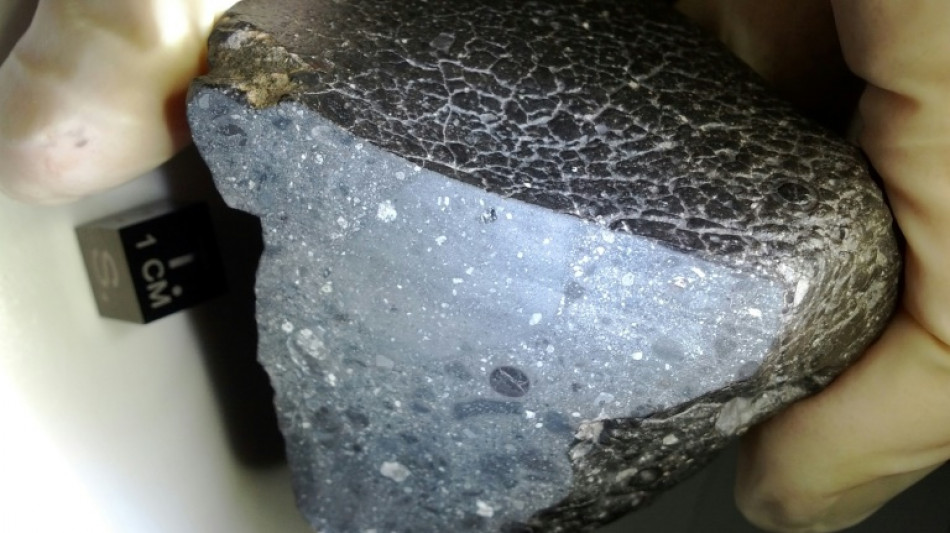
Scientists find oldest Martian meteorite's original home / Photo: - - NASA/AFP/File

 'He's here with me': Japan cycle queen dedicates gold to late brother

 Japan Olympic chief says 'lot more' athletes at Games than expected

 Asian carmakers besting US rivals at home, China poised to strike

 Widgets & Web Offers All-Inclusive Investor Relations Websites for Public Companies, IPOs and SPACs

 Adams named new US captain to 2030 World Cup

 China a better influence in Latin America than US: poll

 Judge pauses construction of border project in Texas national park

 Belgium's De Bruyne fires double to sink Turkey, France held by Italy

 US jobs data boosts stocks as oil prices dip

 US Supreme Court to hear high-stakes climate case

 Trump expected to name intel chief Clayton as AI czar: reports

 Argentina unveils passports-for-investment scheme

 Brazil election debate chaos sparks censorship row

 England's Carse charged by cricket body over nightclub incident

 Amazon vows $1 bn for data center towns, decries 'myths'

 Oil prices drop on G7 fuel release, US jobs data boosts stocks

 G7 agrees deal to ease global energy supply concerns

 Spain's government dealt blow as lawmakers reject housing bills

 Food, medicine shortages deepen in Russian-occupied Oleshky

 Man City whistleblower Rui Pinto facing 'dire consequences' - lawyers

 Russia 'tearing Kyiv apart', mayor says, as strikes paralyse traffic

 Taiwan boxer Lin wins Games gold as Japan edge North Korea on penalties

 Japan tame North Korea to win Games gold after shootout drama

 US posts weak job growth data in September

 Ethiopia's conflict: the regional dimension

Scientists announced Tuesday they had found the crater from which the oldest known Martian meteorite was originally blasted towards Earth, a discovery that could provide clues into how our own planet was formed.
The meteorite NWA 7034, nicknamed Black Beauty, has fascinated geologists since it was discovered in the Sahara Desert in 2011.
It fits easily in the hand, weighing just over 300 grams (10.6 ounces), and contains a mix of materials including zircons, which date back nearly 4.5 billion years.
"That makes it one of the oldest rocks studied in the history of geology," Sylvain Bouley, a planetary scientist at France's Paris-Saclay University, told AFP.
Its journey dates back to the solar system's infancy, "about 80 million years after the planets began forming", said Bouley, who co-authored a new study on the meteorite.
Tectonic plates long ago covered up Earth's ancient crust, meaning that "we have lost this primitive history of our planet", Bouley said.
But Black Beauty could offer "an open book on a planet's first moments", he added.
To open that book, a team of researchers at Australia's Curtin University set out to find the meteorite's original home on Mars.
They knew that it was likely an asteroid hitting the red planet that sent Black Beauty shooting up into space.
The impact "had enough force to eject the rocks at very high speed -- more than five kilometres (three miles) a second -- to escape the Martian gravity", Curtin's Anthony Lagain, the lead author of the study in Nature Communications, told AFP.
Such a crater would have to be massive -- at least three kilometres in diameter.
The problem? The pockmarked surface of Mars has around 80,000 craters at least that big.
- Following the clues -
But the researchers had a clue: by measuring Black Beauty's exposure to cosmic rays, they knew it was dislodged from its first home around five million years ago.
"So, we were looking for a crater that was very young and large," Lagain said.
Another clue was that its composition showed it had suddenly heated up around 1.5 million years ago -- likely by the impact of a second asteroid.
The team then created an algorithm and used a supercomputer to trawl through images of 90 million craters taken by a NASA satellite.
That narrowed it down to 19 craters, allowing the researchers to rule out the remaining suspects.
They found that Black Beauty was dug up from its first home by an asteroid that struck around 1.5 billion years ago, forming the 40-kilometre Khujirt crater.
Then a few million years ago, another asteroid hit not far away, creating the 10-kilometre Karratha crater and shooting the Black Beauty towards Earth.
The region in Mars' southern hemisphere is rich in the elements potassium and thorium, just like Black Beauty.
Another factor was that Black Beauty is the only Martian meteorite that is highly magnetised.
"The region where Karratha was found is the most magnetised on Mars," Lagain said.
Known as the Terra Cimmeria—Sirenum province, it is "a relic of the early crustal processes on Mars, and thus, a region of high interest for future missions," the study said.
Bouley pointed to a "bias" in the currently planned missions to Mars in favour of searching for signs of water and life.
But to understand how planets first form would answer some fundamental questions, Lagain said, including "how Earth became such an exceptional planet in the Universe".
A.Magalhes--PC



