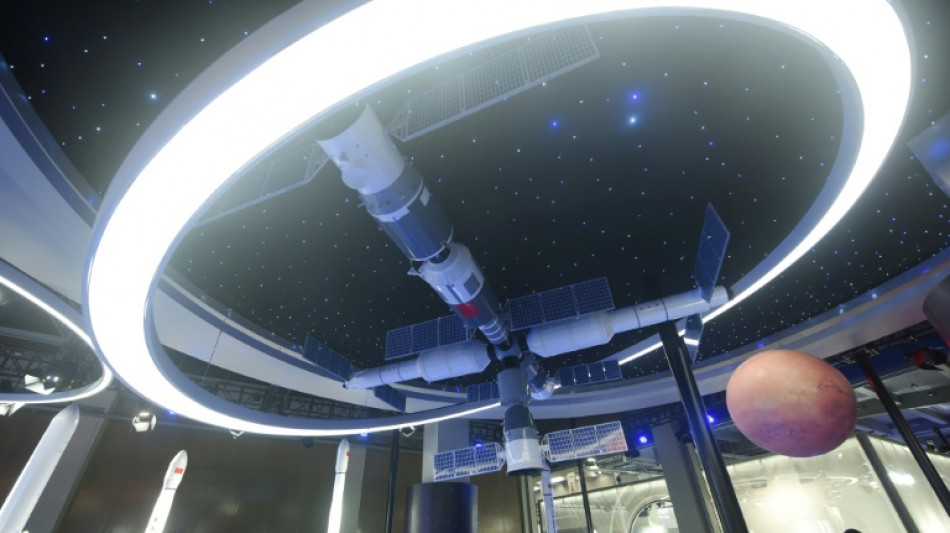
China launches second of three space station modules / Photo: STR - AFP

 'He's here with me': Japan cycle queen dedicates gold to late brother

 Japan Olympic chief says 'lot more' athletes at Games than expected

 Asian carmakers besting US rivals at home, China poised to strike

 Widgets & Web Offers All-Inclusive Investor Relations Websites for Public Companies, IPOs and SPACs

 Adams named new US captain to 2030 World Cup

 China a better influence in Latin America than US: poll

 Judge pauses construction of border project in Texas national park

 Belgium's De Bruyne fires double to sink Turkey, France held by Italy

 US jobs data boosts stocks as oil prices dip

 US Supreme Court to hear high-stakes climate case

 Trump expected to name intel chief Clayton as AI czar: reports

 Argentina unveils passports-for-investment scheme

 Brazil election debate chaos sparks censorship row

 England's Carse charged by cricket body over nightclub incident

 Amazon vows $1 bn for data center towns, decries 'myths'

 Oil prices drop on G7 fuel release, US jobs data boosts stocks

 G7 agrees deal to ease global energy supply concerns

 Spain's government dealt blow as lawmakers reject housing bills

 Food, medicine shortages deepen in Russian-occupied Oleshky

 Man City whistleblower Rui Pinto facing 'dire consequences' - lawyers
 Russia 'tearing Kyiv apart', mayor says, as strikes paralyse traffic

 Taiwan boxer Lin wins Games gold as Japan edge North Korea on penalties

 Japan tame North Korea to win Games gold after shootout drama

 US posts weak job growth data in September
 Ethiopia's conflict: the regional dimension

China on Sunday launched the second of three modules needed to complete its new space station, state media reported, the latest step in Beijing's ambitious space programme.
The uncrewed craft, named Wentian, was propelled by a Long March 5B rocket at 2:22 pm (0622 GMT) from the Wenchang launch centre on China's tropical island of Hainan.
A quarter of an hour later, an official from the China Manned Space Agency (CMSA) confirmed the "success" of the launch.
Hundreds of people gathered on nearby beaches to take photos of the launcher rising through the air in a plume of white smoke.
After around eight minutes of flight, "the Wentian lab module successfully separated from the rocket and entered its intended orbit, making the launch a complete success," the CMSA said.
Beijing launched the central module of its space station Tiangong -- which means "heavenly palace" -- in April 2021.
Almost 18 metres (60 feet) long and weighing 22 tons (48,500 pounds), the new module has three sleeping areas and space for scientific experiments.
It will dock with the existing module in space, a challenging operation that experts said will require several high-precision manipulations and the use of a robotic arm.
"This is the first time China has docked such large vehicles together, which is a delicate operation," said Jonathan McDowell, an astronomer at the Harvard-Smithsonian Center for Astrophysics.
He said until the next module arrives, the space station will have a "rather unusual L-shape" which will take a lot of power to keep stable.
"These are all technical challenges that the USSR pioneered with the Mir station in the late 1980s, but it's new to China," he told AFP.
"But it will result in a much more capable station with the space and power to carry out more scientific experiments."
Wentian will also serve as a backup platform to control the space station in the event of a failure.
The third and final module is scheduled to dock in October, and Tiangong -- which should have a lifespan of at least 10 years -- is expected to become fully operational by the end of the year.
- Fast-paced space plan -
Under Chinese President Xi Jinping, the country's plans for its heavily promoted "space dream" have been put into overdrive.
China has made large strides in catching up with the United States and Russia, where astronauts and cosmonauts have decades of experience in space exploration.
"The CSS (Chinese Space Station) will complete its construction... in one and half a year which will be the fastest in history for any modular space station," said Chen Lan, analyst for the site Go-Taikonauts.com, which specialises in China's space programme.
"In comparison, the constructions of Mir and the International Space Station took 10 and 12 years respectively."
China's space programme has already landed a rover on Mars and sent probes to the Moon.
In addition to a space station, Beijing is also planning to build a base on the Moon and send humans there by 2030.
China has been excluded from the International Space Station since 2011, when the United States banned NASA from engaging with the country.
While China does not plan to use its space station for global cooperation on the scale of the ISS, Beijing has said it is open to foreign collaboration.
F.Santana--PC



