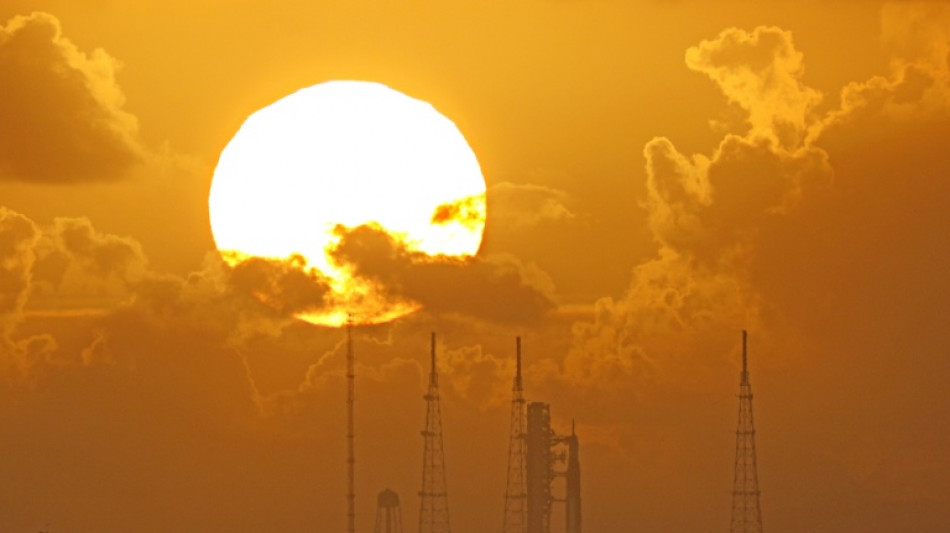
What to know about the Artemis 2 mission's Moon flyby / Photo: Gregg Newton - AFP/File

 Split loyalties for Indian football fans at Brazil friendly

 India-Pakistan blockbuster brings cricket fever to Japan baseball field

 Wong waiting on Rafa after winning Asian Games tennis gold

 With Russia next door and rising costs, Latvia goes to the polls

 Penalty hero rues empty seats as Games hosts Japan win football gold

 North Korea fires ballistic missile after Seoul's apology demand

 US regulator finds Boeing 737 MAX software bug 'not a safety concern'

 Ohtani 'managing' injuries as Dodgers launch MLB post-season

 Botched US execution leaves murderer unconscious on ventilator: lawyers

 Cornell rape case exposes sexual violence at US colleges

 France held by Italy in Zidane's homecoming after Olise stunner

 Ethiopian pro-government militia claims Tigray airport as regional tensions spike

 Ohtani shaking off injuries as Dodgers launch MLB post-season
 Sea levels to rise in California as coastal wave surges up west coast

 New rallies urged in France as protests disrupt over 730 schools

 Djokovic survives China Open scare, Sabalenka starts strong

 King Charles to evoke colonial 'darkest days' on Caribbean tour

 Tesla shares jump after global car sales top estimates

 DR Congo Ebola outbreak killed more than 4,000: official figures

 Djokovic survives China Open scare against wildcard world no. 104

 Lula, Bolsonaro trade blows in final scramble for votes in Brazil

 New clashes erupt as protests disrupt over 560 French schools

 NY governor vows to close loophole after alleged Cornell gang rape

 Ethiopia Tigray rebels pushed back as regional tensions spike

 Stocks rise, yields fall as US job numbers disappoint

For the first time in more than half a century, astronauts will fly around the Moon on Monday, marking the high point of the Artemis 2's lunar mission.
Here's what you need to know about the event:
- Live broadcast -
The flyby will last around seven hours, starting Monday around 2:45 p.m. eastern US time (1845 GMT) and ending around 9:20 p.m. (0120 GMT).
NASA will broadcast the flyby live on its website, as well as on YouTube, Amazon and Netflix, with commentary from both the astronauts aboard the mission and experts at the Mission Control center in Houston, Texas.
Given the lengthy distance -- further than any humans have ever traveled from Earth -- NASA has cautioned that the livestream video quality may be poor at times.
- Radio silence -
There will be a period of around 40 minutes during the flyby where all communication with Artemis 2 will be cut off as the astronauts pass behind the Moon.
"It'll be exciting, you know, in a slightly scary way, when they go behind the moon," Derek Buzasi, a professor of astronomy and astrophysics at the University of Chicago, told AFP.
The academic recalled during the Apollo missions to the Moon, "we all held our breaths a little bit."
- History-making milestones -
The Artemis 2 mission represents several first, as it will be the first time a woman, Christina Koch, a Black person, Victor Glover, and a non-American, Jeremy Hansen, will reach the Moon.
Until now, only the Apollo-era astronauts, all of whom were white American men, reached the Moon, between 1968 and 1972.
Shortly before the start of the flyby, the Artemis 2 crew will also reach the furthest distance humans have ever traveled from Earth.
The spacecraft is expected to surpass the Apollo 13 distance record by 4,102 miles (6,600 kilometers) and will reach a maximum distance from the planet of 252,757 miles (406,772 kilometers).
- Moon the size of a basketball -
Apollo flights flew some 70 miles (110 kilometers) above the lunar surface, but the Artemis 2 crew will be over 4,000 miles (6,500 kilometers) away at their closest approach.
The spaceship will actually swing around the Moon without entering its orbit by following a carefully planned trajectory.
The distance from the Moon will allow astronauts on board to see the complete, circular surface of the Moon, including regions near both poles.
The Moon will appear to the astronauts "about the size of a basketball held at arm's length," Noah Petro, head of NASA's planetary geology lab, told AFP.
- Far side of the Moon -
The flyby will see the Artemis 2 crew pass behind the far side of the Moon, which is not visible to Earth.
The astronauts of the Apollo mission also flew behind the Moon, but they were too close to witness it in entirety.
The Artemis 2 crew will therefore be able to see regions of the Moon that had previously only been captured by robotic imagers.
The four astronauts have gone through years of training to observe and describe the geological formations they observe as accurately as possible.
NASA scientists hope the observations recorded by the crew will provide information about the composition of the Moon and its history, as well as the wider solar system by extension.
- Solar eclipse -
Toward the end of the flyby, the astronauts will experience a rare phenomenon: a solar eclipse.
For about 53 minutes, their spacecraft will perfectly align with the Moon and the Sun, causing the star to disappear from view.
The astronauts will then have the chance to study the solar corona, the outermost layer of the Sun's atmosphere, which will become visible as a sort of glowing halo.
They will also be on the lookout for possible flashes of light caused by meteorites crashing into the surface of the Moon.
- 'Earthrise' redux -
The Artemis 2 astronauts will also see the Earth disappear and reappear behind the Moon.
Their position will potentially allow them to recreate the famous "Earthrise" photograph from the Apollo 8 mission in 1968.
The iconic photograph taken by astronaut William Anders captured the bright blue Earth against the vast darkness of space, with the Moon's cratered surface in the foreground.
M.Gameiro--PC



