
-
 Split loyalties for Indian football fans at Brazil friendly
-
Antonelli tops times in final practice at Bahrain GP

-
 India-Pakistan blockbuster brings cricket fever to Japan baseball field
-
Gauff digs deep to beat Osorio in China Open second round

-
 Wong waiting on Rafa after winning Asian Games tennis gold
-
Fresh protests to hit Spain after housing measures defeated

-
 With Russia next door and rising costs, Latvia goes to the polls
-
'He's here with me': Japan cycle queen dedicates gold to late brother

-
 Penalty hero rues empty seats as Games hosts Japan win football gold
-
Japan Olympic chief says 'lot more' athletes at Games than expected

-
 North Korea fires ballistic missile after Seoul's apology demand
-
Asian carmakers besting US rivals at home, China poised to strike

-
 US regulator finds Boeing 737 MAX software bug 'not a safety concern'
-
Widgets & Web Offers All-Inclusive Investor Relations Websites for Public Companies, IPOs and SPACs

-
 Ohtani 'managing' injuries as Dodgers launch MLB post-season
-
Adams named new US captain to 2030 World Cup

-
 Botched US execution leaves murderer unconscious on ventilator: lawyers
-
China a better influence in Latin America than US: poll

-
 Cornell rape case exposes sexual violence at US colleges
-
Judge pauses construction of border project in Texas national park
-
 France held by Italy in Zidane's homecoming after Olise stunner
-
Belgium's De Bruyne fires double to sink Turkey, France held by Italy

-
 Ethiopian pro-government militia claims Tigray airport as regional tensions spike
-
US jobs data boosts stocks as oil prices dip

-
 Ohtani shaking off injuries as Dodgers launch MLB post-season
-
US Supreme Court to hear high-stakes climate case
-
 Sea levels to rise in California as coastal wave surges up west coast
-
Trump expected to name intel chief Clayton as AI czar: reports

-
 New rallies urged in France as protests disrupt over 730 schools
-
Argentina unveils passports-for-investment scheme

-
 Djokovic survives China Open scare, Sabalenka starts strong
-
Brazil election debate chaos sparks censorship row

-
 King Charles to evoke colonial 'darkest days' on Caribbean tour
-
England's Carse charged by cricket body over nightclub incident

-
 Tesla shares jump after global car sales top estimates
-
Amazon vows $1 bn for data center towns, decries 'myths'

-
 DR Congo Ebola outbreak killed more than 4,000: official figures
-
Oil prices drop on G7 fuel release, US jobs data boosts stocks

-
 Djokovic survives China Open scare against wildcard world no. 104
-
G7 agrees deal to ease global energy supply concerns

-
 Lula, Bolsonaro trade blows in final scramble for votes in Brazil
-
Spain's government dealt blow as lawmakers reject housing bills

-
 New clashes erupt as protests disrupt over 560 French schools
-
Food, medicine shortages deepen in Russian-occupied Oleshky

-
 NY governor vows to close loophole after alleged Cornell gang rape
-
Man City whistleblower Rui Pinto facing 'dire consequences' - lawyers

-
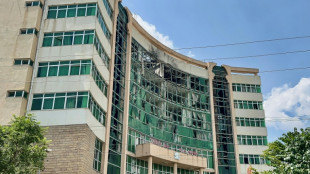 Ethiopia Tigray rebels pushed back as regional tensions spike
-
Russia 'tearing Kyiv apart', mayor says, as strikes paralyse traffic

-
 Stocks rise, yields fall as US job numbers disappoint
-
Taiwan boxer Lin wins Games gold as Japan edge North Korea on penalties

New frontier: Artemis astronauts break space distance record
The four astronauts embarking on NASA's lunar flyby became on Monday the humans to travel furthest from our planet, as they begin documenting areas of the Moon never before seen by the naked eye.
The Artemis II team broke the record set by the 1970's Apollo 13 mission, which they are expected to surpass by 4,105 miles (6,606 kilometers) when they reach this journey's anticipated furthest distance from Earth -- 252,760 miles (406,778 kilometers) -- later today.
"Today, for all humanity, you're pushing beyond that frontier," said Jenni Gibbons in Houston's mission control.
It was one of the voyage's most notable achievements yet.
Astronaut Jeremy Hansen said the moment was set "to challenge this generation and the next, to make sure this record is not long-lived."
The crew proposed designating two previously unnamed craters: one in honor of their nickname for their spacecraft, "Integrity."
They offered a second name, "Carroll," for another crater, which they requested be named after the late wife of mission commander Reid Wiseman, who died of cancer.
"It's a bright spot on the Moon," said Hansen, his voice breaking with emotion. "And we would like to call it Carroll."
The astronauts embraced, and mission control in Houston held a moment of silence.
"Integrity and Carroll crater, loud and clear. Thank you," said Gibbons.
- Lunar observations begin -
The crew members are now beginning in earnest their lunar observation period, in which they'll spend more than six hours analyzing and documenting lunar surface features.
The Orion capsule is zipping around the Moon before U-turning and heading back to Earth in a so-called "free-return trajectory," a return-trip that will take about four days.
The astronauts received encouragement from the late Jim Lovell, who took part in the Apollo 8 and 13 missions and recorded the message shortly before his death.
"It's a historic day, and I know how busy you'll be, but don't forget to enjoy the view," the Artemis astronauts heard from Lovell.
Swooping around the far side of the Moon, the crew will witness previously hidden lunar territory -- the sphere looming large through their capsule windows.
Adding to the historic nature of the mission led by Reid Wiseman, the Artemis II crew includes several firsts.
Victor Glover will be the first person of color to fly around the Moon, Christina Koch will be the first woman, and Canadian Jeremy Hansen the first non-American.
There will be a period of around 40 minutes during the flyby where all communication with Artemis II will be cut off, as the astronauts pass behind the Moon.
"It'll be exciting, you know, in a slightly scary way, when they go behind the Moon," Derek Buzasi, a professor of astronomy and astrophysics at the University of Chicago, told AFP.
- Human eye vs camera -
The astronauts have already started seeing features never previously glimpsed directly.
An image sent back by the crew showed the Moon's Orientale basin visible, a massive crater that before had only been viewed by orbiting, uncrewed cameras.
Near the end of their flyby, the astronauts will witness a solar eclipse, when the Sun will be behind the Moon.
Despite the technological advancements since the Apollo era, NASA still relies on the eyesight of its astronauts to learn more about the Moon.
"The human eye is basically the best camera that could ever or will ever exist," Kelsey Young, the lead scientist for the Artemis II mission, told AFP. "The number of receptors in the human eye far outweighs what a camera is able to do."
P.Sousa--PC



