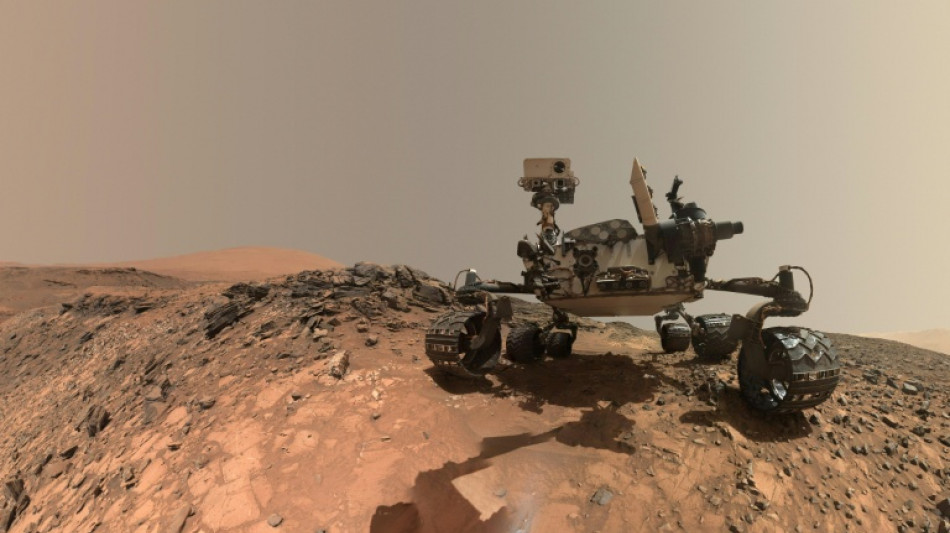
Rover discovers more building blocks of life on Mars / Photo: Handout - NASA/AFP/File

 'He's here with me': Japan cycle queen dedicates gold to late brother

 Japan Olympic chief says 'lot more' athletes at Games than expected

 Asian carmakers besting US rivals at home, China poised to strike
 Widgets & Web Offers All-Inclusive Investor Relations Websites for Public Companies, IPOs and SPACs

 Adams named new US captain to 2030 World Cup

 China a better influence in Latin America than US: poll

 Judge pauses construction of border project in Texas national park

 Belgium's De Bruyne fires double to sink Turkey, France held by Italy

 US jobs data boosts stocks as oil prices dip

 US Supreme Court to hear high-stakes climate case

 Trump expected to name intel chief Clayton as AI czar: reports

 Argentina unveils passports-for-investment scheme

 Brazil election debate chaos sparks censorship row

 England's Carse charged by cricket body over nightclub incident

 Amazon vows $1 bn for data center towns, decries 'myths'
 Oil prices drop on G7 fuel release, US jobs data boosts stocks

 G7 agrees deal to ease global energy supply concerns

 Spain's government dealt blow as lawmakers reject housing bills

 Food, medicine shortages deepen in Russian-occupied Oleshky

 Man City whistleblower Rui Pinto facing 'dire consequences' - lawyers

 Russia 'tearing Kyiv apart', mayor says, as strikes paralyse traffic

 Taiwan boxer Lin wins Games gold as Japan edge North Korea on penalties

 Japan tame North Korea to win Games gold after shootout drama

 US posts weak job growth data in September

 Ethiopia's conflict: the regional dimension

A NASA rover has discovered more building blocks of life on Mars after carrying out a chemistry experiment never before conducted on another planet, scientists said Tuesday.
The organic molecules are not definitive evidence of past life, the NASA-led team emphasised, because they could also have formed on the red planet or crash-landed on meteorites.
But it proves that these important clues to Martian history have been preserved on the surface for more than three billion years, they added.
Back then, the surface of Mars was thought to have been dotted with huge lakes and rivers full of liquid water, a key ingredient for life as we know it.
NASA's Curiosity rover landed in a former lake bed called the Gale crater in 2012, and has been searching for signs of possible past life since.
The car-sized rover carried two tubes of a chemical called TMAH, which can break apart organic matter to see what it is made out of.
"This experiment's never been run before on another world," Amy Williams, an astrobiologist working on the Curiosity mission told AFP.
The team were under pressure because they only had "two shots to get it right", added Williams, the lead author of a new study describing the results.
The experiment, conducted in 2020, detected more than 20 organic molecules, including several that had never before been confirmed on Mars.
These included a molecule called benzothiophene, which has also been found in meteorites and asteroids.
"The same stuff that rained down on Mars from meteorites is what rained down on Earth, and it probably provided the building blocks for life as we know it on our planet," Williams said.
Another molecule containing nitrogen "is a precursor to how DNA is eventually built," she added.
"We're seeing the building blocks for life -- prebiotic chemistry on Mars -- preserved in these rocks for billions of years."
- Future missions -
But none of this can prove that life -- even tiny, microbial organisms -- once flourished on Mars.
One way to potentially make such an "extraordinary claim" would be to bring some Martian rocks back to Earth so scientists can study them more closely, Williams said.
NASA's Perseverance rover has already collected a bunch of rocks for such a mission, called Mars Sample Return.
However the mission has effectively been cancelled by the administration of President Donald Trump following a US Congress vote in January.
Future missions could still benefit from Curiosity's demonstration that experiments using the TMAH chemical work on other worlds, the new study in Nature Communications said.
The European Space Agency's Rosalind Franklin rover, which has a much longer drill than Curiosity, will take the chemical to Mars.
After years of delays, NASA announced last week that the ESA's rover is now scheduled to blast off towards the red planet in late 2028.
The chemical will also be on board the Dragon rotorcraft, which is planned to launch in 2028 on a mission to explore Saturn's moon Titan.
F.Ferraz--PC



