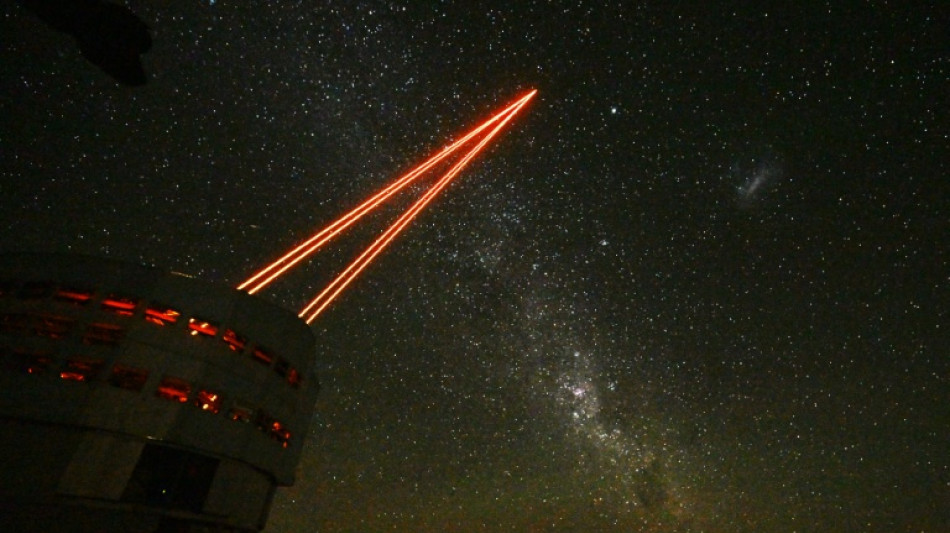
Exoplanets can have magnetic fields, 'hot Jupiter' winds reveal / Photo: RODRIGO ARANGUA - AFP/File

 Japan Olympic chief says 'lot more' athletes at Games than expected

 Asian carmakers besting US rivals at home, China poised to strike

 Widgets & Web Offers All-Inclusive Investor Relations Websites for Public Companies, IPOs and SPACs

 Adams named new US captain to 2030 World Cup

 China a better influence in Latin America than US: poll

 Judge pauses construction of border project in Texas national park

 Belgium's De Bruyne fires double to sink Turkey, France held by Italy

 US jobs data boosts stocks as oil prices dip

 US Supreme Court to hear high-stakes climate case

 Trump expected to name intel chief Clayton as AI czar: reports

 Argentina unveils passports-for-investment scheme

 Brazil election debate chaos sparks censorship row

 England's Carse charged by cricket body over nightclub incident

 Amazon vows $1 bn for data center towns, decries 'myths'

 Oil prices drop on G7 fuel release, US jobs data boosts stocks

 G7 agrees deal to ease global energy supply concerns

 Spain's government dealt blow as lawmakers reject housing bills

 Food, medicine shortages deepen in Russian-occupied Oleshky

 Man City whistleblower Rui Pinto facing 'dire consequences' - lawyers

 Russia 'tearing Kyiv apart', mayor says, as strikes paralyse traffic

 Taiwan boxer Lin wins Games gold as Japan edge North Korea on penalties

 Japan tame North Korea to win Games gold after shootout drama

 US posts weak job growth data in September

 Ethiopia's conflict: the regional dimension

 Life expectancy almost back to pre-Covid levels, says WHO

Planets beyond our solar system can have magnetic fields similar to those closer to home, astronomers said Tuesday after observing extreme winds on scorching worlds known as "hot Jupiters".
The observations offer the strongest evidence yet of magnetic fields outside our cosmic backyard, a subject which has long eluded scientists.
"It's the first time we can compare the magnetic environments of other worlds -- a key step toward ultimately understanding which planets can stay alive, keep their water, and perhaps even, one day, host life as we know it," said astronomer Julia Seidel of France's Cote d'Azur Observatory.
By deflecting the charged particles that bombard planets, magnetic fields play a "very complex role in atmospheric retention," Seidel, the lead author of a new study in Nature Astronomy, told AFP.
In our solar system, Earth, Jupiter and Saturn have active magnetic fields -- but Venus and Mars do not.
However exactly what is happening on far-away worlds known as exoplanets is difficult to measure.
Seidel and her colleagues did not originally intend to measure magnetic fields, but instead set out to look into wind.
The team studied seven "hot Jupiters", gas giants where temperatures can hit nearly 2,000 degrees Celsius. They have "compositions completely unknown in our solar system," Seidel explained.
These planets are so close to their stars that they are tidally locked.
This means they always have one side facing their star -- similar to how the same side of the Moon always faces Earth.
So it will always be a blisteringly hot day on one side of these planets, while the other sits in eternal night.
This extreme difference creates very violent winds, ranging from 7,200 to 25,000 kilometres (4,475 to 15,500 miles) an hour, the scientists found.
To measure these winds, they used the European Southern Observatory's Very Large Telescope in Chile and the Gemini North telescope in Hawaii.
- 'Totally counter intuitive' -
They also found something unexpected: the hotter the planet, the weaker the wind.
"This is totally counter intuitive," study co-author Vivien Parmentier said in a statement.
"Because, all things being equal, hot planets have more energy to accelerate the winds!"
The only plausible explanation was the presence of a magnetic field around these planets that slows down the movement of charged particles in their atmosphere.
The intensity of the magnetic fields was similar to those seen in our solar system, ranging from around four times stronger than Saturn's to half that of Jupiter's.
"This is the first study with such strong evidence" of magnetic fields on exoplanets, because it covers several worlds with the same traits, Seidel said.
"Now we know that exoplanets have magnetic fields" that are of "the same order of magnitude as what we see for Jupiter or even Earth," she added.
Previously, models had predicted exoplanets could have magnetic fields a hundred times more intense than those in our solar system.
By understanding the impact of magnetic fields in the "extreme laboratories" of hot Jupiters, "we are getting close to a comprehensive understanding of their role in planetary atmospheres," Seidel concluded.
L.E.Campos--PC



