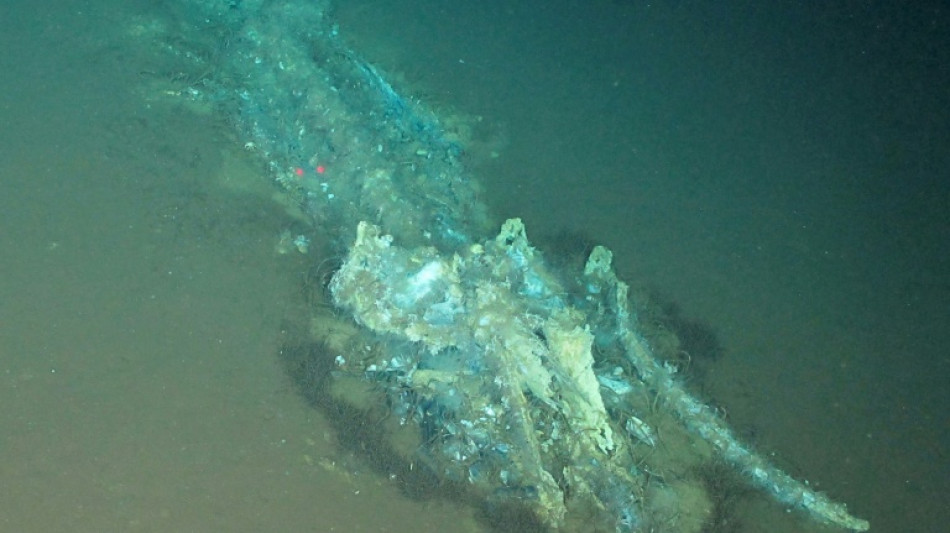
World's largest whale graveyard discovered by Chinese sub / Photo: Handout - Global TREnD, IDSSE/AFP

 US regulator finds Boeing 737 MAX software bug 'not a safety concern'

 Ohtani 'managing' injuries as Dodgers launch MLB post-season

 Botched US execution leaves murderer unconscious on ventilator: lawyers

 Cornell rape case exposes sexual violence at US colleges

 France held by Italy in Zidane's homecoming after Olise stunner

 Ethiopian pro-government militia claims Tigray airport as regional tensions spike

 Ohtani shaking off injuries as Dodgers launch MLB post-season

 Sea levels to rise in California as coastal wave surges up west coast

 New rallies urged in France as protests disrupt over 730 schools

 Djokovic survives China Open scare, Sabalenka starts strong

 King Charles to evoke colonial 'darkest days' on Caribbean tour

 Tesla shares jump after global car sales top estimates

 DR Congo Ebola outbreak killed more than 4,000: official figures

 Djokovic survives China Open scare against wildcard world no. 104

 Lula, Bolsonaro trade blows in final scramble for votes in Brazil

 New clashes erupt as protests disrupt over 560 French schools

 NY governor vows to close loophole after alleged Cornell gang rape

 Ethiopia Tigray rebels pushed back as regional tensions spike

 Stocks rise, yields fall as US job numbers disappoint

 Man City verdict a 'big topic' for England players, says Tuchel

 NY attorney general tasked with investigating alleged Cornell gang rape

 China widens military footprint with Laos air base
 G7 talks as US pressures Europe over diesel stocks

 Man City launch appeal against explosive financial ruling

 Swiss president to quit government
The world's largest whale graveyard has been discovered at the bottom of the Indian Ocean by Chinese scientists, who found that the vast expanse of both new and ancient carcasses supports huge communities of deep-sea life.
It is also the deepest and oldest known whale graveyard on Earth, according to research published in the journal Nature on Wednesday, with some fossils dating back 5.3 million years.
From inside a small submersible, the Chinese researchers saw many strange animals -- many believed to be new to science -- living off the whale carcasses.
A new, though extinct, species of whale was also identified among the nearly 500 skeletons found up to 7,000 metres deep along a 1,200 kilometre corridor of bones in the Indian Ocean west of Australia.
Lead study author Xiaotong Peng of the Chinese Academy of Sciences told AFP that the researchers were "astonished" when the scale of their discovery became clear.
It was known that when whales die and drop to the seafloor, their sunken bodies -- called "whale falls" -- provide a source of food to deep-sea creatures.
"But discovering a necropolis of this scale was completely unexpected: the size of distribution, the depth and the age range were far beyond anything we had imagined," Xiaotong Peng said.
The whales were believed to have died in such numbers in this particular area because it is a popular foraging habitat -- and has a V-shaped trench that funnels carcasses to the seafloor.
- 'Truly incredible experience' -
For the discovery, the Fendouzhe submersible carried out 32 dives in 2023 -- though what it found was only revealed in Nature on Wednesday.
The sub took up to three people on the dives, collecting the fossil samples using robotic arms.
Study co-author Peng Zhou said witnessing the whale graveyard "was a truly incredible experience".
"The vibrant ecosystems we saw offered a completely different perspective on this otherwise dark and cold ocean floor."
Among the animals they discovered living off the carcasses were jellyfish, brittle stars, bone-boring worms and molluscs called bivalves.
Most of the 485 fossils the scientists catalogued were from different species of beaked whales.
Extrapolating from the number of bones they found, the scientists estimated there could be more than 10 million carcasses across the area, which is called the Diamantina Zone.
The soft tissue and lipids inside that many carcasses "translates to roughly 6.7 million tonnes of sequestered carbon," Xiaotong Peng said.
This provides an immense source of sustenance for animals, similar to how hydrothermal vents create their own ecosystems on the ocean floor.
Some of the animals seen by the scientists also live in hydrothermal vents and cold seeps, suggesting whale carcasses could help connect these deep-sea communities.
While this is by far the largest whale graveyard yet found, fossils found during trawling suggest there could be others off South Africa, the Iberian peninsula and the Crozet islands, said the study.
- 'More blockbusters to come'? -
University of Hawaii oceanographer Craig Smith, who discovered the first whale fall in 1987 but was not involved in the new research, told AFP it was "extremely exciting".
"The vast number of fossil whale falls documented, including a new species of beaked whale, is truly amazing and is of major importance to understanding whale evolution and whale distributions over geologic time," he said.
Whale fall researcher Amy Baco-Taylor at Florida State University told AFP the "remarkable discovery" would "likely provide many new insights".
This includes for the animals living in these "chemosynthetic" communities, whose numbers had been thought to have been drastically reduced by human whaling, she added.
US palaeontologist Stephen Godfrey compared the "truly unique discovery" to past major underwater finds, such as when scientists first identified hydrothermal vents teeming with life on the ocean floor in 1977.
He called for future submersible voyages to find more whale graveyards across the world.
This discovery "reminded me of a trailer for the first in a series of epic movies", Godfrey commented in a linked Nature paper.
"I hope that there will be many more of these blockbusters to come."
C.Cassis--PC



