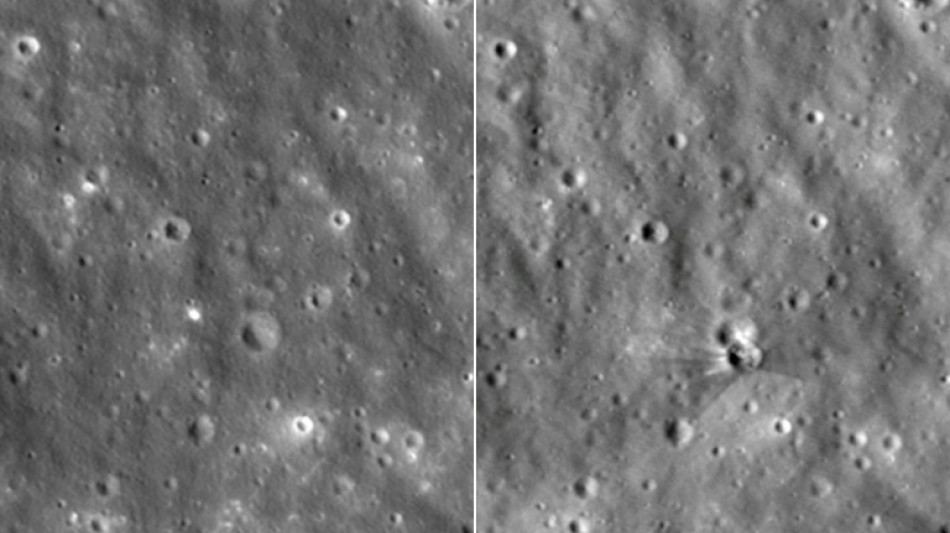
NASA images reveal crater left by SpaceX rocket's Moon crash / Photo: - - NASA Goddard/Intuitive Machines/AFP

 UK PM launches bid to help homeless, donating part of his wages

 Golden Shoe winner Kane hopes for Ballon d'Or after 'best season ever'

 Kyiv's ex-defence chief makes risky bet by venturing into electoral grounds

 Coventry have survival inspiration says Lampard

 Reijnders leaves Man City for Saudi's Al Qadsiah

 Trump says will meet North Korea's Kim later this year

 Stocks waver, dollar drops as US Treasury moves to lower bond yields

 France recalls rare disease drug Tavneos after deaths

 Arsenal agree to sign Villa defender Konsa: reports

 Evacuation orders lifted in Belgian wildfire zone

 UK media skewered for 'hounding' black academic

 More than 7,300 excess deaths in France's historically hot summer so far

 US socialists score shock Florida win as Trump picks stumble

 Iran warns Gulf countries against helping US after UAE cuts trade ties

 Senior FIFA official withdraws support from embattled Infantino

 Lawson replaces injured Hadjar for Red Bull at Dutch GP

 Robots sort packages and serve fast food at Beijing showcase

 Leeds sign Swiss defender Elvedi from Monchengladbach

 Robinson double rocks Pakistan in first Test before rain stops play

 Queen Camilla says was 'difficult' keeping King Charles' cancer private

 UK PM launches bid to get rough sleepers off streets by Christmas

 England bowl against Pakistan in first Test of post-Bazball era

 Villa sign Japanese 'keeper Suzuki, Italian defender Ruggeri

 Injury-plagued Pogba released by Monaco

 Japanese 'keeper Suzuki signs for Aston Villa

NASA on Tuesday released new images of the crater caused by a SpaceX rocket slamming into the Moon earlier this month.
The photographs were captured by the Lunar Reconnaissance Orbiter (LRO) between August 11 and 12, and show the impact formed by a SpaceX Falcon 9 upper stage striking the Moon's surface on August 5.
Scientists from the US space agency determined the crater was 60-feet-wide (18 meters), and less than 10 feet deep, based on the length of its shadow.
The Falcon 9 launched in January 2025 carrying Firefly Aerospace's Blue Ghost 1 lunar lander, a private mission that made a soft landing on the Moon.
These weren't the first images of the crash site. The Korean space agency published pictures on August 6 that were taken a day earlier by Korea Pathfinder Lunar Orbiter (KPLO), also known as Danuri.
The LRO, in service since 2009, circles the Moon from pole to pole every two hours while the Moon rotates underneath it.
A NASA statement said it was challenging to capture the image. To photograph a specific spot on the Moon, the spacecraft must wait until that location turns into view, which took six days in this case -- and the spacecraft had to be tilted just right so that its camera pointed to the crater while it passed 60 miles overhead.
Timing was the other challenge, NASA said: "If the camera snapped even 10 seconds too early or too late, the target would drift off-center by 10 miles."
The images they captured from different viewing angles brought out different features, including brighter and darker streaks fanning out around the crater.
NASA explained the darker streaks "are made of surface dust and rocks altered over a long time by solar wind, galactic cosmic rays, and micrometeorite impacts" that was thrown up by the collision from 1.5 feet below the surface.
The brighter streaks that hug the crater's rim were fresh material excavated from deeper underground.
Finding the crater site was a global endeavor that brought together leading experts and hobbyists.
NASA said its Center for Near Earth Object Studies incrementally refined the trajectory until identifying the location of impact, which it then provided to Korea.
The Danuri team in turn sent their coordinates to NASA's LRO team to help refine their follow-up imaging sequence.
S.Caetano--PC