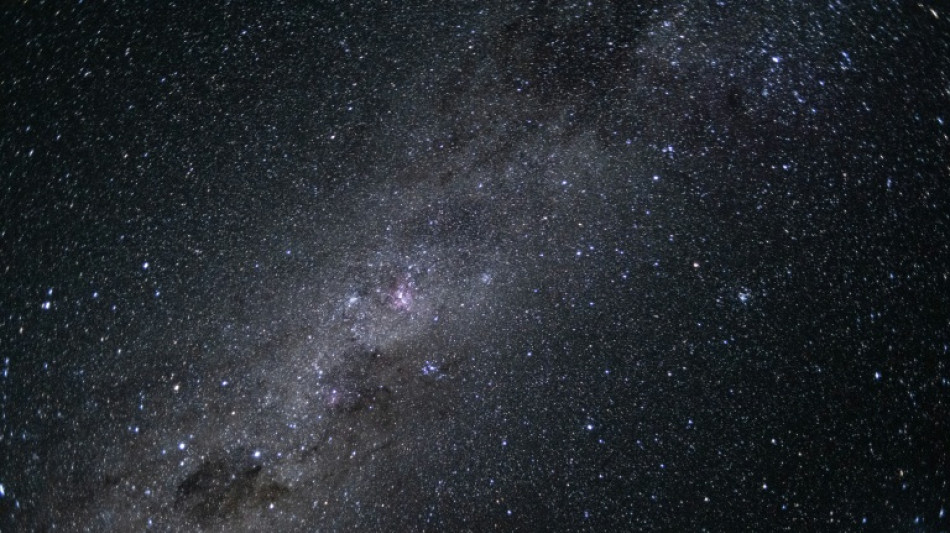
Milky Way's fastest star discovered spinning around black hole / Photo: Handout - NASA/AFP/File

 Kylie Jenner employee describes closet ordeal and pepper-spray incident

 Synchron Halts Clinical Trials of Second-Generation Brain Implant Due to Performance Issues

 Davante Adams injury deepens Los Angeles Rams receiver shortage

 João Franco’s earlier post draws attention after arrest over fatal Turkey brawl

 Itlu Arjuna receives U/A certificate ahead of theatrical release

 Dhananjaya de Silva guides Sri Lanka to 221-4 against Pakistan

 Delhi gold loses Rs 800 while silver falls Rs 5,000

 Pradeep Antony, Smeha Manimegalai portray secret spouses in Mr & Mrs Office

 Woman barred from every Greggs outlet after series of offences

 Ketchup packets link suspect to break-in at Eddie Rocket’s restaurant

 Spain's General Strike Links Housing Crisis to Lost Purchasing Power

 China's Factory Inflation Accelerates While Consumer Demand Stays Weak

 Bank of England Raises Interest Rate to 4% as Energy Risks Intensify

 OPEC Says Oil Output Is Near Prewar Levels Despite Shipping Disruptions

 China's Singles' Day Exposes Persistent Consumer Caution

 Irish police prepare for further hoax bomb threats after hundreds of schools targeted

 RBA Inflation Target Origins: Why Australia Chose a Range Over Zero

 Sister recounts fatal machete attack as Irish murder trial continues

 NEET’s Merit Promise Erodes as Cost and Time Barriers Rise for Medical Aspirants

 HoloCoder technology promises brighter smartphone images and 3D depth data

 TuckShop Announces Cast for 'Jack and the Beanstalk' Drag Panto

 Nvidia faces scrutiny over alleged Chinese intelligence link to Jensen Huang

 Samsung One UI 9.5 Reportedly Adds Call Recording for WhatsApp and Telegram

 Kiara Advani Reveals Sidharth Malhotra’s Reaction to Toxic Backlash

 Four firms compete to design Chennai’s model mobility corridors

Astronomers have discovered the fastest star in the Milky Way zooming at 25,000 kilometres a second around the supermassive black hole at the centre of our galaxy.
The star, named S301, orbits so dangerously close to the black hole that scientists believe it can shed light on this unimaginably powerful cosmic monster -- and test out Albert Einstein's theory of relativity.
"Decades carefully tracking stars orbiting our galaxy's central black hole, Sagittarius A*, have led to this breakthrough discovery," Reinhard Genzel of the Max Planck Institute for Extraterrestrial Physics in Germany said in a statement.
"Because it orbits so close to Sagittarius A*, S301 opens a new window to the fundamental properties of spacetime in this extreme black-hole environment," added Genzel, who shared a 2020 physics Nobel prize for discovering the black hole.
To spot S301 -- which is two billion times fainter than the star Betelgeuse in our sky -- the team of astronomers used the European Southern Observatory's Very Large Telescope in the Chilean desert.
They first noticed the star in 2023, and have been tracking its orbit since.
"What is special about this star is that it's orbiting Sagittarius A* on a very tight orbit, taking just 8.7 years to complete it," explained Felix Mang, a co-author of a new study describing the discovery.
The star gets roughly as close to the black hole as Saturn gets to our Sun, which is "unprecedented", the PhD student emphasised.
- Torn from its partner -
When the star gets closest to the immense suck of the black hole, it is travelling around 25,000 kilometres per second (15,500 miles per second).
That is 100,000 times faster than a commercial airplane, or more than eight percent of the speed of light, making it the fastest star ever detected in our galaxy.
Scientists believe that S301 was once part of a binary star system that was torn apart by the almighty pull of the black hole.
While S301 became trapped in the black hole's gravity, its partner star was blasted out with such force it likely left the galaxy entirely.
The astronomers will get another good look at the star when it makes its next closest approach to the black hole in 2031.
The team hopes that data from two complete orbits will allow them to determine the star's trajectory with enough precision they can also directly measure the black hole's rotation.
Like most objects in the universe, black holes are thought to spin.
Einstein's theory of general relativity predicted that a spinning black hole would drag spacetime along with it, twisting it in a way that changes the orbits of the surrounding stars.
Within the next 10 years, the astronomers hope to use S301 to measure the black hole's spin for the first time.
"Without this star, we would need to measure the motion of other stars for several more decades to get anywhere close to measuring the spin of the black hole," explained French astronomer and study co-author Juan Osorno.
The study was published in Nature on Wednesday.
L.Henrique--PC