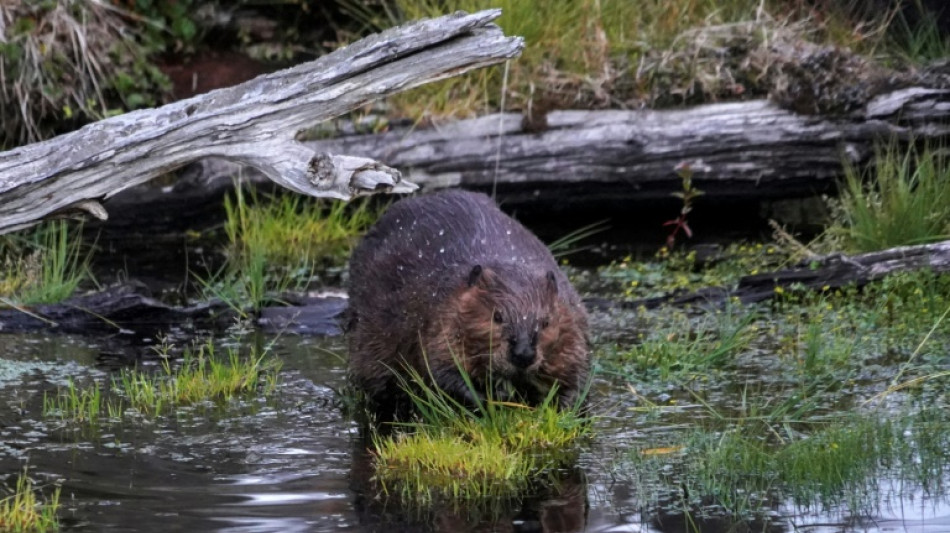
Eager beaver: dams improve quality of river water hit by climate change / Photo: PABLO COZZAGLIO - AFP

 World No.1 Sinner pulls out of Shanghai Masters to delay return

 Red Bull's Verstappen grabs pole position for Bahrain GP

 India beat Pakistan in blockbuster as golfer Kim wins 'crazy' gold

 India beat arch-rivals Pakistan to win Asian Games cricket gold

 Ethiopia's Tigray rebels abandon regional capital as govt advances: journalist

 Tom Kim powers to Games gold and exemption from military service

 Split loyalties for Indian football fans at Brazil friendly

 India-Pakistan blockbuster brings cricket fever to Japan baseball field

 Wong waiting on Rafa after winning Asian Games tennis gold

 With Russia next door and rising costs, Latvia goes to the polls

 Penalty hero rues empty seats as Games hosts Japan win football gold

 North Korea fires ballistic missile after Seoul's apology demand

 US regulator finds Boeing 737 MAX software bug 'not a safety concern'

 Ohtani 'managing' injuries as Dodgers launch MLB post-season

 Botched US execution leaves murderer unconscious on ventilator: lawyers

 Cornell rape case exposes sexual violence at US colleges

 France held by Italy in Zidane's homecoming after Olise stunner

 Ethiopian pro-government militia claims Tigray airport as regional tensions spike

 Ohtani shaking off injuries as Dodgers launch MLB post-season
 Sea levels to rise in California as coastal wave surges up west coast

 New rallies urged in France as protests disrupt over 730 schools

 Djokovic survives China Open scare, Sabalenka starts strong

 King Charles to evoke colonial 'darkest days' on Caribbean tour

 Tesla shares jump after global car sales top estimates

 DR Congo Ebola outbreak killed more than 4,000: official figures

Hotter, drier weather means beaver populations are spreading in the western United States, and their dams are helping to mitigate the negative impacts of climate change on river water quality, according to a new study on Tuesday.
The findings -- discovered almost by accident -- offered a "rare bright spot" in an otherwise bleak landscape of climate change news, the lead author told AFP.
Stanford University scientists and colleagues conducted the research over three years on the East River, a main tributary of the Colorado River in the US state of Colorado.
It has long been known that beaver dams can improve the quality of river water by filtering out contaminants.
But what came as a surprise is what the Stanford team described as a virtuous climate change-induced "feedback" loop.
It works like this: hotter, drier spells linked to a warming world often reduce water quality, mainly because less water leads to a higher concentration of contaminants such as nitrate, a form of nitrogen.
At the same time, a changing climate has increased the range of industrious buck-toothed beavers, and widened the impact of their dams, thus helping to dilute the negative impact of global warming.
"In building more dams, they mitigate that degradation in water quality that's caused by climate change," lead author Christian Dewey told AFP.
When the beavers' dams raise water levels upstream, water is diverted into surrounding soils and secondary waterways, collectively called a riparian zone.
"These zones act like filters, straining out excess nutrients and contaminants before water re-enters the main channel downstream," according to a press release about the study, published in Nature Communications.
- 'Rare bright spot' -
The same contaminants -- potentially harmful to humans, animals or plants in river water -- are thus dispersed with little or no negative impact in soils.
This is good news in the area where the research was conducted, as the Colorado River provides drinking water and supports livelihoods for some 40 million people, according to the US government.
Nitrogen in particular promotes algae overgrowth, which starves water of oxygen needed to support diverse animal life and a healthy ecosystem.
The study found that the benefits provided by the beaver dams improved water quality in both high- and low-water conditions linked to climate change -- whether hot and dry spells, or heavy rainfall and snowmelt.
In both cases, "the beaver dam pushed more water and nitrate into surrounding soil than did either seasonal extreme, leading to vastly more removal of nitrate", Dewey said.
He said he did not set out to study beaver dams initially, but one cropped up on the river he was testing for seasonal changes in hydrology.
"It was incredibly lucky," he said.
He cautioned that the feedback dynamic may be unique to the particular conditions in western United States, and thus may not be found elsewhere.
But the findings are still "a rare bright spot in climate news", and perhaps an example of nature restoring balance.
"We push too far, and then (there's) sort of a swinging back in the other direction, at least in the case of beavers."
E.Paulino--PC



