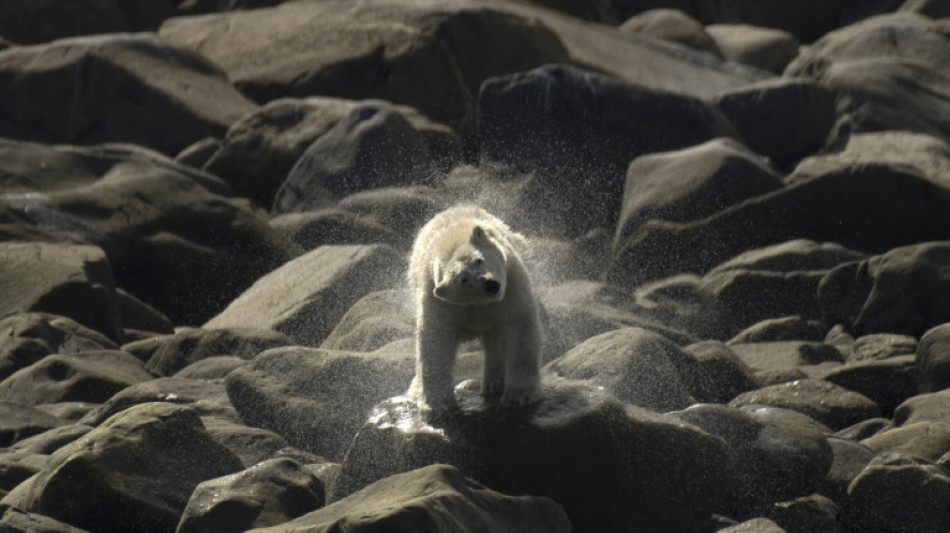
Canadian polar bears disappearing fast: study / Photo: Olivier MORIN - AFP/File

 US warns of rapid escalation in Mideast war

 Iran 'put hearts on the court' to win Asian Games basketball bronze

 School girl Yu helps China dominate in Asian Games swimming openers

 Myanmar win first Asian Games teqball gold as Spain great Puyol watches

 China's 13-year-old Yu scorches to first major gold at Asian Games

 Russians vote on last day of parliamentary elections

 Hong Kong pays final respects to former city leader Tung

 Typhoon put people off Asian Games opening ceremony, official says

 China's 13-year-old Yu cruises as Asian Games swimming begins

 AI 'warning shots' focus Beijing on national security risks

 Philippine tribe in limbo over US-led tech hub

 Leo XIV, first US pope transcends his restrained style

 Singer Ed Sheeran says Gaza situation 'unjustifiable' following controversy

 In 'Tenzing', a Sherpa mountaineer gets his due

 Ed Sheeran set to return to stage after Palestinian controversy

 Toulouse edge Vannes, Lyon beat Pau to take Top 14 summit

 Germans arrested for Louvre stunt in Mona Lisa hall

 Saudi-led coalition says Houthis fired ballistic missile at Riyadh

 France's debt climbs to highest since 1978: ministry

 McIlroy two shots off the lead at Wentworth after eagle on 18

 Martinez brace saves Inter in Serie A top-two clash with Roma

 Rosenior abused but guides Paris FC past old club Strasbourg

 Seven-try Lyon beat Pau, climb to Top 14 summit

 Brighton defeat a 'big lesson' against complacency for Arsenal, says Arteta

 Thousands protest inaction over climate crisis in Switzerland

Polar bears are disappearing fast from the Western part of Hudson Bay, on the southern tip of the Canadian Arctic, according to a new government survey.
The number of female bears and cubs in particular has seen a dramatic decline.
Researchers have flown over the region -- which includes the town of Churchill, a tourist destination touted as the "polar bear capital of the world" -- every five years to count the number of bears and extrapolate population trends.
During the last survey in late August and early September 2021, the results of which were released earlier this month, they spotted 194 bears and, based on that count, estimated a total population of 618 bears, down from 842 five years earlier.
"Comparison to aerial surveys estimates from 2011 and 2016 suggests that the WH (Western Hudson Bay population) may be decreasing in abundance," the study said.
It also "revealed significant declines in the abundance of adult female and subadult bears (cubs) between 2011 and 2021."
"The observed declines are consistent with long-standing predictions regarding the demographic effects of climate change on polar bears," the researchers said.
They also cited possible displacements of bears to neighboring regions and hunting for the population decline.
The bears' sea-ice habitat has been disappearing at an alarming rate, with the far north warming up to four times faster than the rest of the world.
The sea ice has become less thick and is breaking up earlier in the spring as well as freezing later in the fall.
The bears rely on the ice for foraging for seals, movement and reproduction.
Since the 1980s, the ice pack in the bay has decreased by nearly 50 percent in summer, according to the US National Snow and Ice Data Center.
A report published two years ago in the journal Nature Climate Change suggested this trend could lead to the near-extinction of these animals, noting there were 1,200 polar bears on the western shores of Hudson Bay in the 1980s.
P.Cavaco--PC