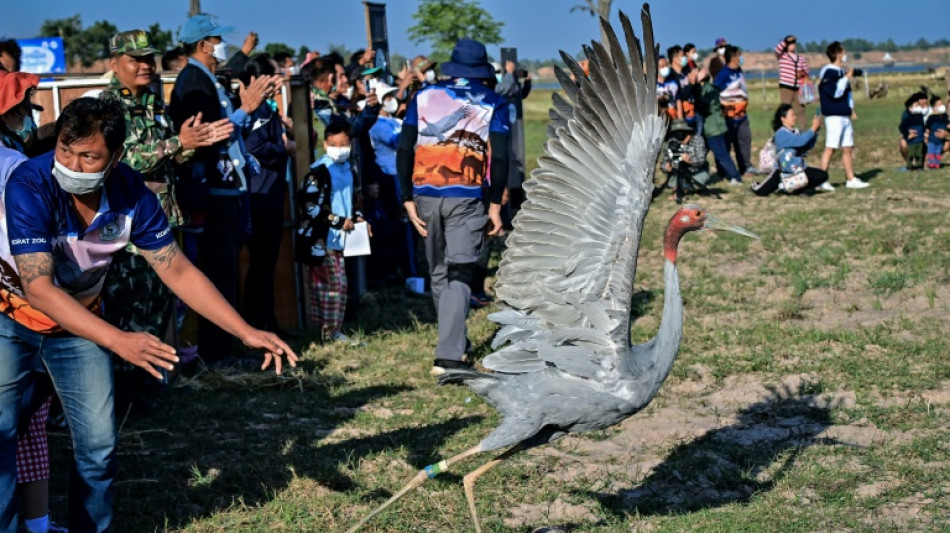
Fly away home: rare Eastern Sarus cranes released in Thailand / Photo: Lillian SUWANRUMPHA - AFP

 US warns of rapid escalation in Mideast war

 Iran 'put hearts on the court' to win Asian Games basketball bronze

 School girl Yu helps China dominate in Asian Games swimming openers

 Myanmar win first Asian Games teqball gold as Spain great Puyol watches

 China's 13-year-old Yu scorches to first major gold at Asian Games

 Russians vote on last day of parliamentary elections

 Hong Kong pays final respects to former city leader Tung

 Typhoon put people off Asian Games opening ceremony, official says

 China's 13-year-old Yu cruises as Asian Games swimming begins

 AI 'warning shots' focus Beijing on national security risks

 Philippine tribe in limbo over US-led tech hub

 Leo XIV, first US pope transcends his restrained style

 Singer Ed Sheeran says Gaza situation 'unjustifiable' following controversy

 In 'Tenzing', a Sherpa mountaineer gets his due

 Ed Sheeran set to return to stage after Palestinian controversy

 Toulouse edge Vannes, Lyon beat Pau to take Top 14 summit

 Germans arrested for Louvre stunt in Mona Lisa hall

 Saudi-led coalition says Houthis fired ballistic missile at Riyadh

 France's debt climbs to highest since 1978: ministry

 McIlroy two shots off the lead at Wentworth after eagle on 18

 Martinez brace saves Inter in Serie A top-two clash with Roma

 Rosenior abused but guides Paris FC past old club Strasbourg

 Seven-try Lyon beat Pau, climb to Top 14 summit

 Brighton defeat a 'big lesson' against complacency for Arsenal, says Arteta

 Thousands protest inaction over climate crisis in Switzerland

As the sun came up, 13 Thai Eastern Sarus cranes were released over a rippling reservoir in northeast Thailand, the latest effort to revive the almost-extinct species in the kingdom.
More commonly known as Thai cranes, the birds nearly disappeared from the country roughly 50 years ago -- they were last spotted in the wild in 1968 -- before a collaboration between the Thai government, Nakhon Ratchasima Zoo and United Nations to save them.
A breeding programme, using fowl donated by Cambodia, began in 1989, with the first reintroduction in 2011.
Sarus cranes are classed by the ICNC as "vulnerable", with an estimated 15,000 remaining in the wild -- with the Thai sub-species having been thought to have disappeared from Thailand's wild wetlands.
But since 2011, more than 150 captively-bred birds -- which can grow to up to six feet (1.8 metres) and weigh almost seven kilograms (15 pounds) -- have been released in Buriram province.
"It is the only place where the Thai cranes are able to live and reproduce on their own," said Governor Chaiwat Chuntirapong.
The birds were transported in large, specially adapted boxes -- their red-feathered heads watching through mesh windows -- from the Wetland and Eastern Sarus Crane Conservation Center where they were bred to the Huai Chorakhe Mak Reservoir.
The latest flock of 13 cranes were released all at once on Christmas Day. The tall birds loudly honked and clumsily flapped as they unsteadily took to the skies accompanied by cheering children and spectators.
It was the final moment in a long journey for the researchers, who carefully nurtured the cranes from hatching, gradually introduced them to the wild and then took them to their final flight to freedom.
"The herdsman wears a suit that hides her body and wears a bird's head puppet on her hands to teach the birds everything from feeding to familiarising them with nature," said Nakhon Ratchasima Zoo researcher Tanat Uttaraviset.
As a result of the long process, roughly 60 to 70 percent of the birds survive in the wild, he said.
Prior to their release, each bird is micro-chipped and tagged, allowing researchers to track them and improve the conservation efforts.
As well as rearing and releasing the cranes, an important part of the programme has been educating people about the species and the environment.
Huai Chorakhe Mak Reservoir was chosen partly thanks to its natural proliferation of water chestnuts -- an important food source for cranes in the dry season.
But their habitat remains threatened by the "widespread invasion of agriculture", said director of Nakhon Ratchasima Zoo Thanachon Kensing.
The zoo has established a learning centre, teaching tourists and locals about how to better care for the environment the birds need to survive.
"Changing villagers' attitudes is difficult," Thanachon admitted.
"But if we can communicate with them... this project will be successful," he said.
Watching his red-headed charges soar off over the sparkling waters, researcher Tanat had just one hope.
"The ultimate goal is to secure the crane population," he said.
P.Serra--PC