In Uruguay, an effort to save horses from foreign plates
/ Photo: Pablo PORCIUNCULA - AFP

 US warns of rapid escalation in Mideast war

 Iran 'put hearts on the court' to win Asian Games basketball bronze

 School girl Yu helps China dominate in Asian Games swimming openers

 Myanmar win first Asian Games teqball gold as Spain great Puyol watches

 China's 13-year-old Yu scorches to first major gold at Asian Games

 Russians vote on last day of parliamentary elections

 Hong Kong pays final respects to former city leader Tung

 Typhoon put people off Asian Games opening ceremony, official says

 China's 13-year-old Yu cruises as Asian Games swimming begins

 AI 'warning shots' focus Beijing on national security risks

 Philippine tribe in limbo over US-led tech hub

 Leo XIV, first US pope transcends his restrained style

 Singer Ed Sheeran says Gaza situation 'unjustifiable' following controversy

 In 'Tenzing', a Sherpa mountaineer gets his due

 Ed Sheeran set to return to stage after Palestinian controversy

 Toulouse edge Vannes, Lyon beat Pau to take Top 14 summit

 Germans arrested for Louvre stunt in Mona Lisa hall

 Saudi-led coalition says Houthis fired ballistic missile at Riyadh

 France's debt climbs to highest since 1978: ministry

 McIlroy two shots off the lead at Wentworth after eagle on 18

 Martinez brace saves Inter in Serie A top-two clash with Roma

 Rosenior abused but guides Paris FC past old club Strasbourg

 Seven-try Lyon beat Pau, climb to Top 14 summit

 Brighton defeat a 'big lesson' against complacency for Arsenal, says Arteta

 Thousands protest inaction over climate crisis in Switzerland

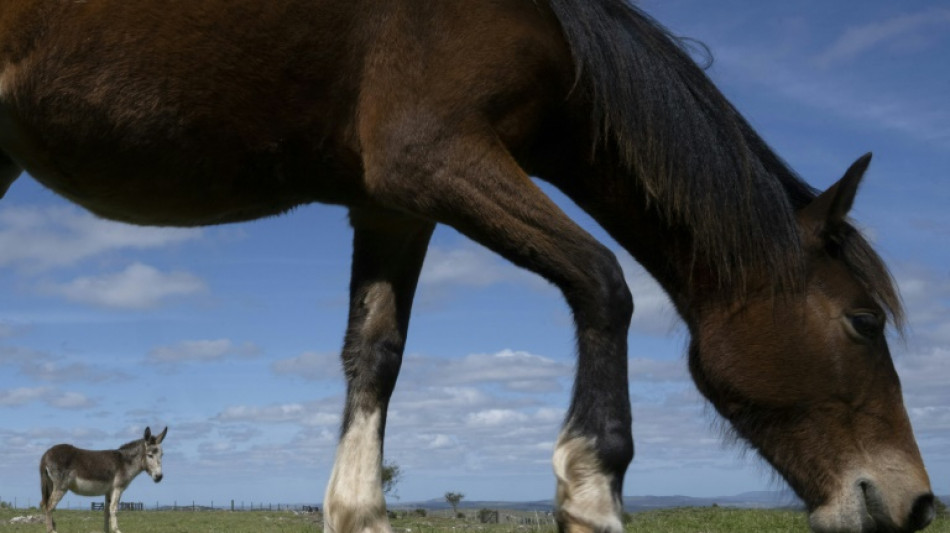
Among a motley collection of rescued farm animals, four horses graze peacefully on a farm outside the Uruguayan capital Montevideo, blissfully unaware they had narrowly escaped the chopping block.
Uruguay, a country where horses are not considered food but companions, has seen a rise in equine meat exports, prompting efforts to rescue horses destined for slaughter.
In 2020, the small South American nation was the seventh-largest exporter of horse meat, according to the OEC economic data site, with Belgium, Russia, France and Japan among the top importers.
Most of Uruguay's tens of thousands of race, sports and work horses end up on someone's plate somewhere else in the world after they become injured, old, or their owners simply cannot care for them anymore.
Uruguayan horses are not bred for meat, but used in racing or dressage and on farms -- often by cattle-breeding gauchos who prefer to travel the grassy plains on horseback rather than by car.
In Pan de Azucar, some 115 kilometers (71 miles) east of Montevideo, horses destined for slaughter are finding a second chance on the farm of Juan Pablo Pio.
For now, he is playing host to four horses that were bought by the NGO Santuarios Primitivo, who took the animals from a truck headed for one of Uruguay's three equine slaughterhouses, and them brought to his farm.
"They have come to live what is left of their lives here," said Pio, who described his mission as "doing things because they are right and not because they are profitable."
"Their only mission... is to exist," he added of the four-footed newcomers.
Pio also has a rescued chicken, a donkey, a pig and a cow.
- Fattened up -
Santuarios Primitivo was created three years ago by Pablo Amorin y Martin Erro, friends with ties to the equestrian world.
Since then, they have saved some 250 horses and found new homes for them on dozens of farms across the small South American nation.
Amorin told AFP that his team contacts herdsmen who gather unwanted horses from around Uruguay to be fattened up and sold for slaughter.
"We tried to go to the slaughterhouses, but they wouldn't open their doors for us to buy (horses) from them," he said.
"So, we turned our attention to... the 'tropilleros.' When we have money or space to buy and adopt horses, we talk to the herdsmen and tell them: 'When the next shipment comes in, we want five horses for ourselves'."
Many of the herdsmen are happy to help, said Amorin, and sometimes even ask the rescuers to take a particular horse that they had grown fond of from among the condemned.
- 'Noble animal' -
Uruguay is cattle country: beef is its main export commodity and there are more than three cows for each of the country's 3.5 million inhabitants -- the highest number per capita in the world.
As for horses, there is one for every seven inhabitants, according to the Uruguayan Equine Veterinary Association -- about half-a-million.
In 2021, the country slaughtered 58,152 horses, according to Uruguay's INAC national meat institute -- up 61 percent from 2020 and the highest number by far in a decade.
Uruguay's horse meat export volume rose percent in 2021, valued at some $28.8 million, said the INAC. In 2022, exports rose further still.
Beef is cheap in Uruguay, and for an Uruguayan to eat horse meat would be sacrilege. But the fact that their horses are being eaten abroad is an uncomfortable open secret.
"The horse carries symbolic value in our culture," anthropologist Gustavo Laborde told AFP.
In Uruguay, it is said that "the country was made on horseback," he added.
Yet as much as the horse is regarded as a "noble animal," there was an element of "hypocrisy" in balking at horse meat while turning a blind eye to the animals' often tough working lives after which "the vast majority of horses end up in the refrigerator" anyway, said Laborde.
H.Portela--PC