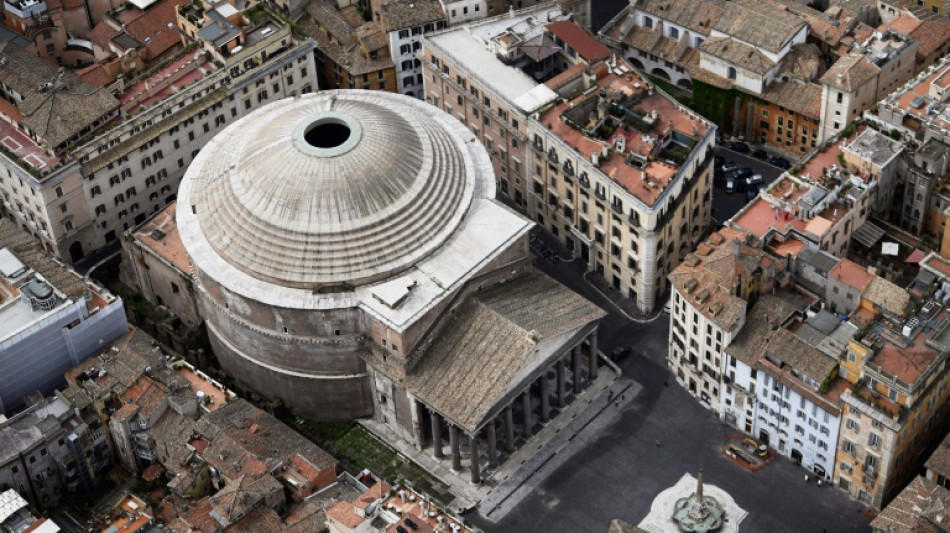
Researchers dig up secrets of 'self-healing' Roman concrete / Photo: Filippo MONTEFORTE - AFP

 US warns of rapid escalation in Mideast war

 Iran 'put hearts on the court' to win Asian Games basketball bronze

 School girl Yu helps China dominate in Asian Games swimming openers

 Myanmar win first Asian Games teqball gold as Spain great Puyol watches

 China's 13-year-old Yu scorches to first major gold at Asian Games

 Russians vote on last day of parliamentary elections

 Hong Kong pays final respects to former city leader Tung

 Typhoon put people off Asian Games opening ceremony, official says

 China's 13-year-old Yu cruises as Asian Games swimming begins

 AI 'warning shots' focus Beijing on national security risks

 Philippine tribe in limbo over US-led tech hub

 Leo XIV, first US pope transcends his restrained style

 Singer Ed Sheeran says Gaza situation 'unjustifiable' following controversy

 In 'Tenzing', a Sherpa mountaineer gets his due

 Ed Sheeran set to return to stage after Palestinian controversy

 Toulouse edge Vannes, Lyon beat Pau to take Top 14 summit

 Germans arrested for Louvre stunt in Mona Lisa hall

 Saudi-led coalition says Houthis fired ballistic missile at Riyadh

 France's debt climbs to highest since 1978: ministry

 McIlroy two shots off the lead at Wentworth after eagle on 18

 Martinez brace saves Inter in Serie A top-two clash with Roma

 Rosenior abused but guides Paris FC past old club Strasbourg

 Seven-try Lyon beat Pau, climb to Top 14 summit

 Brighton defeat a 'big lesson' against complacency for Arsenal, says Arteta

 Thousands protest inaction over climate crisis in Switzerland

How have Rome's ancient aqueducts and architectural marvels such as the Pantheon, which features the world's largest unreinforced concrete dome, endured the test of time?
Researchers at the Massachusetts Institute of Technology (MIT) and other institutions believe they have uncovered the mystery of the durability of the 2,000-year-old structures -- self-healing concrete.
The secret lies in an ingredient of the ancient concrete used by the Romans that the researchers, whose findings are published in the latest edition of the journal Science Advances, said has been overlooked in previous studies.
The durability of the concrete used by the Romans has most frequently been attributed to the use of volcanic ash from Pozzuoli on the Bay of Naples, which was shipped across the Roman empire for construction.
But the researchers focused their attention on another component of the ancient concrete mix, small white chunks called "lime clasts."
"Ever since I first began working with ancient Roman concrete, I've always been fascinated by these features," said MIT professor of civil and environmental engineering Admir Masic, an author of the study.
"These are not found in modern concrete formulations, so why are they present in these ancient materials?"
The researchers said the lime clasts had been thought to be the result of "sloppy mixing practices" or poor-quality raw materials.
But they are in fact what gives the ancient concrete a "previously unrecognized self-healing capability."
"The idea that the presence of these lime clasts was simply attributed to low quality control always bothered me," said Masic.
"If the Romans put so much effort into making an outstanding construction material... why would they put so little effort into ensuring the production of a well-mixed final product?"
For the study, the researchers examined 2,000-year-old Roman concrete samples from the masonry mortar of a city wall in Privernum, Italy.
They found that a process known as "hot mixing" is what gave the concrete its "super-durable nature" in which the Romans mixed quicklime with water and the volcanic ash at high temperatures.
"The benefits of hot mixing are twofold," Masic said.
"First, when the overall concrete is heated to high temperatures, it allows chemistries that are not possible if you only used slaked lime, producing high-temperature-associated compounds that would not otherwise form.
"Second, this increased temperature significantly reduces curing and setting times since all the reactions are accelerated, allowing for much faster construction," he said.
It is the lime clasts that give the ancient concrete its "self-healing functionality," according to the research team, which also included scientists from Switzerland and Italy.
Tiny cracks in the concrete would tend to travel through the high-surface-area lime clasts and, when exposed to water, would recrystallize as calcium carbonate, filling the crack almost like glue.
"These reactions take place spontaneously and therefore automatically heal the cracks before they spread," said the researchers, who conducted tests using modern concrete and the ancient formula.
T.Batista--PC